

A leg bone fracture can occur after a fall, road traffic accident, sports injury, direct impact, or other trauma. Depending on the location and severity of the fracture, it may cause severe pain, swelling, difficulty standing, deformity, or an inability to put weight on the affected leg.
At Shri Bone & Joint Clinic, leg fractures are evaluated to understand which bone is injured, the fracture pattern, whether the bones remain aligned, and whether surrounding joints or soft tissues are affected. Treatment may range from immobilisation and monitoring to surgical fixation for unstable or displaced fractures.
What Is a Leg Bone Fracture?
A leg bone fracture is a break or crack affecting one or more bones of the lower limb. Depending on how the term is used, this can include fractures involving the femur in the thigh, tibia and fibula in the lower leg, or fractures occurring close to the knee or ankle.
Fractures can vary considerably. A simple, stable fracture may remain well aligned, while a displaced or unstable fracture can cause the broken bone fragments to move out of their normal position.
Some fractures are closed, meaning the skin remains intact. An open fracture occurs when the fracture communicates with an external wound and requires urgent medical attention because of the increased risk of infection and soft-tissue injury.
When Is Leg Bone Fracture Treatment Recommended?
Any suspected leg fracture should be medically evaluated, particularly when pain makes standing or walking difficult.
Treatment is recommended after examination and imaging confirm the fracture and determine its severity. The exact approach depends on the bone involved, fracture pattern, displacement, stability, patient age, bone quality, and associated injuries.
Common symptoms that require orthopedic assessment include:
- Severe pain following an injury
- Swelling or bruising
- Difficulty standing or walking
- Inability to bear weight
- Visible deformity
- Tenderness over the injured bone
- Abnormal movement of the leg
- A wound near the fracture
- Numbness, weakness, or changes in foot sensation
A high-energy injury or an open wound associated with a suspected fracture should receive urgent medical assessment.
What Are the Benefits of Proper Leg Bone Fracture Treatment?
The primary goal of fracture treatment is to allow the bone to heal in an appropriate position while protecting the function of the surrounding joints and muscles.
Proper treatment can help:
- Restore bone alignment
- Provide stability during healing
- Reduce the risk of abnormal healing
- Protect nearby joints and soft tissues
- Support safe return to weight-bearing
- Restore movement progressively
- Reduce stiffness and muscle weakness through rehabilitation
- Help the patient return to everyday activities
Early diagnosis is particularly important because treatment decisions can differ substantially between a small stable fracture and a displaced or complex injury.



How Is Leg Bone Fracture Treatment Performed?
Treatment begins with a detailed assessment of the injury. The orthopedic doctor examines the affected leg and may assess swelling, tenderness, deformity, skin condition, movement, circulation, and nerve function.
X-rays are commonly used to identify the location and pattern of the fracture. CT scans or other investigations may be recommended for selected complex fractures or when more detailed assessment is required.
Non-Surgical Treatment
Stable fractures that remain in an acceptable position may sometimes be managed without surgery.
Depending on the injury, treatment can involve:
- Splinting
- Casting
- Bracing
- Pain management
- Restricted weight-bearing
- Crutches or walking aids
- Follow-up X-rays
- Progressive physiotherapy
Regular follow-up is important to confirm that the fracture remains appropriately aligned while healing.
Reduction of a Displaced Fracture
When broken bone fragments have moved out of position, they may need to be realigned. This process is known as reduction.
Some fractures can be realigned without making a surgical incision and then immobilised. Other unstable or significantly displaced fractures may require surgical reduction and fixation.
The appropriate method depends on the fracture pattern and stability.
Surgical Treatment
Surgery may be considered when a fracture is unstable, significantly displaced, involves a joint, cannot maintain satisfactory alignment with non-surgical treatment, or is associated with certain open or complex injuries.
Depending on the bone and fracture pattern, fixation may involve:
- Plates and screws
- Intramedullary nails or rods
- Screws
- External fixation in selected situations
The purpose of fixation is to stabilise the fracture so that the bone can heal in an appropriate position.
Not every leg fracture requires surgery. The decision should be based on the individual injury rather than the presence of a fracture alone.
What Is Recovery Like After Leg Bone Fracture Treatment?
Recovery depends heavily on the bone involved and the severity of the fracture.
During the early stage, swelling and pain gradually settle while the injured bone begins healing. The patient may need to avoid or limit weight-bearing depending on the stability of the fracture and the treatment performed.
Follow-up appointments and imaging allow the orthopedic doctor to monitor healing.
As recovery progresses, physiotherapy may be introduced to address stiffness, muscle weakness, balance, joint movement, and walking.
Rehabilitation can include:
- Range-of-motion exercises
- Muscle activation
- Progressive strengthening
- Balance exercises
- Gait training
- Gradual weight-bearing
- Functional exercises
Patients should not increase weight-bearing or return to strenuous activity simply because pain has improved. Bone healing needs to be assessed before activity is progressed.
How Long Does a Leg Bone Fracture Take to Heal?
There is no single recovery period for every leg fracture.
Many fractures require several weeks for initial bone healing, while more complex injuries can require several months before full functional recovery. Returning to sports or physically demanding work may take longer.
Recovery can be affected by:
- Bone involved
- Fracture severity
- Displacement
- Open versus closed fracture
- Patient age
- Bone quality
- Type of treatment
- Smoking
- Nutrition and general health
- Associated ligament or soft-tissue injuries
- Rehabilitation
Follow-up X-rays and clinical assessment are more useful for determining healing progress than relying on a fixed number of weeks.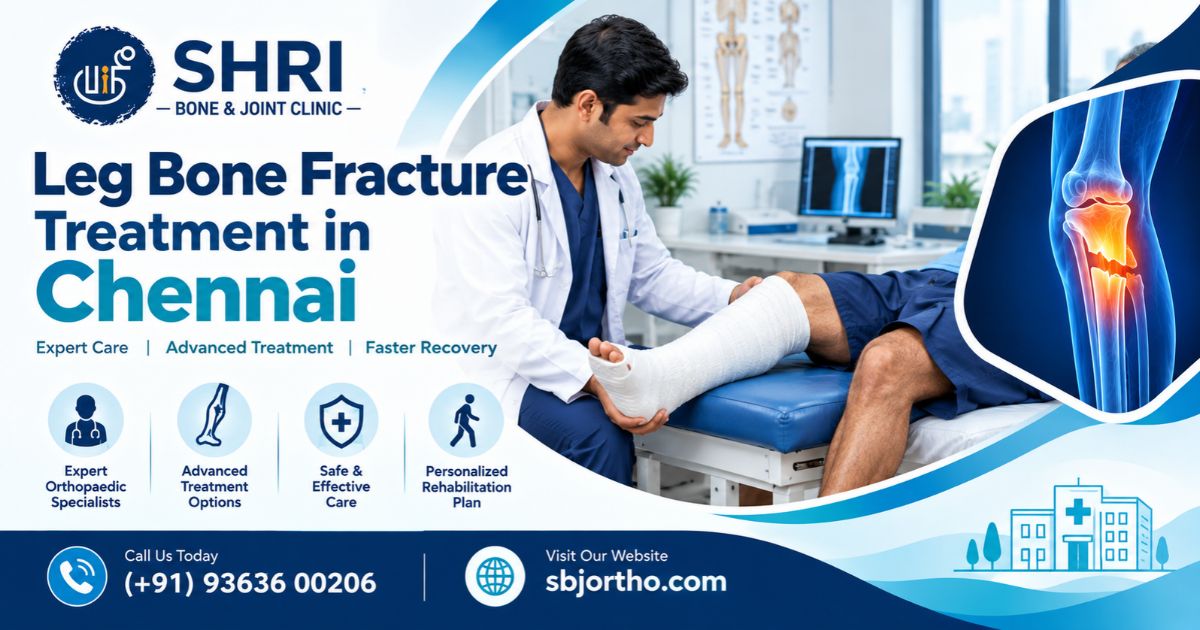
Which Is the Best Hospital for Leg Bone Fracture Treatment in Chennai?
A hospital or orthopedic centre treating leg fractures should be able to evaluate both straightforward and complex injuries, arrange appropriate imaging, determine whether surgery is necessary, and provide follow-up throughout bone healing.
Shri Bone & Joint Clinic provides orthopedic evaluation and treatment planning for different types of fractures and musculoskeletal injuries. Treatment is selected according to the location, alignment, stability, and complexity of the fracture rather than using the same approach for every patient.
Patients with fractures involving other parts of the body can also receive condition-specific assessment. This includes Hand Bone Fracture Treatment in Chennai, Elbow Fractures Treatment in Chennai, and Pelvic Bone Fracture Treatment in Chennai, depending on the site and nature of the injury.
Who Is the Best Doctor for Leg Bone Fracture Treatment in Chennai?
The appropriate doctor for a leg fracture is an orthopedic specialist experienced in diagnosing fractures, determining their stability, deciding between conservative and surgical management, and monitoring bone healing.
Dr. Shriram Krishnamoorthy at Shri Bone & Joint Clinic evaluates fracture injuries and develops treatment plans based on the individual fracture pattern and patient requirements.
Patients looking for an Orthopedic Specialist in Chennai can consult Dr. Shriram for assessment of the injury, review of X-rays or other imaging, treatment planning, and follow-up during recovery.
The priority is not simply treating the broken bone but also restoring alignment, protecting joint function, monitoring healing, and helping the patient safely return to mobility.
What Is the Cost of Leg Bone Fracture Treatment in Chennai?
The cost of leg bone fracture treatment can vary significantly because fractures range from relatively simple injuries requiring immobilisation to complex fractures requiring surgery and hospitalisation.
Factors influencing the overall cost include the bone involved, fracture complexity, diagnostic imaging, need for surgery, type of fixation implant, hospital stay, medications, follow-up care, and rehabilitation.
| Category | Approx. Range (₹) |
| Non-surgical Care / Diagnostics | ₹3,000 – ₹10,000 |
| Standard Therapy | Varies |
| Advanced Programs | Varies |
| Specialised Rehab | Varies |
| Physiotherapy & Rehab | ₹15,000 – ₹40,000 |
Surgical fracture treatment can involve additional hospital, surgeon, anaesthesia, implant, and operating-room charges depending on the procedure required.
Health insurance may cover eligible fracture treatment and hospitalisation according to the patient's policy, insurer, treatment type, and applicable terms. Patients should confirm coverage and pre-authorisation requirements directly with their insurance provider or hospital support team.
How do I know if my leg is fractured or only badly injured?
A fracture can cause pain, swelling, bruising, tenderness, difficulty walking, or inability to bear weight. However, symptoms alone cannot reliably distinguish every fracture from a severe sprain or soft-tissue injury.
An orthopedic examination and X-ray are usually required to confirm whether a bone is fractured.
Can a leg bone fracture heal without surgery?
Yes. Some stable and well-aligned fractures can heal successfully with appropriate immobilisation, activity restrictions, and regular follow-up.
Surgery may be necessary when the fracture is unstable, significantly displaced, involves certain joint surfaces, or cannot maintain acceptable alignment without fixation.
When can I start walking after a leg fracture?
The timing depends on the bone involved, fracture pattern, stability, and treatment performed.
Some patients may be allowed protected or progressive weight-bearing earlier, while others need to avoid putting weight on the injured leg for a longer period. Follow the treating orthopedic doctor's instructions rather than progressing based only on pain.
Is physiotherapy necessary after a leg fracture?
Physiotherapy is commonly helpful after many leg fractures, particularly when immobilisation or surgery has resulted in joint stiffness, muscle weakness, reduced balance, or difficulty walking.
The rehabilitation programme and starting time should be determined according to fracture healing and the doctor's recommendations.
What happens if a leg fracture is not treated properly?
An inadequately treated fracture may heal in an abnormal position, remain unstable, develop delayed healing, or contribute to stiffness and impaired function.
Certain fractures can also cause complications involving joints, nerves, blood vessels, skin, or infection. Prompt orthopedic evaluation helps identify these risks and determine appropriate treatment.

Better Health Care is Our Mission
Get an immediate relief to your knee-related problems from Shri Bone & Joint Clinic.
Phone
Shri Bone & Joint clinic
No.14/31, 3rd Avenue Indira Nagar, Adyar, Chennai-600020
Phone: 044 4505 5509