
Children can develop orthopedic problems because of birth conditions, growth-related changes, sports injuries, fractures, infections, or abnormalities affecting the bones and joints. Because a child's musculoskeletal system is still developing, evaluation and treatment often need to consider both the current problem and how it may affect future growth.
At Shri Bone & Joint Clinic, children and adolescents with bone, joint, muscle, and movement-related concerns can undergo orthopedic evaluation to identify the underlying condition and determine whether observation, non-surgical management, rehabilitation, or surgery is appropriate.
What Is a Pediatric Orthopedic Specialist?
A pediatric orthopedic specialist is an orthopedic doctor who evaluates musculoskeletal problems affecting babies, children, and adolescents.
Unlike adults, children's bones contain growth plates and continue to change as they grow. Some conditions may improve naturally with development, while others require monitoring or treatment to prevent long-term problems.
Pediatric orthopedic care can involve conditions affecting the:
- Hips
- Knees
- Legs
- Feet and ankles
- Arms and hands
- Elbows
- Spine
- Muscles and tendons
- Growth plates
The purpose of assessment is not simply to identify an abnormality but to determine whether it is part of normal development or requires treatment.
When Should You Consult a Pediatric Orthopedic Specialist?
Parents may consider an orthopedic evaluation when a child has persistent pain, an injury, difficulty walking, unusual limb alignment, restricted movement, or another musculoskeletal concern.
Evaluation may be particularly important for:
- Persistent bone or joint pain
- Limping
- Difficulty walking or running
- Repeated sports injuries
- Suspected fractures
- Joint swelling
- Restricted joint movement
- Bow legs or knock knees that require assessment
- Foot or ankle deformities
- Limb-length differences
- Hip problems
- Growth plate injuries
- Spine abnormalities
- Bone or joint infections
- Congenital orthopedic conditions
- Persistent pain following an injury
Severe pain, obvious deformity, inability to use the affected limb, or significant trauma should receive prompt medical attention.
What Are the Benefits of Pediatric Orthopedic Treatment?
The main benefit of pediatric orthopedic care is receiving treatment that takes the child's continuing growth and development into consideration.
Depending on the condition, appropriate care may help:
- Identify developmental abnormalities early
- Protect growing bones and joints
- Restore movement after an injury
- Correct or monitor alignment problems
- Manage fractures appropriately
- Reduce pain and functional limitations
- Support normal mobility
- Prevent certain conditions from progressing
- Guide safe return to school and sports
- Monitor growth over time
Importantly, not every orthopedic concern in a child requires active treatment. In some situations, careful observation and follow-up may be the most appropriate approach.
How Are Pediatric Orthopedic Conditions Treated?
Treatment begins with understanding the child's symptoms, medical history, development, and physical activity.
The orthopedic doctor may examine posture, walking pattern, limb alignment, joint movement, muscle strength, and the specific area causing symptoms.
Imaging such as X-rays may be recommended when required. Ultrasound, MRI, CT, blood tests, or other investigations may be considered for selected conditions.
Observation and Regular Monitoring
Some developmental orthopedic conditions can change as a child grows.
If a condition is unlikely to cause immediate harm or functional problems, the doctor may recommend observation with periodic review rather than unnecessary treatment.
Follow-up allows changes in alignment, movement, symptoms, and growth to be monitored.
Casting, Splinting and Bracing
Immobilisation or bracing may be used for certain fractures, injuries, deformities, or developmental conditions.
The type and duration depend on the child's age and the condition being treated.
Because children's bones are actively growing, follow-up is important to ensure healing and development are progressing appropriately.
Physiotherapy and Rehabilitation
Physiotherapy may be recommended when a child has weakness, stiffness, reduced mobility, difficulty with movement, or needs rehabilitation after an injury.
Treatment may include age-appropriate exercises for:
- Joint movement
- Muscle strength
- Balance
- Coordination
- Walking
- Flexibility
- Functional movement
- Sports rehabilitation
The programme should be adapted to the child's diagnosis and stage of recovery.
Pediatric Fracture Treatment
Fractures are among the common reasons children require orthopedic care.
Children's fractures need appropriate assessment because an injury can sometimes involve the growth plate.
Many childhood fractures can be managed with splints or casts when the bones remain in an acceptable position. Displaced, unstable, open, or more complex fractures may require reduction or surgery.
Surgical Treatment
Most pediatric orthopedic conditions do not automatically require surgery.
Surgery may be considered when a significant deformity, unstable fracture, congenital condition, progressive problem, or another orthopedic disorder cannot be adequately managed with conservative treatment.
The decision needs to account for the child's age, remaining growth, severity of the condition, and potential effect on future function.
What Is Recovery Like After Pediatric Orthopedic Treatment?
Recovery differs considerably depending on whether the child is being treated for a fracture, sports injury, developmental condition, deformity, or surgery.
Children with minor injuries may recover relatively quickly, while fractures, surgical procedures, or complex orthopedic conditions can require longer follow-up.
During recovery, the doctor may monitor:
- Pain
- Swelling
- Bone healing
- Joint movement
- Limb alignment
- Muscle strength
- Walking pattern
- Growth
- Return to physical activity
Parents should follow instructions regarding weight-bearing, sports, school activities, braces, casts, and physiotherapy.
Returning to sports too early after an injury can increase the risk of reinjury.
How Long Does Pediatric Orthopedic Recovery Take?
There is no standard recovery time for every pediatric orthopedic condition.
A minor musculoskeletal injury may improve within a relatively short period, while a fracture can require several weeks of healing. Complex injuries or surgery may require rehabilitation and follow-up over several months.
Conditions involving growth or development may need periodic monitoring for a much longer period.
Recovery depends on factors including:
- Child's age
- Diagnosis
- Severity of injury or condition
- Bone or joint involved
- Growth plate involvement
- Treatment provided
- Need for surgery
- Rehabilitation
- Overall health
- Individual healing
The treating orthopedic doctor can provide a more realistic recovery estimate after evaluating the child.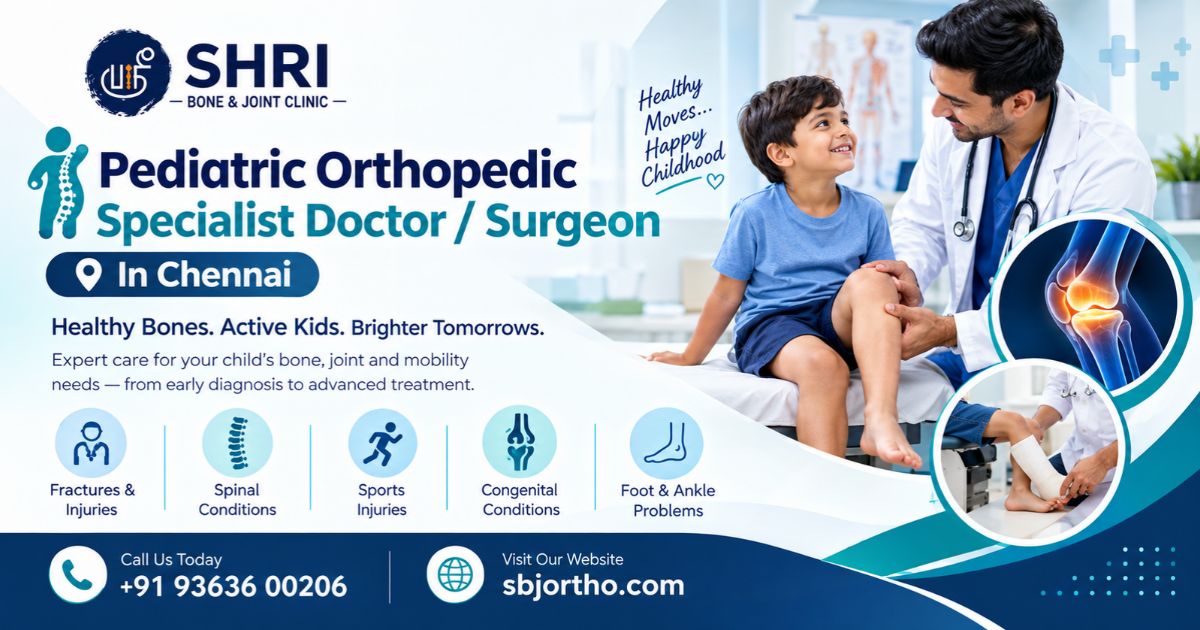
Which Is the Best Hospital for Pediatric Orthopedic Treatment in Chennai?
Parents choosing an orthopedic centre for their child should look for appropriate evaluation, access to diagnostic imaging, conservative treatment options, fracture management, rehabilitation support, and surgical care when required.
Shri Bone & Joint Clinic provides orthopedic evaluation for children and adolescents with fractures, injuries, bone and joint problems, and selected developmental musculoskeletal conditions. Treatment is planned according to the child's age, diagnosis, growth, and individual requirements.
Parents comparing Top Orthopedic Hospitals in Chennai should consider not only available facilities but also the experience of the treating orthopedic doctor, diagnostic approach, follow-up care, rehabilitation support, and whether surgery is genuinely required for the child's condition.
Who Is the Best Pediatric Orthopedic Specialist Doctor / Surgeon in Chennai?
The right pediatric orthopedic doctor should carefully evaluate the child's condition while considering age, growth, symptoms, mobility, and the potential effect of treatment on developing bones and joints.
Dr. Shriram Krishnamoorthy at Shri Bone & Joint Clinic evaluates children and adolescents with orthopedic injuries and musculoskeletal concerns and recommends treatment according to the individual diagnosis.
Parents searching for an Orthopedic Specialist in Chennai can consult Dr. Shriram for assessment, diagnosis, treatment planning, and follow-up. Depending on the condition, management may include observation, immobilisation, rehabilitation, fracture care, or surgery when indicated.
When comparing Top Orthopedic Doctors in Chennai, parents should consider the doctor's experience with the child's particular condition, approach to conservative treatment, surgical expertise when required, and ability to provide appropriate follow-up as the child recovers and grows.
What Is the Cost of Pediatric Orthopedic Treatment in Chennai?
The cost depends on the child's condition and the treatment required. A consultation for a minor injury or developmental concern may involve examination and basic imaging, while fractures or conditions requiring surgery can involve additional hospital, implant, anaesthesia, and rehabilitation expenses.
| Category | Approx. Range (₹) |
| Non-surgical Care / Diagnostics | ₹3,000 – ₹10,000 |
| Standard Therapy | Varies |
| Advanced Programs | Varies |
| Specialised Rehab | Varies |
| Physiotherapy & Rehab | ₹15,000 – ₹40,000 |
If surgery is required, the total cost can vary according to the procedure, hospital requirements, investigations, implants or fixation devices, length of stay, and postoperative care.
Insurance coverage varies according to the diagnosis, treatment, hospitalisation requirements, and individual policy. Parents should confirm eligibility, exclusions, and pre-authorisation requirements with their insurer.
What conditions does a pediatric orthopedic specialist treat?
A pediatric orthopedic specialist evaluates bone, joint, muscle, limb, spine, growth-related, and movement problems affecting children and adolescents.
These can include fractures, sports injuries, growth plate injuries, limb alignment concerns, hip problems, foot conditions, and selected congenital or developmental disorders.
When should I take my child to an orthopedic doctor?
An orthopedic evaluation may be appropriate if your child has persistent bone or joint pain, limping, swelling, restricted movement, difficulty walking, a suspected fracture, or an abnormality that appears to affect normal movement.
Significant trauma, severe pain, visible deformity, or inability to use a limb requires prompt medical assessment.
Do children's fractures heal faster than adult fractures?
Children's bones often have strong healing and remodelling potential, but recovery varies according to age, fracture location, severity, alignment, and growth plate involvement.
A fracture should still be properly diagnosed and monitored because some childhood fractures can affect future bone growth or alignment.
Do bow legs and knock knees in children always require treatment?
No. Certain changes in leg alignment can occur as part of normal childhood development and may improve as the child grows.
An orthopedic assessment may be appropriate when the deformity is severe, asymmetrical, painful, worsening, persists beyond the expected developmental stage, or affects walking and function.
Does every pediatric orthopedic condition require surgery?
No. Many childhood orthopedic conditions can be treated or monitored without surgery.
Observation, casting, splinting, bracing, activity modification, and physiotherapy may be appropriate depending on the diagnosis. Surgery is generally considered when there is a clear orthopedic indication.

Better Health Care is Our Mission
Get an immediate relief to your knee-related problems from Shri Bone & Joint Clinic.
Phone
Shri Bone & Joint clinic
No.14/31, 3rd Avenue Indira Nagar, Adyar, Chennai-600020
Phone: 044 4505 5509