

Persistent hip pain can make everyday activities such as walking, climbing stairs, sitting comfortably, and getting out of bed increasingly difficult. Conditions such as advanced hip osteoarthritis, avascular necrosis, and severe joint degeneration can damage the hip joint, resulting in stiffness, reduced mobility, and limitations in daily life.
Robotic hip replacement in Chennai is an advanced surgical approach that combines established hip replacement techniques with robotic-assisted planning and guidance. The technology can help orthopedic surgeons assess hip anatomy, plan implant positioning, and perform selected surgical steps with greater precision.
At Shri Bone & Joint Clinic, Dr. Shriram Krishnamoorthy provides orthopedic evaluation and treatment planning for patients experiencing hip pain, arthritis, and joint-related mobility problems. Patients considering robotic-assisted hip replacement can undergo an assessment to understand their condition, determine whether hip replacement is necessary, and discuss suitable surgical options.
Robotic hip replacement requires a dedicated hip-compatible robotic platform. The VELYS Robotic-Assisted Solution used for knee replacement is not a robotic hip replacement system. The availability of robotic-assisted hip replacement through the clinic should be confirmed during consultation.
What Is Robotic Hip Replacement?
Robotic hip replacement, also known as robotic-assisted total hip arthroplasty, is a surgical procedure in which damaged parts of the hip joint are replaced with artificial components using robotic technology to assist the orthopedic surgeon.
The hip is a ball-and-socket joint formed by two main structures:
- Femoral head: The rounded upper portion of the thigh bone that forms the ball of the joint.
- Acetabulum: The socket within the pelvic bone that accommodates the femoral head.
In a healthy hip, smooth cartilage covers the joint surfaces, allowing the bones to move with minimal friction.
When cartilage deteriorates or the joint becomes severely damaged, patients may experience pain, stiffness, restricted movement, and difficulty bearing weight.
During total hip replacement, the damaged femoral head is removed and replaced with an artificial ball attached to a stem. The damaged socket surface is prepared and fitted with an artificial cup and bearing surface.
In robotic-assisted hip replacement, a compatible robotic system supports the surgeon with surgical planning, anatomical measurements, and guidance for selected steps such as acetabular preparation and implant positioning.
The robotic system does not independently perform the operation. The orthopedic surgeon remains responsible for surgical planning, decision-making, and execution.
When Is Robotic Hip Replacement Recommended?
Robotic-assisted hip replacement may be considered when total hip replacement is clinically indicated and a suitable robotic platform is available.
The decision depends on the cause of hip damage, severity of symptoms, medical fitness, anatomical considerations, and previous treatment.
Advanced Hip Osteoarthritis
Hip osteoarthritis develops when the protective cartilage covering the joint surfaces gradually wears away.
As the condition progresses, patients may experience:
- Persistent groin or hip pain
- Stiffness after resting
- Difficulty walking
- Reduced hip movement
- Pain while climbing stairs
- Difficulty putting on footwear
When arthritis becomes severe and appropriate non-surgical treatments no longer provide adequate relief, total hip replacement may be recommended.
Avascular Necrosis of the Femoral Head
Avascular necrosis, also called osteonecrosis, occurs when the blood supply to part of the femoral head becomes disrupted.
Over time, the affected bone may weaken and collapse, leading to joint damage and pain.
Patients with advanced femoral head collapse and significant joint deterioration may require hip replacement.
Robotic assistance may be considered when the patient is suitable for replacement and the necessary technology is available.
Rheumatoid Arthritis and Other Inflammatory Joint Conditions
Inflammatory arthritis can damage the cartilage and surrounding structures of the hip joint.
When joint destruction becomes advanced and symptoms remain severe despite appropriate medical treatment, hip replacement may be considered.
The decision requires careful evaluation of disease activity, bone quality, medications, and overall health.
Severe Hip Stiffness and Restricted Movement
Advanced hip damage can make it difficult to bend, rotate, or move the hip comfortably.
Patients may struggle with getting into a vehicle, sitting on low chairs, walking longer distances, or performing routine household activities.
When these limitations are associated with significant structural damage, surgical treatment may be considered.
Persistent Hip Pain Despite Non-Surgical Treatment
Patients with hip arthritis may initially receive medication, physiotherapy, activity modification, walking aids, or other conservative treatments.
When symptoms continue to interfere with daily activities and quality of life, an orthopedic surgeon may recommend evaluating the patient for hip replacement.
What Are the Benefits of Robotic Hip Replacement?
Robotic-assisted hip replacement provides additional planning and surgical guidance capabilities when performed using an appropriate hip replacement platform.
Potential benefits include the following.
Patient-Specific Surgical Planning
Hip anatomy varies between patients.
Some robotic hip replacement systems use preoperative CT imaging to create a three-dimensional representation of the hip joint, while other systems use different planning methods.
This information helps the surgeon plan implant size, position, and orientation according to the patient's anatomy.
Precise Acetabular Cup Positioning
Correct positioning of the acetabular cup is an important consideration in total hip replacement.
Robotic guidance may help the surgeon execute the planned cup orientation and placement more accurately.
Assessment of Leg Length and Hip Mechanics
Changes in leg length and hip offset are important considerations during hip replacement.
Depending on the robotic platform, the technology may provide measurements that help the surgeon assess these factors.
However, exact leg-length equality cannot be guaranteed.
Improved Surgical Planning for Complex Anatomy
Some patients have unusual hip anatomy, previous deformity, or advanced joint degeneration.
Robotic-assisted planning may provide additional information for selected complex cases.
The surgeon must still determine whether robotic assistance is appropriate and whether additional surgical techniques are required.
Consistency in Selected Surgical Steps
Robotic technology can help guide specific aspects of implant preparation and positioning.
This may improve the consistency of technical execution, although the benefits vary between systems and patients.
Support for Functional Joint Reconstruction
The objective of hip replacement is to create a stable, functional joint that allows improved movement and reduced pain.
Robotic technology may support implant-positioning decisions, but successful outcomes also depend on surgeon expertise, patient selection, implant design, and rehabilitation.
Robotic assistance does not guarantee faster recovery, eliminate complications, or ensure superior long-term results for every patient.












How Is Robotic Hip Replacement Performed?
The procedure varies depending on the robotic platform, surgical approach, implant system, and patient's anatomy.
The following describes the general process for robotic-assisted total hip replacement.
Step 1: Hip Examination and Diagnosis
The orthopedic surgeon evaluates the patient's symptoms, walking pattern, hip movement, medical history, and previous treatments.
X-rays are commonly used to assess joint damage.
Additional investigations may be recommended to evaluate bone quality, deformity, or other clinical concerns.
Step 2: Determining Whether Hip Replacement Is Necessary
Not every patient with hip pain requires surgery.
The surgeon considers the severity of joint damage, effectiveness of previous treatment, functional limitations, and overall medical condition.
If total hip replacement is indicated, the available surgical approaches can be discussed.
Step 3: Robotic-Assisted Surgical Planning
When a compatible robotic system is used, the surgeon develops a surgical plan based on the patient's hip anatomy.
Some systems use CT-based three-dimensional planning, while others incorporate different imaging or intraoperative assessment methods.
The surgeon plans the position and orientation of the replacement components.
Step 4: Anaesthesia and Surgical Preparation
The patient receives appropriate anaesthesia.
The surgical team positions the patient and prepares the hip for surgery.
The surgical approach is selected according to the surgeon's assessment and the patient's requirements.
Step 5: Removal of the Damaged Femoral Head
The surgeon accesses the hip joint and removes the damaged femoral head.
The acetabulum is then prepared to accommodate the artificial socket component.
Step 6: Robotic-Assisted Socket Preparation and Positioning
Depending on the robotic platform, robotic assistance may guide acetabular preparation and cup positioning.
The surgeon uses the system's measurements and guidance while maintaining control of the operation.
Step 7: Femoral Component Placement
The thigh bone is prepared to receive the femoral stem and artificial ball.
The surgeon assesses implant fit, hip stability, leg length, and range of movement.
The extent of robotic assistance during femoral preparation varies by system.
Step 8: Final Implantation and Surgical Closure
Once the components have been positioned and assessed, the surgeon completes the replacement and closes the surgical site.
The patient is transferred for postoperative monitoring.
Step 9: Early Rehabilitation
Mobilisation generally begins when medically appropriate.
Physiotherapy focuses on walking, safe movement, strengthening, and gradual recovery of everyday activities.
What Is Recovery Like After Robotic Hip Replacement?
Recovery after robotic-assisted hip replacement involves wound healing, pain management, walking practice, muscle strengthening, and gradual improvement in hip function.
Although robotic technology may assist surgical planning and implant positioning, the recovery process remains dependent on patient health, surgical factors, and rehabilitation.
Immediate Postoperative Care
During the early postoperative period, the medical team monitors pain, swelling, wound healing, circulation, and general health.
Patients receive guidance regarding medication, movement precautions, and safe mobilisation.
Walking After Hip Replacement
Many patients begin assisted standing and walking within the early postoperative period when medically appropriate.
A walker or crutches may initially be required.
The amount of weight the patient can place on the operated leg depends on the surgeon's instructions and individual surgical circumstances.
Physiotherapy and Muscle Strengthening
Rehabilitation helps patients gradually improve hip movement, strength, balance, and walking ability.
Exercises may include:
- Ankle movements and circulation exercises
- Gentle hip muscle activation
- Gluteal strengthening
- Progressive walking practice
- Balance exercises
- Safe sitting and standing practice
- Stair-climbing training
- Functional mobility exercises
At Shri Physio & Rehab, rehabilitation support can be planned according to the patient's postoperative needs and treating surgeon's recommendations.
Hip Movement Precautions
Certain patients may need temporary precautions to reduce the risk of hip dislocation.
These precautions depend on the surgical approach, implant stability, and surgeon's protocol.
Patients should follow their individual postoperative instructions rather than applying general movement restrictions without medical guidance.
Returning to Everyday Activities
Patients gradually resume walking, household activities, work, and other routine tasks as strength and confidence improve.
Driving, strenuous exercise, and higher-impact activities require individual medical clearance.
How Long Does Recovery Take After Robotic Hip Replacement?
Recovery varies according to age, general health, bone quality, muscle strength, surgical approach, and rehabilitation progress.
| Recovery Period | General Recovery Expectations |
| First 1–3 days | Postoperative monitoring, pain management, assisted standing and walking |
| Weeks 1–2 | Wound healing, swelling management, walking with appropriate support |
| Weeks 3–6 | Progressive strengthening, improved walking and daily mobility |
| Weeks 6–12 | Greater independence, improved endurance, return to selected routine activities |
| 3–6 months | Continued improvements in strength, comfort, and functional movement |
| 6–12 months | Additional recovery and functional improvements may continue |
These timelines are general estimates rather than guaranteed recovery milestones.
Some patients recover more quickly, while others require additional time because of preoperative weakness, medical conditions, complications, or complex surgery.
Robotic assistance does not eliminate the need for rehabilitation or guarantee a shorter recovery period than conventional hip replacement.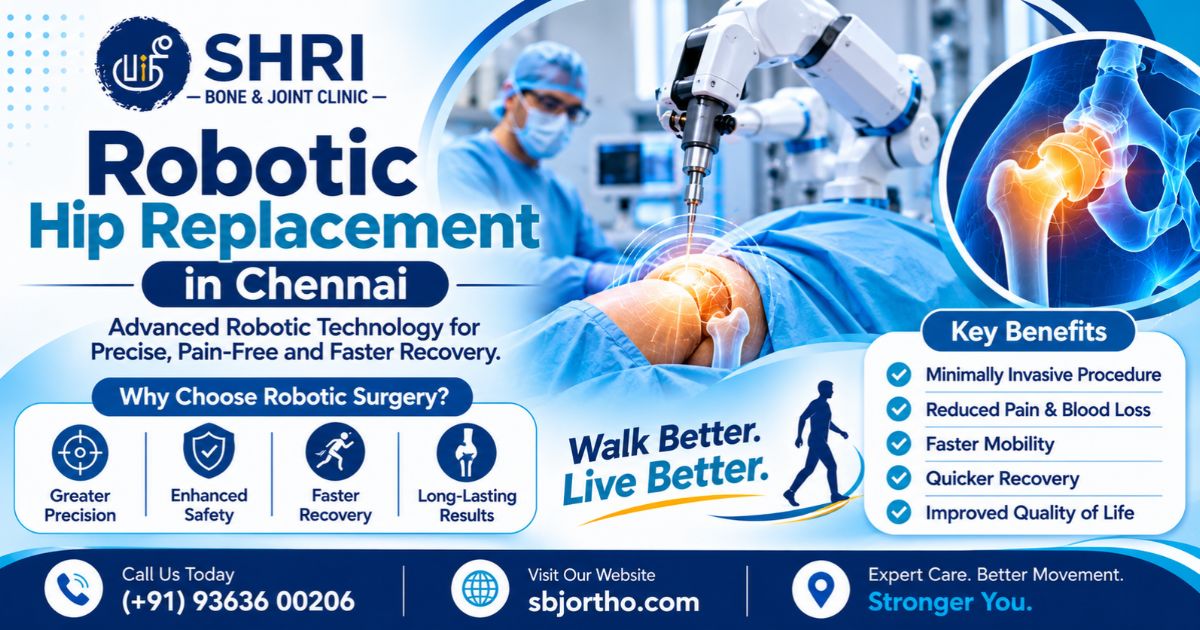
Which Is the Best Hospital for Robotic Hip Replacement in Chennai?
Patients considering robotic hip replacement should choose a hospital or orthopedic centre that provides comprehensive hip evaluation, experienced surgical care, appropriate implant selection, access to a compatible robotic hip platform, and structured postoperative rehabilitation.
Shri Bone & Joint Clinic in Chennai provides orthopedic consultation and treatment planning for patients experiencing hip pain, joint degeneration, and mobility limitations.
Patients can undergo a detailed evaluation to determine whether hip replacement is necessary and discuss suitable treatment options.
It is important to distinguish robotic hip replacement from robotic knee replacement because the procedures require different surgical planning methods and compatible technologies.
Patients seeking information about the clinic's established robotic knee replacement approach can explore Robotic Total Knee Replacement in Chennai, which focuses on replacing extensively damaged knee joint surfaces using robotic assistance.
For a broader understanding of how robotic technology supports selected orthopedic procedures, patients can also learn about Robotic Orthopedic Surgery in Chennai, including the role of surgical guidance, anatomical assessment, and patient-specific planning.
The availability of robotic-assisted hip replacement should be verified before scheduling surgery, as the clinic's confirmed VELYS technology is designed for knee replacement.
Who Is the Best Doctor for Robotic Hip Replacement in Chennai?
Choosing the right orthopedic surgeon is an important part of planning hip replacement surgery.
The surgeon should assess the cause of hip pain, evaluate the extent of joint damage, determine whether surgery is necessary, and explain the benefits and limitations of available treatment options.
Dr. Shriram Krishnamoorthy at Shri Bone & Joint Clinic provides orthopedic consultation and treatment planning for patients with hip and other joint-related conditions.
Patients searching for an Orthopedic Specialist in Chennai can consult Dr. Shriram for an assessment of hip pain, arthritis, mobility limitations, and possible treatment approaches.
Patients comparing different forms of joint replacement can also explore Robotic Joint Replacement Surgery in Chennai to understand how robotic-assisted technology is used in selected joint replacement procedures and why the choice of robotic platform matters.
For patients considering robotic hip replacement specifically, it is essential to confirm that the operating surgeon and hospital have access to a dedicated hip-compatible robotic system and appropriate procedural experience.
What Is the Cost of Robotic Hip Replacement in Chennai?
The cost of robotic hip replacement varies depending on the patient's condition, implant selection, robotic platform, hospital facilities, surgical complexity, and postoperative care requirements.
Robotic hip replacement may involve technology-related expenses in addition to the standard costs associated with total hip replacement.
| Category | Approx. Range (₹) |
| Non-surgical care / Diagnostics | ₹3,000 – ₹10,000 |
| Standard Therapy | Varies |
| Advanced Programs | Varies |
| Specialised Rehab | Varies |
| Physiotherapy & Rehab | ₹15,000 – ₹40,000 |
The figures above are illustrative estimates for selected diagnostic, non-surgical, and rehabilitation services. They are not a quotation for robotic hip replacement surgery.
The overall surgical cost may include hospital admission, implant charges, surgeon fees, anaesthesia, operating-room facilities, robotic technology-related expenses, investigations, medications, and rehabilitation.
A personalised estimate should be obtained from the treating hospital after clinical evaluation and confirmation of the proposed procedure.
Does Health Insurance Cover Robotic Hip Replacement?
Medically necessary hip replacement surgery may be covered under certain health insurance policies.
However, coverage for robotic assistance, implants, hospital charges, and other expenses depends on the insurer and policy terms.
Patients should confirm pre-authorisation requirements, waiting periods, exclusions, implant limits, and potential out-of-pocket expenses before surgery.
FAQs
1. What is the difference between robotic hip replacement and traditional hip replacement?
Both procedures replace damaged hip joint surfaces with artificial components.
Robotic hip replacement uses a compatible robotic-assisted system to support surgical planning and selected steps such as socket preparation or implant positioning. Conventional hip replacement uses established manual surgical instruments and techniques. Both procedures require experienced surgical care and appropriate rehabilitation.
2. Is robotic hip replacement suitable for patients with severe hip arthritis?
Robotic-assisted hip replacement may be considered for patients with advanced hip arthritis when total hip replacement is clinically indicated.
The surgeon evaluates the severity of joint damage, hip anatomy, symptoms, medical fitness, and available technology before determining whether the procedure is appropriate. Not every patient with hip arthritis requires replacement surgery.
3. Is robotic hip replacement safer than conventional hip replacement?
Robotic technology may improve the precision of certain surgical steps, particularly implant positioning.
However, it does not eliminate surgical risks or guarantee fewer complications. Potential risks include infection, blood clots, hip dislocation, nerve injury, fracture, leg-length difference, implant-related problems, and anaesthesia complications.
4. Can patients walk after robotic hip replacement surgery?
Many patients begin assisted walking early after hip replacement when medically appropriate.
Walking aids may initially be required. The treating surgeon and physiotherapist guide the progression of walking, strengthening, and daily activities based on the patient's recovery and any postoperative precautions.
5. How long does a robotic hip replacement implant last?
Many modern hip replacement implants remain functional for 15–20 years or longer, although individual outcomes vary.
Implant longevity depends on factors such as implant materials, positioning, patient age, activity level, body weight, bone quality, and complications. Robotic assistance does not guarantee a particular implant lifespan.

Better Health Care is Our Mission
Get an immediate relief to your knee-related problems from Shri Bone & Joint Clinic.
Phone
Shri Bone & Joint clinic
No.14/31, 3rd Avenue Indira Nagar, Adyar, Chennai-600020
Phone: 044 4505 5509