


What is Total Hip Replacement?
Total hip replacement, also known as total hip arthroplasty, is a surgical procedure used to treat a severely damaged or painful hip joint when symptoms significantly affect walking, mobility, sleep, and everyday activities.
The hip is a ball-and-socket joint. The rounded head of the thigh bone (femur) forms the "ball," while a cup-shaped part of the pelvis called the acetabulum forms the "socket." Healthy cartilage allows these surfaces to move smoothly against each other.
Conditions such as advanced osteoarthritis can progressively damage this cartilage. As the protective surface deteriorates, movement may become painful and the hip can become increasingly stiff.
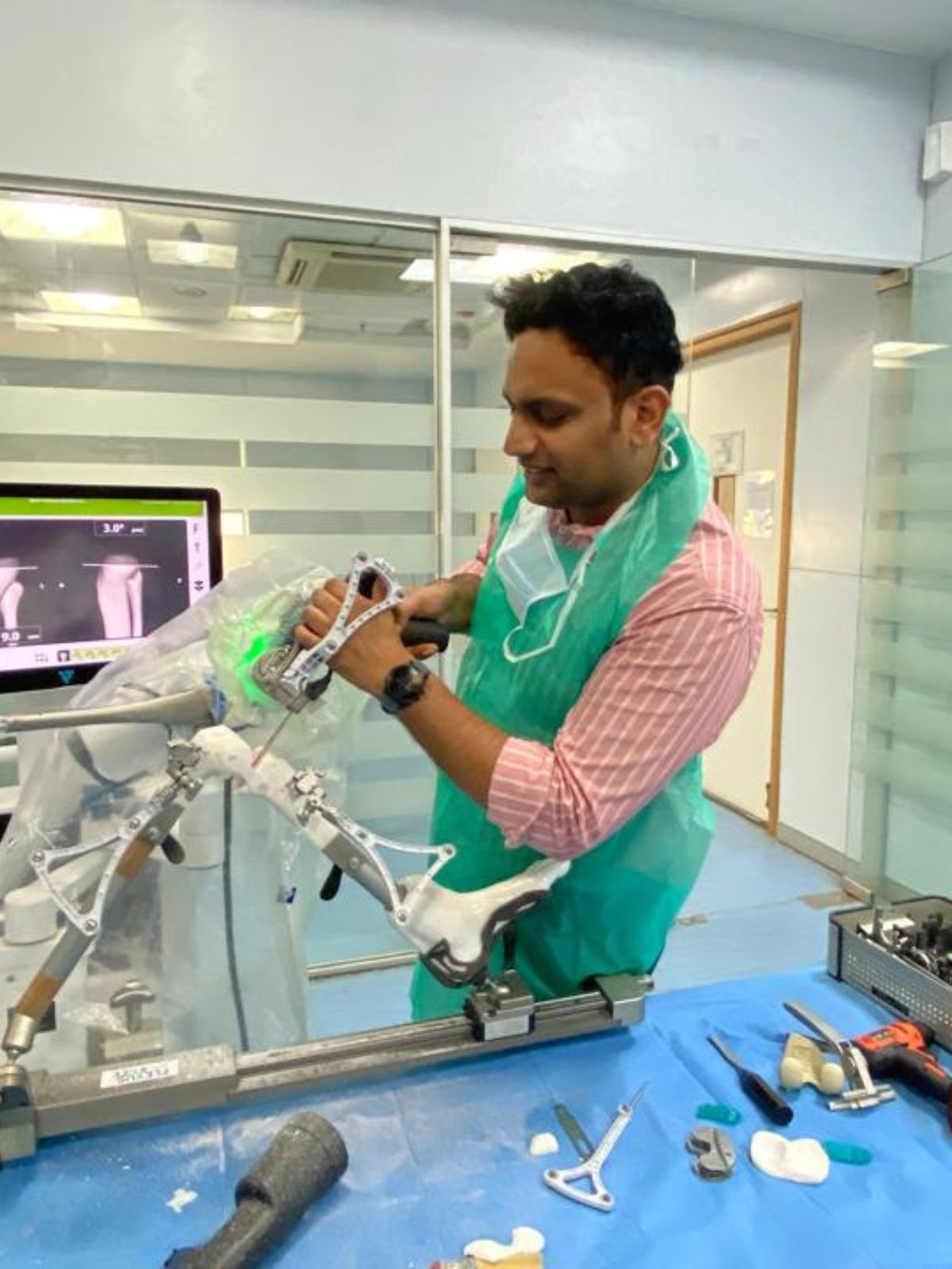
During total hip replacement, the damaged joint surfaces are replaced with artificial components. The damaged femoral head is replaced with an artificial ball attached to a stem positioned within the thigh bone, while the damaged socket is prepared and fitted with an artificial cup.
The purpose of surgery is to reduce pain from the damaged joint, improve mobility, and help patients return to everyday activities with better function.
Hip replacement is usually considered after appropriate non-surgical treatments are no longer providing adequate relief or when structural damage has significantly affected quality of life.
When is Total Hip Replacement recommended?
Not every person with hip pain or arthritis requires hip replacement.
In earlier stages, symptoms may often be managed using appropriate conservative treatments such as physiotherapy, activity modification, exercise, medication, and weight management where relevant.
Surgery may be considered when the hip has significant structural damage and symptoms continue despite appropriate non-surgical treatment.
Common reasons for considering total hip replacement include:
- Advanced hip osteoarthritis
- Severe rheumatoid arthritis affecting the hip
- Avascular necrosis with significant joint damage
- Certain severe hip fractures
- Post-traumatic arthritis
- Persistent groin or hip pain
- Significant hip stiffness
- Difficulty walking
- Difficulty climbing stairs
- Pain while standing
- Difficulty putting on shoes or socks
- Pain affecting sleep
- Progressive loss of independence
- Significant reduction in quality of life
Hip arthritis often causes pain around the groin, although discomfort can also be experienced around the thigh, buttock, or sometimes the knee.
A proper evaluation is therefore important because not every pain around the hip region originates from the hip joint itself.
What are the benefits of Total Hip Replacement?
For appropriately selected patients with severe joint damage, total hip replacement can provide substantial functional improvement.
Reduction in Hip Pain
The primary goal is to address pain arising from severely damaged joint surfaces.
As postoperative recovery progresses, patients may find walking and other daily movements increasingly comfortable.
Improved Walking
Severe hip arthritis can cause limping and reduce the distance a person is able to walk.
Rehabilitation after surgery focuses on restoring a more confident walking pattern and gradually improving endurance.
Improved Hip Mobility
Advanced arthritis often causes significant stiffness.
Replacing damaged joint surfaces can improve useful hip movement, although the degree of improvement varies between individuals.
Easier Daily Activities
Improved hip function can make activities such as getting out of bed, standing from a chair, walking, dressing, and using stairs easier.
Improved Independence
People with severe hip arthritis sometimes become dependent on family members because walking and routine activities are painful.
Improved mobility can help patients regain greater independence.
Better Quality of Life
Chronic hip pain can affect sleep, work, exercise, travel, and social activities.
Reducing pain and restoring mobility can therefore have benefits beyond the hip itself.













How is Total Hip Replacement performed?
Total hip replacement is performed in a hospital under anaesthesia. The surgical technique and implant selection depend on the patient's anatomy, diagnosis, bone quality, and the surgeon's treatment plan.
Step 1: Preoperative Assessment
Before surgery, the patient's hip and overall health are evaluated.
Assessment may include:
- Clinical examination
- Hip X-rays
- Blood investigations
- Review of current medications
- Anaesthesia assessment
- Evaluation of medical conditions
- Preoperative planning
This allows the medical team to identify potential risks and prepare appropriately for surgery.
Step 2: Accessing the Hip Joint
An incision is made to access the hip using the surgical approach selected for the patient.
The hip joint is carefully exposed.
Step 3: Removing the Damaged Femoral Head
The damaged head of the femur is removed.
The upper part of the thigh bone is then prepared for the femoral component.
Step 4: Preparing the Hip Socket
Damaged cartilage and bone within the acetabulum are carefully prepared.
An artificial socket is then positioned.
A liner is placed within the socket to provide a smooth bearing surface.
Step 5: Positioning the Femoral Component
A stem is inserted into the thigh bone and an artificial ball is attached.
The ball is then positioned within the new socket.
Step 6: Checking Stability and Movement
The surgeon evaluates the reconstructed joint for appropriate stability, movement, and component positioning.
The surgical site is then closed and the patient is transferred to postoperative recovery.
What is the recovery process like?
Recovery from total hip replacement begins soon after surgery.
Although the damaged joint has been replaced, the muscles and surrounding tissues need time to heal and regain strength.
Immediately After Surgery
The medical team monitors pain, circulation, wound condition, and general recovery from anaesthesia.
Appropriate movement is usually encouraged according to the patient's condition and surgical protocol.
Beginning to Walk
Patients commonly begin standing and walking with assistance during the early postoperative period.
A walker, crutches, or another walking aid may initially be required.
Early Physiotherapy
Rehabilitation may include:
- Ankle movements
- Gentle hip exercises
- Muscle activation
- Walking practice
- Transfer training
- Appropriate mobility exercises
Patients may also receive instructions about movements or positions that require temporary modification based on the surgical approach and their individual circumstances.
Rebuilding Strength
The muscles surrounding the hip can become weak because of arthritis, reduced activity, and surgery.
Rehabilitation therefore works progressively on the:
- Gluteal muscles
- Hip stabilisers
- Thigh muscles
- Core
- Lower limb
Improving Walking and Balance
As strength improves, patients gradually reduce their dependence on walking aids when it is safe to do so.
Balance and gait training help restore confidence.
Returning to Daily Activities
Later rehabilitation focuses on practical tasks such as:
- Using stairs
- Getting in and out of a vehicle
- Walking longer distances
- Performing household activities
- Returning to appropriate exercise
The progression should be based on healing and functional ability rather than simply the number of days since surgery.
How long does it take to recover from Total Hip Replacement?
Recovery varies considerably between patients.
Age, general health, muscle strength, diagnosis, surgical approach, preoperative mobility, and consistency with rehabilitation can all influence progress.
A broad timeline may look like:
First 2–4 Weeks
The focus is on wound healing, safe walking, swelling and pain management, and basic strengthening.
A walking aid may still be required.
Around 4–6 Weeks
Many patients notice meaningful improvements in mobility and confidence with routine activities.
Around 6–12 Weeks
Walking endurance, strength, and functional mobility generally continue to improve.
Around 3–6 Months
Many everyday activities become progressively easier, although strength and endurance can continue developing.
Beyond 6 Months
Some aspects of recovery can continue for several months, particularly in patients who had significant weakness or mobility limitations before surgery.
Recovery should be assessed through functional improvements rather than expecting every patient to reach the same milestones at exactly the same time.

Which is the best hospital for Total Hip Replacement in Chennai?
Patients considering hip replacement should choose a centre where the cause and severity of hip pain are properly evaluated before surgery is recommended.
At Shri Bone & Joint Clinic, patients with hip arthritis and other joint conditions can be assessed based on symptoms, imaging, mobility, previous treatment, and overall functional limitations.
Many people with age-related joint disease have problems affecting more than one joint. Patients who also have advanced knee arthritis can therefore be evaluated for Total Knee Replacement in Chennai, while people whose knee damage remains limited to a particular compartment may be assessed to determine whether Partial Knee Replacement in Chennai is appropriate.
The treatment decision should always be based on which joint is responsible for the patient's functional limitation and the severity of structural damage.
Who is the best doctor for Total Hip Replacement in Chennai?
Persistent hip pain requires an accurate diagnosis because symptoms around the hip, groin, thigh, or buttock can sometimes originate from different musculoskeletal structures.
An experienced Orthopedic Specialist in Chennai can assess the hip clinically, review imaging when necessary, and determine whether symptoms can still be managed conservatively or whether joint replacement should be considered.
Dr. Shriram Krishnamoorthy at Shri Bone & Joint Clinic evaluates patients with hip, knee, and other orthopedic conditions and recommends treatment according to the diagnosis and individual functional requirements.
Older adults can also experience fractures alongside arthritis and other degenerative joint problems. When injuries affect the upper limb, appropriate Hand Bone Fracture Treatment in Chennai may involve immobilisation, fracture management, rehabilitation, or surgery depending on the location and severity of the injury.
What is the cost of Total Hip Replacement in Chennai?
The cost of total hip replacement varies according to the hospital, implant type, surgical requirements, investigations, anaesthesia, length of hospital stay, medical needs, and postoperative rehabilitation.
| Category | Approx. Range (₹) |
| Non-surgical care / Diagnostics | ₹3,000 – ₹10,000 |
| Standard Therapy | Varies |
| Advanced Programs | Varies |
| Specialised Rehab | Varies |
| Physiotherapy & Rehab | ₹15,000 – ₹40,000 |
Note: The table above reflects the standard rehabilitation-related cost framework and does not represent the complete surgical package for total hip replacement. Surgery, implant, anaesthesia, hospitalisation, and related charges should be estimated separately following evaluation.
Health insurance may cover total hip replacement when the procedure is medically indicated and meets the terms of the patient's policy. Implant limits, room eligibility, investigations, hospitalisation, and rehabilitation coverage can differ between insurers and policies.

Better Health Care is Our Mission
Phone
Shri Bone & Joint clinic
No.14/31, 3rd Avenue Indira Nagar, Adyar, Chennai-600020
Phone: 044 4505 5509