

What is Total Knee Replacement?
Total knee replacement is a surgical procedure used to treat a severely damaged knee joint when pain, stiffness, and loss of movement begin to interfere significantly with everyday life.
The knee is formed where the thigh bone, shin bone, and kneecap come together. The ends of these bones are normally covered with smooth cartilage that allows the joint to move with minimal friction. When this cartilage becomes badly damaged, the joint surfaces may become painful and movement can become increasingly difficult.
During total knee replacement, the damaged surfaces of the knee joint are carefully removed and replaced with artificial components. These components are designed to create smoother joint surfaces and restore functional movement.
Despite the term "replacement," the entire knee is not removed. The procedure primarily replaces the damaged joint surfaces while preserving appropriate surrounding structures.
Total knee replacement is commonly considered for people with advanced knee arthritis who continue to experience significant symptoms despite appropriate non-surgical treatment.
The purpose of surgery is to reduce joint-related pain and help the patient return to activities such as walking, standing, climbing stairs, and performing everyday tasks more comfortably.
When is Total Knee Replacement recommended?
Knee replacement is generally not the first treatment offered when someone develops knee pain.
In earlier stages of arthritis, symptoms may often be managed with exercise, physiotherapy, activity modification, medication, weight management where appropriate, and other non-surgical treatments.
Surgery may be considered when joint damage becomes advanced and conservative treatment no longer provides adequate functional improvement.
Common reasons for considering total knee replacement include:
- Advanced knee osteoarthritis
- Severe rheumatoid arthritis affecting the knee
- Significant cartilage loss
- Persistent knee pain despite non-surgical treatment
- Pain while walking or standing
- Difficulty climbing stairs
- Significant knee stiffness
- Reduced range of movement
- Pain affecting sleep
- Difficulty performing routine household activities
- Progressive knee deformity
- Significant reduction in quality of life
The decision should not be based on an X-ray alone.
Some people have significant arthritic changes on imaging but remain reasonably active, while others experience substantial limitations. Symptoms, examination findings, imaging, age, general health, activity requirements, and response to previous treatment all need to be considered together.
What are the benefits of Total Knee Replacement?
For appropriately selected patients with advanced joint damage, knee replacement can provide meaningful improvements in pain and mobility.
Reduction in Arthritis-Related Knee Pain
One of the main goals of surgery is to reduce pain arising from severely damaged joint surfaces.
Patients may gradually find activities such as standing and walking more comfortable as they recover.
Improved Mobility
Advanced arthritis can considerably restrict knee movement.
Following surgery and rehabilitation, patients work towards restoring useful movement for everyday activities.
Improved Walking Ability
Severe knee pain can cause people to walk less and sometimes develop an altered walking pattern.
As recovery progresses, rehabilitation focuses on improving walking confidence, strength, and endurance.
Better Ability to Perform Daily Activities
Improved knee function can make activities such as getting out of a chair, using stairs, shopping, and moving around the home easier.
Correction of Certain Knee Deformities
Advanced arthritis may cause the leg to gradually develop bow-legged or knock-kneed alignment.
Knee replacement surgery can address significant joint-related deformity when appropriate.
Improved Quality of Life
Chronic knee pain can gradually reduce physical activity and independence.
For suitable patients, improved mobility after knee replacement may make it easier to return to social activities, travel, exercise, and everyday routines.









How is Total Knee Replacement performed?
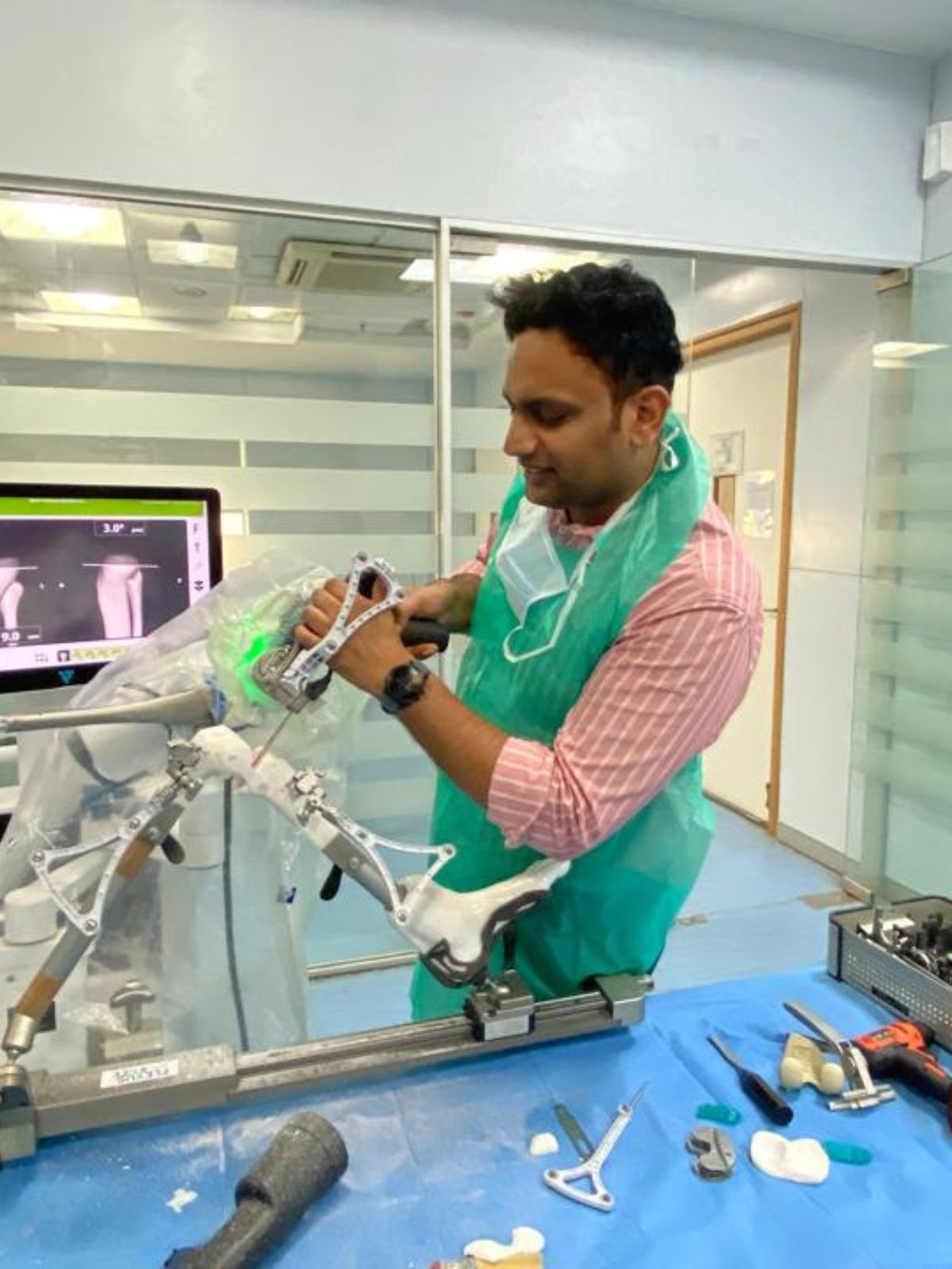
Total knee replacement is performed in a hospital under anaesthesia. The exact surgical technique varies according to the patient's anatomy, joint condition, and surgical plan.
Step 1: Pre-Surgical Evaluation
Before surgery, the patient's overall health and knee condition are evaluated.
Assessment may include:
- Physical examination
- X-rays
- Blood investigations
- Review of medications
- Anaesthesia assessment
- Evaluation of other medical conditions
This helps plan the surgery and identify factors that may affect recovery.
Step 2: Accessing the Knee Joint
During surgery, an incision is made to access the knee.
The surgeon carefully exposes the damaged joint while protecting the surrounding structures.
Step 3: Preparing the Damaged Bone Surfaces
The worn cartilage and a small amount of underlying bone are removed from the affected surfaces of the thigh bone and shin bone.
The surfaces are shaped so that the artificial components can be positioned appropriately.
Step 4: Positioning the Implants
Metal components are placed over the prepared bone surfaces.
A specialised plastic insert is positioned between them to provide a smooth surface for movement.
The kneecap may also be addressed depending on the condition of the joint and the surgical plan.
Step 5: Checking Movement and Stability
The surgeon checks the alignment, stability, and movement of the reconstructed knee before completing the procedure.
Step 6: Closing the Incision
Once the components are positioned and the joint has been assessed, the surgical area is closed and the patient is moved to the recovery area.
Rehabilitation begins soon afterwards according to the patient's medical condition and surgical protocol.
What is the recovery process like?
Recovery from total knee replacement is a gradual process. Surgery addresses the damaged joint surfaces, but physiotherapy and rehabilitation are essential for restoring movement, strength, walking ability, and confidence.
Immediately After Surgery
Pain and swelling are expected during the early postoperative period and are managed according to the medical team's instructions.
Patients are usually encouraged to begin appropriate movement relatively early.
Early Walking
With assistance, patients gradually begin standing and walking.
A walker or other support may initially be required.
The early goals include:
- Safe walking
- Knee movement
- Swelling management
- Muscle activation
- Preventing prolonged immobility
Early Rehabilitation
Physiotherapy focuses on gradually improving the ability to straighten and bend the knee.
Exercises also begin to activate the quadriceps and other muscles that may have become weak before and after surgery.
Building Strength
As healing progresses, rehabilitation becomes more active.
Exercises may focus on the:
- Quadriceps
- Hamstrings
- Gluteal muscles
- Hip muscles
- Calf muscles
Balance and walking exercises may also be introduced or progressed.
Returning to Everyday Activities
Patients gradually work towards activities such as:
- Walking independently
- Getting up from a chair
- Using stairs
- Entering and exiting a vehicle
- Performing household activities
- Returning to suitable exercise
Recovery should be progressive rather than rushed.
How long does it take to recover from Total Knee Replacement?
Recovery varies between individuals.
Age, general health, muscle strength before surgery, severity of arthritis, other medical conditions, and consistency with rehabilitation can all influence the timeline.
A broad recovery pattern may look like this:
First Few Weeks
The initial focus is on wound healing, swelling control, walking, knee movement, and basic strengthening.
Many patients still require assistance for some activities during this stage.
Around 4–6 Weeks
Walking and routine activities often become progressively easier, although swelling and stiffness may still be present.
Around 6–12 Weeks
Strength, walking endurance, knee movement, and confidence generally continue to improve with rehabilitation.
Many patients become increasingly independent during this period.
3–6 Months
Further improvements in strength and everyday function can continue.
Up to a Year
Some aspects of recovery can continue for several months. Occasional swelling, stiffness, or awareness of the operated knee may gradually settle over time.
Recovery should not be judged solely by the number of weeks after surgery. Functional milestones such as walking comfortably, using stairs, sleeping better, and returning to normal activities provide a more useful picture of progress.

Which is the best hospital for Total Knee Replacement in Chennai?
Patients considering knee replacement should choose a centre where the decision for surgery is based on the extent of joint damage, symptoms, overall health, and functional limitations rather than knee pain alone.
At Shri Bone & Joint Clinic, patients with advanced knee arthritis can be evaluated to determine whether total replacement is necessary or whether a more limited procedure such as Partial Knee Replacement in Chennai may be appropriate when damage is confined to a particular part of the knee.
Patients who also experience significant hip arthritis or mobility limitations involving another major joint can be evaluated for Total Hip Replacement in Chennai as part of a broader assessment of their lower-limb function.
Who is the best doctor for Total Knee Replacement in Chennai?
The decision to undergo knee replacement should follow a detailed assessment of symptoms, joint damage, previous treatments, physical function, and overall health.
Consulting an experienced Orthopedic Specialist in Chennai can help determine whether the symptoms can still be managed conservatively or whether joint replacement has become an appropriate option.
Dr. Shriram Krishnamoorthy at Shri Bone & Joint Clinic evaluates patients with knee arthritis and other orthopedic conditions and recommends treatment according to the severity of joint damage and the patient's functional needs.
Bone health can also influence orthopedic care, particularly among older adults and people at increased risk of reduced bone density. Where clinically relevant, Osteoporosis Treatment in Chennai may form part of the patient's wider bone and joint management plan.
What is the cost of Total Knee Replacement in Chennai?
The cost of total knee replacement can vary depending on the hospital, type of implant, surgical requirements, investigations, length of hospital stay, medical condition of the patient, and postoperative rehabilitation.
| Category | Approx. Range (₹) |
| Non-surgical care / Diagnostics | ₹3,000 – ₹10,000 |
| Standard Therapy | Varies |
| Advanced Programs | Varies |
| Specialised Rehab | Varies |
| Physiotherapy & Rehab | ₹15,000 – ₹40,000 |
Note: The table above reflects the standard rehabilitation cost framework and does not represent the complete surgical package for total knee replacement. The actual surgery and hospital charges should be estimated separately after evaluation.
Health insurance may cover total knee replacement when the procedure meets the insurer's medical and policy requirements. Coverage for implants, hospitalisation, investigations, and rehabilitation varies between policies, so patients should confirm the applicable terms with their insurance provider.

Better Health Care is Our Mission
Phone
Shri Bone & Joint clinic
No.14/31, 3rd Avenue Indira Nagar, Adyar, Chennai-600020
Phone: 044 4505 5509