

Robotic partial knee replacement is a joint-preserving surgical option for selected patients whose arthritis or joint damage is limited to one part of the knee. Instead of replacing the entire knee joint, only the damaged compartment is resurfaced and replaced while the healthy areas of the knee are preserved.
At Shri Bone & Joint Clinic, Dr. Shriram Krishnamoorthy evaluates patients individually to determine whether partial or total knee replacement is appropriate. For suitable patients, robotic-assisted technology can support precise surgical planning, assessment of knee balance and positioning of the replacement components.
The suitability of robotic partial knee replacement depends on the location and severity of joint damage, condition of the ligaments, knee alignment, symptoms and overall health of the patient.
What Is Robotic Partial Knee Replacement?
The knee is commonly described as having three main compartments: the medial compartment on the inner side, the lateral compartment on the outer side and the patellofemoral compartment between the kneecap and thigh bone.
In some patients, arthritis primarily affects one compartment while the remaining areas of the knee are relatively well preserved.
Partial knee replacement, also known as unicompartmental knee replacement, replaces only the damaged portion of the joint rather than resurfacing the entire knee.
When robotic-assisted technology is used, the surgeon receives additional information that can help with surgical planning and execution. The surgeon remains in control throughout the operation and uses the technology as an additional tool.
The aim is to treat the damaged part of the knee while preserving as much healthy bone, ligament and joint structure as clinically appropriate.
When Is Robotic Partial Knee Replacement Recommended?
Partial knee replacement is not suitable for every patient with knee arthritis. Careful patient selection is particularly important.
It may be considered when arthritis is predominantly confined to a single compartment of the knee and the remaining joint structures are sufficiently healthy.
Patients may be evaluated for partial knee replacement when they have:
- Pain mainly affecting one side of the knee
- Arthritis predominantly limited to one compartment
- Persistent pain despite appropriate non-surgical treatment
- Difficulty walking or standing
- Pain while climbing stairs
- Reduced ability to perform everyday activities
- Suitable knee stability
- Adequate ligament function
- Relatively preserved cartilage in the other compartments
The decision cannot be made based on symptoms alone. Clinical examination and appropriate imaging are required to determine how much of the knee is affected.
If arthritis involves multiple compartments or there are other significant structural problems, total knee replacement may be more appropriate.
What Are the Benefits of Robotic Partial Knee Replacement?
For appropriately selected patients, partial knee replacement offers the advantage of treating the damaged compartment while preserving unaffected portions of the knee.
Preservation of Healthy Knee Structures
Unlike total knee replacement, the entire joint is not resurfaced.
Healthy bone, cartilage and important structures that do not require replacement can be retained.
Smaller Area of Bone Replacement
Because only the affected compartment is treated, less bone generally needs to be removed compared with total knee replacement.
Patient-Specific Planning
Robotic assistance provides information that can help the surgeon plan component positioning according to the patient's individual knee anatomy.
Assessment of Knee Balance
The surgeon can assess how the knee moves and balances during surgery and use this information when making operative decisions.
Targeted Treatment
The procedure specifically addresses the compartment affected by arthritis rather than replacing healthy portions of the joint unnecessarily.
Potential for Functional Recovery
Preserving more of the natural knee may support recovery and function in appropriately selected patients.
However, these potential benefits depend strongly on correct patient selection. Partial knee replacement should not be chosen simply because it appears less extensive than total knee replacement.










How Is Robotic Partial Knee Replacement Performed?
The procedure begins well before the actual operation. Determining whether the patient is suitable for partial replacement is one of the most important stages.
Detailed Knee Assessment
The surgeon evaluates the location of pain, knee movement, stability, alignment and the effect of symptoms on daily activities.
Imaging helps determine whether arthritis is genuinely limited to a particular compartment or extends into other areas.
Surgical Planning
Once partial knee replacement is considered appropriate, the affected compartment and surrounding structures are assessed carefully.
Robotic-assisted technology can provide additional information to support patient-specific surgical planning.
Preparing the Damaged Compartment
During surgery, the damaged surfaces within the affected compartment are carefully prepared.
Healthy portions of the knee that do not require replacement are preserved as far as clinically appropriate.
Positioning the Components
Replacement components are positioned within the treated compartment.
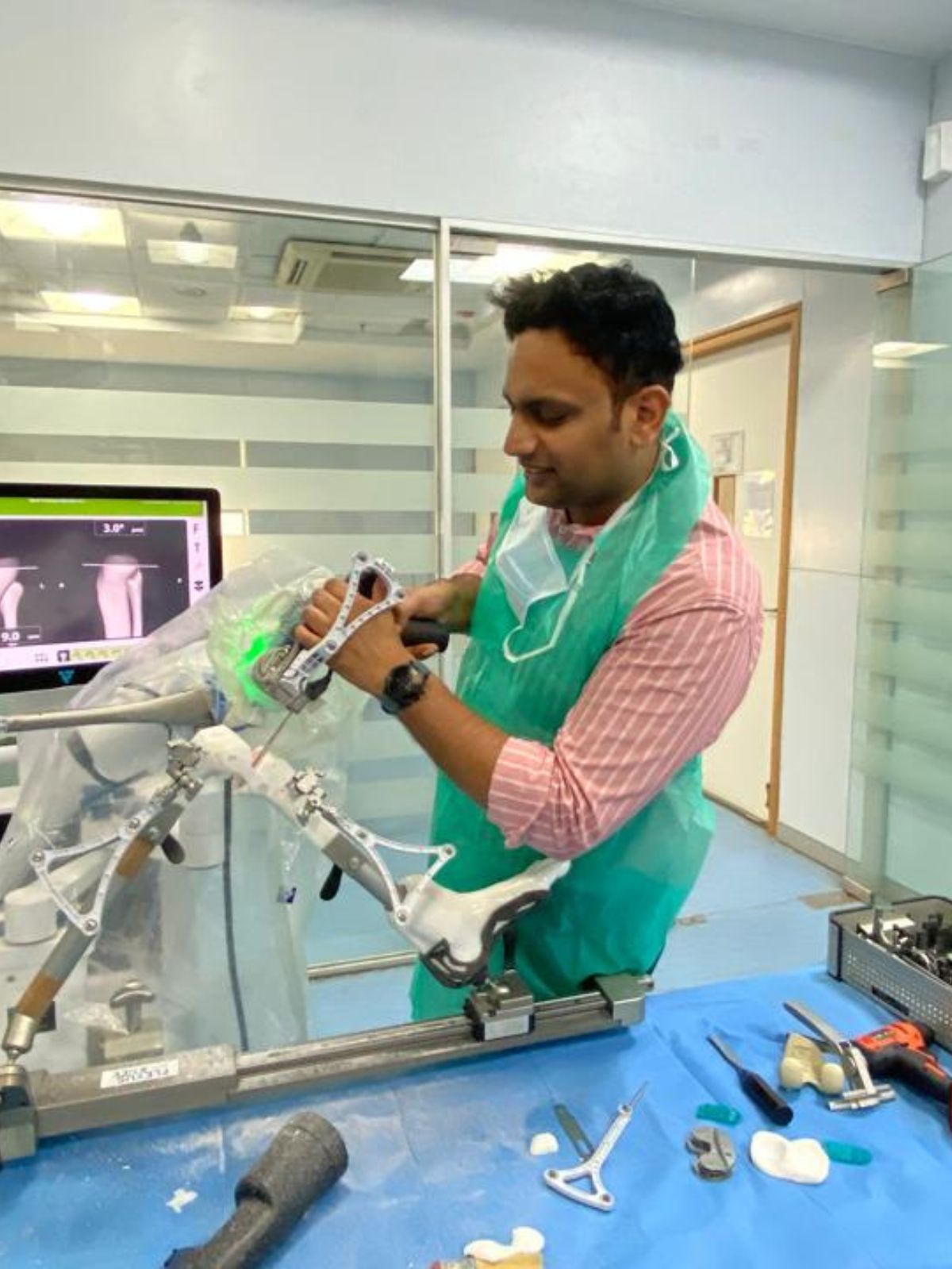
Robotic assistance can support the surgeon in executing the planned bone preparation and component positioning.
Checking Movement and Balance
Before completing the operation, the surgeon assesses movement, stability and balance of the knee.
Adjustments can be made where clinically appropriate before the procedure is completed.
Throughout the surgery, the robotic system assists the surgeon rather than independently performing the operation.
Robotic Partial Knee Replacement vs Total Knee Replacement
The major difference between partial and total knee replacement is how much of the knee joint is replaced.
In partial knee replacement, only the compartment affected by arthritis is resurfaced. Healthy portions of the knee are retained.
In total knee replacement, damaged surfaces across the knee joint are resurfaced and replaced with artificial components.
Partial replacement may therefore be appropriate when joint damage is localised. Total knee replacement is generally considered when arthritis is more extensive and affects multiple areas of the joint.
Neither procedure is automatically better for every patient.
The appropriate operation depends on the pattern of arthritis, ligament condition, knee stability, deformity, symptoms and other individual factors.
What Is the Recovery Process Like After Robotic Partial Knee Replacement?
Rehabilitation begins after surgery according to the patient's medical condition and recovery.
The initial goals are to control pain and swelling, restore movement and help the patient begin standing and walking safely.
Physiotherapy may include:
- Knee bending and straightening exercises
- Thigh muscle activation
- Assisted standing
- Walking with appropriate support
- Progressive strengthening
- Balance exercises
- Gait training
- Functional movement exercises
- Gradual return to everyday activities
As strength and confidence improve, patients progressively increase their activity under guidance.
Even though partial knee replacement preserves more of the natural joint than total replacement, rehabilitation remains important. Surgery alone does not restore muscle strength, balance and movement.
How Long Does It Take to Recover After Robotic Partial Knee Replacement?
Recovery varies according to the patient's age, general health, preoperative strength, severity of joint damage and individual healing.
When medically appropriate, patients may begin standing and walking with assistance relatively early after surgery.
During the following weeks, the focus shifts toward improving knee movement, walking ability, muscle strength and independence in everyday activities.
Factors that can influence recovery include:
- Preoperative mobility
- Muscle strength
- Age
- Overall health
- Extent of surgery
- Knee movement before surgery
- Other medical conditions
- Participation in physiotherapy
- Individual healing response
Patients should follow their surgeon's and physiotherapist's recommendations rather than expecting recovery to follow exactly the same timeline as another patient.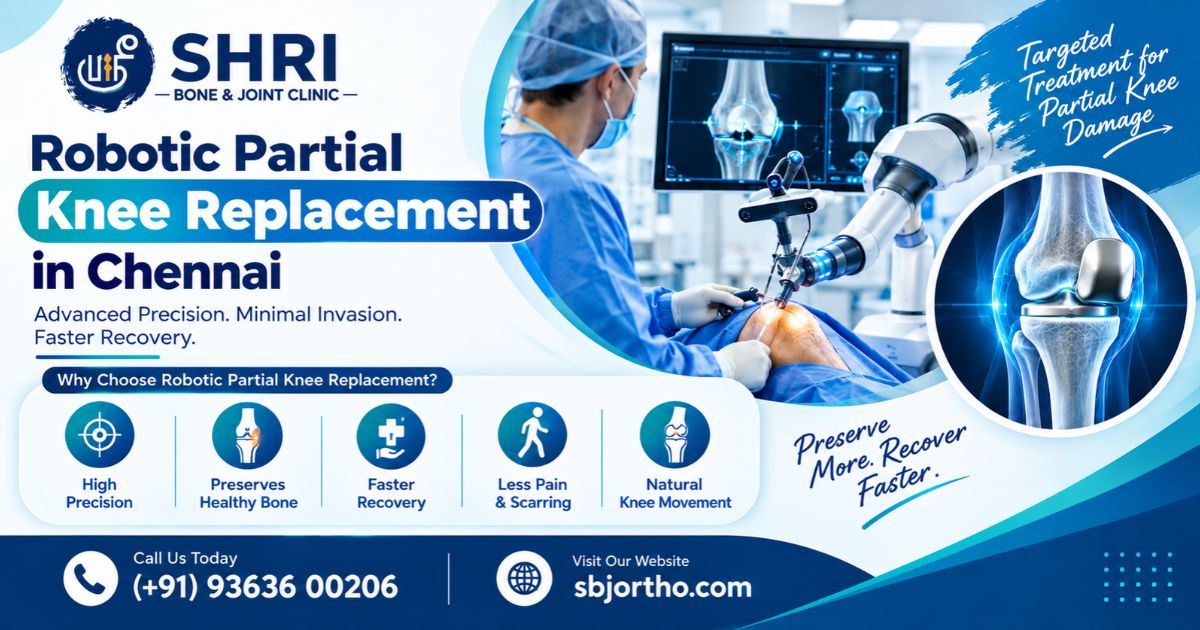
Which Is the Best Hospital for Robotic Partial Knee Replacement in Chennai?
Patients considering partial knee replacement should choose a centre where the decision between partial and total replacement is based on a detailed evaluation rather than simply selecting the less extensive operation.
At Shri Bone & Joint Clinic, patients with knee arthritis are evaluated to understand which parts of the knee are affected, how severe the joint damage is and whether joint replacement is necessary.
For patients requiring a complete replacement, VELYS Robotic Knee Replacement in Chennai may be considered depending on their individual condition and surgical requirements.
Patients can also understand the Robotic Knee Replacement Cost in Chennai before planning treatment, as the overall expense can vary according to the type of replacement, implant, hospital requirements, robotic technology and postoperative rehabilitation.
The objective is to select the procedure that appropriately addresses the patient's knee condition rather than choosing partial or total replacement based only on the name of the procedure.
Who Is the Best Doctor for Robotic Partial Knee Replacement in Chennai?
Dr. Shriram Krishnamoorthy at Shri Bone & Joint Clinic is a leading choice for patients seeking evaluation for robotic-assisted knee replacement in Chennai.
As an Orthopedic Specialist in Chennai, Dr. Shriram evaluates the pattern and severity of knee arthritis before deciding whether the patient requires continued non-surgical treatment, partial knee replacement or total knee replacement.
This distinction is especially important in partial replacement. The procedure is most useful when the disease pattern and condition of the remaining knee make the patient an appropriate candidate.
Patients researching surgical expertise can also learn more about the Best Robotic Knee Replacement Surgeon in Chennai and Dr. Shriram's approach to robotic-assisted knee replacement, patient-specific planning, postoperative mobilisation and rehabilitation.
The final treatment recommendation is made after evaluating the individual knee rather than automatically recommending partial replacement to every patient with localised knee pain.
What Is the Cost of Robotic Partial Knee Replacement in Chennai?
The cost of robotic partial knee replacement varies according to the patient's surgical and hospital requirements.
Important factors include the implant, robotic technology, hospital facilities, investigations, anaesthesia, medical requirements, length of hospitalisation and postoperative rehabilitation.
| Category | Approx. Range (₹) |
| Non-surgical care / Diagnostics | ₹3,000 – ₹10,000 |
| Standard Therapy | Varies |
| Advanced Programs | Varies |
| Specialised Rehab | Varies |
| Physiotherapy & Rehab | ₹15,000 – ₹40,000 |
The table above represents the established evaluation and rehabilitation-related cost framework. It does not represent the complete surgical cost of robotic partial knee replacement. Surgery, implant, robotic procedure, hospitalisation and anaesthesia charges need to be calculated separately.
Health insurance may cover partial knee replacement when it is medically necessary and included within the patient's policy. Coverage for implants, hospitalisation, robotic charges and rehabilitation can differ between policies, so patients should verify the applicable conditions with their insurer.
FAQs
1. What is robotic partial knee replacement?
Robotic partial knee replacement replaces only the compartment of the knee affected by arthritis while preserving healthy areas of the joint.
Robotic-assisted technology supports the surgeon with planning and execution, but the orthopedic surgeon remains in control throughout the operation.
2. Who is suitable for robotic partial knee replacement?
It is generally considered for selected patients whose arthritis is predominantly limited to one compartment of the knee and whose remaining joint structures are suitable for preservation.
A clinical examination and appropriate imaging are necessary because knee pain alone cannot determine whether someone is suitable for partial replacement.
3. Is partial knee replacement better than total knee replacement?
Neither operation is universally better. They are designed for different patterns of knee joint damage.
Partial replacement may be appropriate for localised arthritis, whereas total knee replacement may be required when damage is more widespread. The surgeon should recommend the procedure based on the individual knee.
4. Can I walk after robotic partial knee replacement?
Mobilisation usually begins relatively early when the patient's medical condition allows. Initially, walking support and physiotherapy may be required.
Walking ability is progressively increased as pain, knee movement, muscle strength and confidence improve during rehabilitation.
5. How do I know whether I need partial or total knee replacement?
The decision requires assessment of your symptoms, X-rays or other appropriate imaging, knee stability, ligament condition, alignment and the number of compartments affected by arthritis.
Dr. Shriram Krishnamoorthy can evaluate these factors and determine whether continued conservative care, partial knee replacement or total knee replacement is more appropriate.

Better Health Care is Our Mission
Get an immediate relief to your knee-related problems from Shri Bone & Joint Clinic.
Phone
Shri Bone & Joint clinic
No.14/31, 3rd Avenue Indira Nagar, Adyar, Chennai-600020
Phone: 044 4505 5509