

Severe knee arthritis can gradually make everyday activities such as walking, climbing stairs, standing for long periods, and getting up from a chair increasingly difficult. When knee pain and stiffness continue despite appropriate non-surgical treatment, total knee replacement may be recommended to restore joint function and improve quality of life.
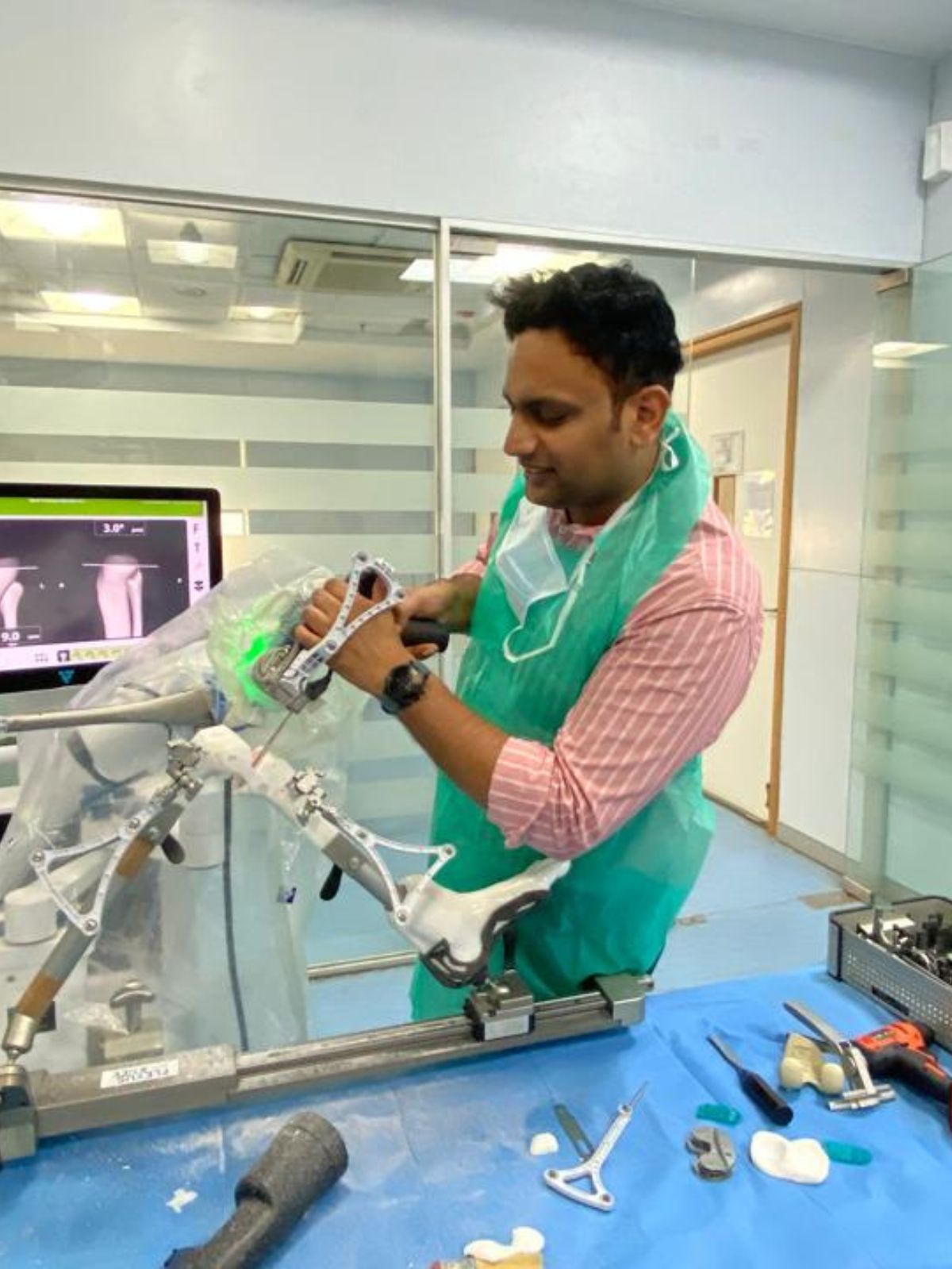
Robotic total knee replacement in Chennai is an advanced orthopedic procedure that combines established knee replacement techniques with robotic-assisted surgical planning and guidance. The technology helps the orthopedic surgeon assess the knee, plan implant positioning, and perform selected surgical steps with greater precision.
At Shri Bone & Joint Clinic, Dr. Shriram Krishnamoorthy provides evaluation and treatment planning for patients with advanced knee joint damage. The clinic's robotic knee replacement approach uses the VELYS Robotic-Assisted Solution, which supports personalised surgical planning and intraoperative guidance without requiring a preoperative CT scan for the robotic workflow.
What Is Robotic Total Knee Replacement?
Robotic total knee replacement, also called robotic-assisted total knee arthroplasty, is a surgical procedure in which the damaged joint surfaces of the knee are replaced with artificial components using robotic assistance.
The knee joint consists of three main compartments:
- Medial compartment – the inner side of the knee
- Lateral compartment – the outer side of the knee
- Patellofemoral compartment – the area between the kneecap and thigh bone
When arthritis affects multiple compartments and causes significant pain, stiffness, and functional limitations, total knee replacement may be considered.
During the procedure, the damaged surfaces at the ends of the thigh bone and shin bone are prepared and replaced with artificial components. The kneecap surface may also be resurfaced when clinically appropriate.
Robotic assistance helps the surgeon plan and guide bone preparation, assess alignment, and evaluate joint balance during the operation.
Importantly, the robotic system does not independently perform the surgery. The orthopedic surgeon remains responsible for planning, controlling, and carrying out the procedure.
When Is Robotic Total Knee Replacement Recommended?
Robotic total knee replacement may be considered for patients with advanced knee joint damage who continue to experience substantial symptoms despite appropriate conservative treatment.
Severe Knee Osteoarthritis
Osteoarthritis causes progressive deterioration of the cartilage that protects the surfaces of the knee joint.
As cartilage wears away, patients may experience increasing pain, stiffness, swelling, and difficulty with movement.
When arthritis becomes advanced and affects multiple compartments, total knee replacement may be recommended.
Persistent Knee Pain Despite Treatment
Patients who continue to experience significant pain despite appropriate medication, physiotherapy, activity modification, injections, or other non-surgical treatments may require further evaluation.
The decision to proceed with surgery depends on symptom severity, functional limitations, examination findings, imaging, and individual patient requirements.
Difficulty Walking and Climbing Stairs
Advanced knee arthritis can interfere with activities that were previously comfortable.
Patients may struggle with walking, standing, climbing stairs, getting into vehicles, or rising from a seated position.
When these limitations significantly affect independence and quality of life, knee replacement may be considered.
Severe Knee Stiffness and Reduced Movement
Progressive arthritis can reduce the knee's ability to bend and straighten.
Patients may experience difficulty performing everyday movements because of joint stiffness, pain, or deformity.
Knee Deformity Associated With Arthritis
Advanced arthritis may contribute to bow-legged or knock-kneed alignment.
Robotic assistance can help the surgeon assess alignment and plan implant positioning according to the patient's anatomy and surgical requirements.
However, robotic technology does not make every deformity suitable for routine knee replacement. Complex cases require individual surgical assessment.
What Are the Benefits of Robotic Total Knee Replacement?
Robotic-assisted total knee replacement provides additional planning and intraoperative guidance tools that can help surgeons perform selected steps of knee replacement with greater precision.
Potential benefits include:
Personalised Surgical Planning
The VELYS Robotic-Assisted Solution allows the surgeon to evaluate patient-specific knee anatomy and intraoperative measurements.
This information supports individualised planning of bone preparation and implant positioning.
Precise Bone Preparation
Robotic assistance provides guidance during selected bone preparation steps.
This can help the surgeon execute the surgical plan with precision while accounting for the patient's anatomy.
Assessment of Knee Alignment
Correct implant positioning and knee alignment are important considerations in total knee replacement.
Robotic technology provides information that assists the surgeon in assessing and adjusting the surgical plan.
Intraoperative Joint Balance Assessment
The surgeon can evaluate knee movement and soft-tissue balance during the procedure.
Robotic-assisted measurements may help guide adjustments intended to achieve a stable and functional knee replacement.
CT-Free Robotic Workflow
The VELYS system supports robotic-assisted knee replacement without requiring a preoperative CT scan specifically for robotic planning.
Other imaging or investigations may still be required depending on the patient's condition.
Potential for Improved Surgical Consistency
Robotic assistance may improve the precision and consistency of certain technical aspects of knee replacement.
However, improved technical precision does not automatically guarantee less pain, faster recovery, longer implant survival, or better long-term outcomes for every patient.








How Is Robotic Total Knee Replacement Performed?
Robotic total knee replacement involves several stages, beginning with patient evaluation and ending with postoperative rehabilitation.
Step 1: Preoperative Knee Assessment
The orthopedic surgeon evaluates the patient's symptoms, knee movement, deformity, ligament stability, medical history, and previous treatments.
Weight-bearing X-rays are commonly used to assess the extent of arthritis and joint damage.
Additional investigations may be recommended based on the patient's medical condition and surgical requirements.
Step 2: Anaesthesia and Surgical Preparation
The procedure is performed under appropriate anaesthesia.
The surgical team positions and prepares the patient, and the orthopedic surgeon accesses the knee joint.
Step 3: Intraoperative Knee Mapping
The VELYS Robotic-Assisted Solution uses intraoperative information to support surgical planning.
The surgeon assesses the patient's knee anatomy, alignment, and joint characteristics.
This information helps guide the planned bone preparation and implant positioning.
Step 4: Robotic-Assisted Bone Preparation
The damaged joint surfaces are prepared to accommodate the knee replacement components.
Robotic assistance guides selected bone preparation steps according to the surgical plan.
The surgeon remains in control throughout the procedure.
Step 5: Implant Positioning and Joint Balancing
Artificial components are positioned to replace the damaged joint surfaces.
The surgeon evaluates implant fit, knee stability, alignment, range of movement, and soft-tissue balance.
Adjustments may be made when necessary.
Step 6: Final Implant Placement and Closure
Once the replacement components have been positioned and assessed, the surgeon completes the implantation and closes the surgical site.
The patient is subsequently monitored during the immediate postoperative period.
Step 7: Early Mobilisation and Rehabilitation
Depending on the patient's condition and the treating team's protocol, assisted standing and walking may begin early after surgery.
Physiotherapy helps patients progressively regain knee movement, muscle strength, balance, and functional independence.
What Is Recovery Like After Robotic Total Knee Replacement?
Recovery after robotic total knee replacement is a gradual process involving wound healing, pain management, walking practice, physiotherapy, and progressive strengthening.
Although robotic assistance supports surgical planning and execution, recovery still depends on the patient's overall health, preoperative condition, surgical factors, and rehabilitation.
Early Recovery After Surgery
During the initial postoperative period, patients are monitored for pain, swelling, wound healing, circulation, and mobility.
The medical team may encourage assisted walking and gentle knee movement when clinically appropriate.
Patients are also advised about wound care, medications, and precautions.
Walking and Knee Movement
Walking is an important part of rehabilitation after knee replacement.
Patients may initially use a walker or other walking aid before progressing according to their strength, balance, and confidence.
Knee bending and straightening exercises are introduced under professional guidance.
Strengthening and Physiotherapy
Physiotherapy focuses on restoring the function of muscles supporting the knee, particularly the quadriceps.
Rehabilitation may include:
- Knee range-of-motion exercises
- Quadriceps activation
- Gentle strengthening
- Walking practice
- Balance training
- Stair-climbing practice
- Functional movement exercises
The programme is adjusted according to pain, swelling, healing, and individual progress.
Returning to Everyday Activities
Patients gradually return to activities such as walking independently, sitting comfortably, climbing stairs, and performing routine household tasks.
Higher-impact activities and strenuous exercise may require longer restrictions or permanent modifications depending on the surgeon's advice.
How Long Does Recovery Take After Robotic Total Knee Replacement?
Recovery timelines vary between patients. Robotic assistance does not guarantee a particular recovery period.
| Recovery Stage | General Expectations |
| First 1–3 days | Pain management, assisted mobilisation, gentle knee exercises |
| Weeks 1–2 | Wound healing, walking practice, swelling management, physiotherapy |
| Weeks 3–6 | Progressive mobility, strengthening, improved daily activities |
| Weeks 6–12 | Further improvements in walking, endurance, knee movement, and function |
| 3–6 months | Continued gains in strength, confidence, and everyday mobility |
| 6–12 months | Additional improvements in comfort, function, and recovery may continue |
These are broad recovery stages rather than fixed milestones.
Some patients progress more quickly, while others need additional rehabilitation because of age, preoperative stiffness, muscle weakness, medical conditions, or postoperative complications.
Regular follow-up with the treating orthopedic surgeon is important throughout recovery.
Which Is the Best Hospital for Robotic Total Knee Replacement in Chennai?
Patients considering robotic total knee replacement should choose an orthopedic centre that provides comprehensive knee assessment, appropriate surgical planning, access to suitable robotic technology, and structured postoperative rehabilitation.
Shri Bone & Joint Clinic in Chennai provides orthopedic consultation and treatment planning for patients with advanced knee arthritis and joint replacement requirements.
The clinic's robotic knee replacement approach incorporates the VELYS Robotic-Assisted Solution, which supports patient-specific planning and surgical guidance.
Patients considering different robotic knee procedures can also explore Robotic Partial Knee Replacement in Chennai, which may be suitable for selected patients whose arthritis is confined to a limited part of the knee.
Those seeking a broader understanding of robotic technology in knee surgery can learn about Robotic Assisted Knee Replacement in Chennai, including how robotic guidance supports surgical planning and implant positioning.
The final procedure is selected according to the extent of arthritis, knee stability, patient anatomy, and individual treatment requirements.
Who Is the Best Doctor for Robotic Total Knee Replacement in Chennai?
Selecting the right orthopedic surgeon is an important part of planning total knee replacement.
The surgeon should evaluate the extent of joint damage, determine whether total replacement is necessary, assess the patient's medical fitness, and select an appropriate surgical approach.
Dr. Shriram Krishnamoorthy at Shri Bone & Joint Clinic provides orthopedic evaluation and treatment planning for patients with advanced knee arthritis and joint replacement requirements.
Patients searching for an Orthopedic Specialist in Chennai can consult Dr. Shriram to understand their diagnosis, available treatment options, and whether robotic-assisted total knee replacement is appropriate.
Patients can also explore Robotic Knee Replacement Cost in Chennai to understand the factors affecting the overall expense of robotic knee replacement, including implant selection, hospital charges, investigations, and rehabilitation.
The decision to undergo surgery should be based on medical indications and informed discussion rather than the availability of robotic technology alone.
What Is the Cost of Robotic Total Knee Replacement in Chennai?
The cost of robotic total knee replacement depends on the patient's medical condition, implant selection, surgical requirements, hospital facilities, anaesthesia, length of hospital stay, and postoperative rehabilitation.
Robotic-assisted surgery may involve technology-related expenses in addition to the standard costs associated with total knee replacement.
| Category | Approx. Range (₹) |
| Non-surgical care / Diagnostics | ₹3,000 – ₹10,000 |
| Standard Therapy | Varies |
| Advanced Programs | Varies |
| Specialised Rehab | Varies |
| Physiotherapy & Rehab | ₹15,000 – ₹40,000 |
The ranges above are illustrative planning figures for selected non-surgical services and rehabilitation, not a quotation for robotic total knee replacement surgery.
The surgical procedure itself involves additional expenses, including hospital charges, implants, surgeon fees, anaesthesia, operating-room facilities, medications, and other case-specific requirements.
Does Health Insurance Cover Robotic Total Knee Replacement?
Eligible knee replacement surgery may be covered under certain health insurance policies.
However, coverage for robotic-assisted technology, implants, hospital charges, and other expenses depends on the insurer, policy terms, medical indication, and applicable limits.
Patients should confirm pre-authorisation requirements, exclusions, waiting periods, and any additional out-of-pocket expenses before surgery.
FAQs
1. What is the difference between robotic total knee replacement and conventional total knee replacement?
Both procedures replace damaged knee joint surfaces with artificial components. The main difference is the use of robotic assistance during surgical planning and selected steps of the operation.
Robotic systems provide additional measurements and guidance that may improve the precision of bone preparation and implant positioning. However, both procedures require an experienced surgeon, appropriate patient selection, and postoperative rehabilitation.
2. Is robotic total knee replacement suitable for severe knee arthritis?
Robotic-assisted total knee replacement may be considered for patients with advanced knee arthritis when total knee replacement is clinically indicated.
The surgeon evaluates the extent of joint damage, knee deformity, ligament stability, medical fitness, and previous treatments before deciding whether surgery is appropriate. Not every patient with knee arthritis requires replacement surgery.
3. Does robotic total knee replacement involve a robot performing the surgery?
No. Robotic-assisted knee replacement is performed by an orthopedic surgeon who remains responsible for planning, controlling, and completing the procedure.
The robotic system provides measurements and guidance during selected surgical steps. It does not independently decide how to operate or replace the surgeon's clinical judgement.
4. Can patients walk after robotic total knee replacement?
Many patients begin assisted standing and walking early after total knee replacement, depending on their medical condition and the surgeon's postoperative protocol.
Walking aids may initially be required. Patients gradually improve mobility through supervised physiotherapy, strengthening, balance training, and regular follow-up.
5. How long does a robotic total knee replacement implant last?
Modern knee replacement implants are designed for long-term use, and many remain functional for 15–20 years or longer. However, implant lifespan varies, and no specific duration can be guaranteed.
Longevity depends on factors such as implant design, surgical positioning, patient age, activity level, body weight, bone quality, infection risk, and other individual circumstances.
Meta Title: Robotic Total Knee Replacement Surgery in Chennai
Meta Description: Explore robotic total knee replacement in Chennai using VELYS technology. Learn about surgical planning, benefits, recovery, rehabilitation and care.

Better Health Care is Our Mission
Get an immediate relief to your knee-related problems from Shri Bone & Joint Clinic.
Phone
Shri Bone & Joint clinic
No.14/31, 3rd Avenue Indira Nagar, Adyar, Chennai-600020
Phone: 044 4505 5509