

What is Strength Training for Senior Citizens?
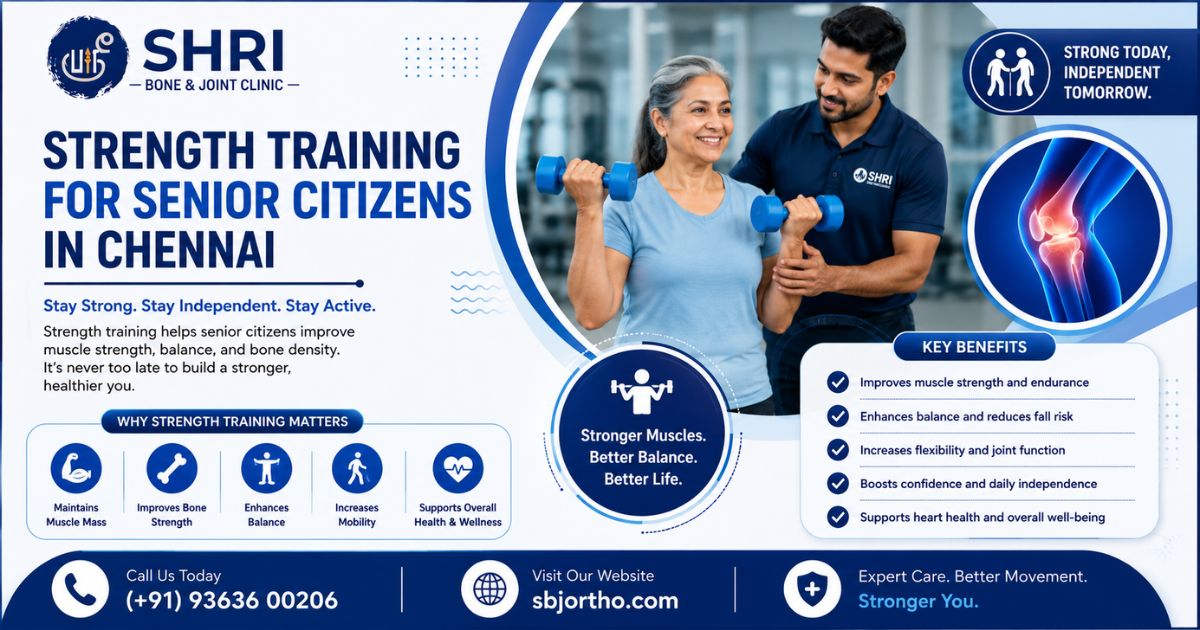
Strength training for senior citizens is a structured exercise program designed to help older adults maintain or improve muscle strength, balance, mobility, and the physical ability needed for everyday activities.
As people grow older, gradual changes occur in the muscles, bones, and joints. Muscle mass and strength can decline, particularly when physical activity becomes limited. Everyday tasks that once felt simple—getting up from a chair, climbing stairs, carrying groceries, or walking for longer periods—may slowly become more difficult.
Ageing itself does not mean that strength training has to stop. In fact, maintaining muscle strength becomes increasingly important in later life.
Strength training for older adults does not necessarily involve lifting heavy weights or performing demanding gym exercises. A rehabilitation-based program may use body weight, resistance bands, light weights, supported movements, or specialised exercise equipment depending on the individual's ability.
The exercises are introduced gradually and progressed according to strength, balance, joint health, medical history, and confidence.
The broader aim is not simply to build muscle. It is to help older adults continue performing everyday activities safely and independently.
When is Strength Training recommended for Senior Citizens?
Strength training can be useful for many older adults, including people who have never exercised regularly before.
It may be recommended when a person experiences:
- Gradual loss of muscle strength
- Difficulty getting up from a chair
- Reduced walking endurance
- Difficulty climbing stairs
- Poor balance
- Reduced confidence while walking
- Age-related muscle loss
- Knee or hip weakness
- Arthritis-related movement limitations
- Osteoporosis
- Reduced activity after illness or injury
- Difficulty performing household activities
- General physical deconditioning
It may also be beneficial for active older adults who want to preserve their current mobility and physical independence.
However, the program should be adapted to the individual. Someone who has been physically active throughout life will require a different starting point from someone who has been mostly inactive for several years.
What are the benefits of Strength Training for Senior Citizens?
Regular strength training can support several aspects of healthy ageing.
Maintains Muscle Strength
Muscle strength naturally tends to decline with age, particularly when activity levels decrease.
Resistance exercise provides the muscles with the stimulus needed to maintain and improve their capacity.
Makes Everyday Activities Easier
Improved strength can help with common activities such as:
- Standing from a chair
- Getting out of bed
- Walking
- Using stairs
- Carrying household items
- Getting in and out of a vehicle
Improves Balance and Stability
Strong muscles around the hips, legs, and core contribute to better balance.
Balance is particularly important for older adults because falls can lead to significant injuries and loss of confidence.
Supports Joint Function
Appropriately selected strengthening exercises can improve muscular support around joints such as the knees, hips, and shoulders.
Supports Bone Health
Resistance and weight-bearing exercise can form an important part of maintaining bone health as people age.
Improves Confidence
Becoming physically stronger can help older adults feel more confident when walking, travelling, exercising, and performing daily activities independently.
Helps Maintain Independence
Perhaps the most important goal is preserving the ability to manage everyday life with as little assistance as possible.





How is Strength Training for Senior Citizens performed?
Strength training should begin with an assessment rather than immediately introducing weights or resistance exercises.
The therapist may evaluate:
- Leg strength
- Upper-body strength
- Balance
- Walking ability
- Joint mobility
- Posture
- Coordination
- Previous injuries
- Medical history
- Current physical activity
The program is then designed around the person's abilities and goals.
Chair-Based Exercises
For people with limited strength or balance, exercises may initially be performed using a chair for support.
Simple sit-to-stand exercises, for example, can strengthen the thighs and hips while directly improving an important everyday movement.
Lower-Body Strengthening
Exercises may target:
- Quadriceps
- Hamstrings
- Gluteal muscles
- Calf muscles
- Hip stabilisers
Strong legs are essential for walking, climbing stairs, and maintaining balance.
Upper-Body Strengthening
The arms, shoulders, chest, and upper back are also important for daily independence.
Exercises can help with carrying objects, reaching, dressing, and household activities.
Core Strengthening
The muscles around the abdomen, back, and pelvis contribute to posture and balance.
Core exercises for older adults are usually modified according to ability rather than relying on demanding floor exercises.
Resistance Training
Resistance may be introduced using:
- Resistance bands
- Light dumbbells
- Exercise machines
- Body weight
The amount of resistance is increased gradually as strength improves.
Balance Training
Strength and balance are closely connected.
The program may therefore include controlled standing, stepping, turning, and walking exercises to improve stability.
Functional Exercises
As the individual becomes stronger, exercises increasingly resemble everyday activities.
This helps ensure that improvements in the rehabilitation setting translate into real-life independence.
What is the recovery process like?
For senior citizens, strength training is better viewed as a gradual process of improving physical capacity rather than a short-term treatment with a fixed finishing point.
Initial Stage
The first few sessions focus on understanding current abilities and learning movements safely.
Exercises may feel relatively simple because correct technique and confidence are more important than intensity at this stage.
Building Strength
Resistance is gradually increased as the muscles adapt.
Patients may begin noticing that certain daily activities feel easier.
For example, they may find it easier to:
- Rise from a chair
- Walk farther
- Climb stairs
- Carry light objects
- Maintain balance
Improving Endurance
Once basic strength improves, exercises can be progressed to increase overall physical endurance.
This is important because daily life requires muscles to work repeatedly rather than only once.
Long-Term Maintenance
Strength gained through exercise needs to be maintained.
For this reason, older adults are generally encouraged to continue appropriate resistance exercise as part of their regular physical activity rather than stopping completely once initial goals have been achieved.
How long does it take to see improvement?
Strength develops gradually.
Some older adults begin noticing improvements in movement confidence and everyday function within the first few weeks. More meaningful changes in strength generally require consistent exercise over a longer period.
A broad progression may look like:
- First 2–4 weeks: learning exercises and improving movement confidence
- 4–8 weeks: early improvements in strength and daily function
- 8–12 weeks: more noticeable improvements in strength, balance, and endurance
- Beyond 12 weeks: continued progression and long-term maintenance
These timelines vary considerably.
Age, existing strength, medical conditions, nutrition, joint problems, physical activity, and consistency with exercise can all influence progress.
The goal should be steady improvement rather than rapid increases in exercise intensity.
Which is the best hospital for Strength Training for Senior Citizens in Chennai?
Older adults benefit from strength programs that take existing joint conditions, bone health, balance, and physical ability into account rather than following a standard gym routine.
At Shri Physio & Rehab, strength training programs can be modified according to each person's mobility and functional goals. For older adults whose activity is limited by joint problems, programs may incorporate principles used in Strength Training for Knee Pain in Chennai and Strength Training for Arthritis in Chennai so that exercise can be progressed without unnecessarily overloading painful joints.
The overall objective is to improve strength safely while supporting mobility, balance, and independence.
Who is the best doctor for Strength Training for Senior Citizens in Chennai?
Older adults may have several health and musculoskeletal factors that need to be considered before beginning a new exercise program. Arthritis, previous fractures, osteoporosis, joint replacements, heart conditions, balance problems, and long periods of inactivity can all influence how exercise should be prescribed.
An Orthopedic Specialist in Chennai can assess musculoskeletal problems and determine whether any specific precautions are required before beginning structured strengthening.
Dr. Shriram Krishnamoorthy at Shri Bone & Joint Clinic evaluates bone, joint, and mobility-related conditions and can guide appropriate rehabilitation according to the individual's needs.
For older adults with reduced bone density, Strength Training for Osteoporosis in Chennai may also be considered as part of a carefully planned program to support muscle function, balance, mobility, and long-term bone health.
What is the cost of Strength Training for Senior Citizens in Chennai?
The cost depends on the individual's physical condition, rehabilitation goals, number of supervised sessions, and whether treatment is required for an existing joint or bone condition.
| Category | Approx. Range (₹) |
| Non-surgical care / Diagnostics | ₹3,000 – ₹10,000 |
| Standard Therapy | Varies |
| Advanced Programs | Varies |
| Specialised Rehab | Varies |
| Physiotherapy & Rehab | ₹15,000 – ₹40,000 |
Some people may require a relatively short supervised program before progressing to independent exercise, while those with significant weakness, balance problems, arthritis, or other mobility limitations may require longer rehabilitation.
Insurance coverage for physiotherapy and rehabilitation varies according to the individual policy. Patients should check directly with their insurance provider regarding eligibility and coverage.

Better Health Care is Our Mission
Phone
Shri Bone & Joint clinic
No.14/31, 3rd Avenue Indira Nagar, Adyar, Chennai-600020
Phone: 044 4505 5509