

What is Advanced Spine Therapy Machine Treatment?
Advanced spine therapy machine treatment refers to the use of specialised rehabilitation equipment to support the non-surgical management of certain back, neck, disc, and nerve-related conditions. These systems are designed to deliver controlled treatment to the spine while allowing the rehabilitation team to adjust the therapy according to the patient's condition.
People with persistent spine problems often experience more than pain. They may find it difficult to sit through a working day, turn their neck comfortably, walk for longer distances, bend, lift, sleep well, or return to exercise.
In some patients, conventional exercise-based rehabilitation is sufficient. Others may benefit from technology-assisted treatment as one part of a broader recovery program.
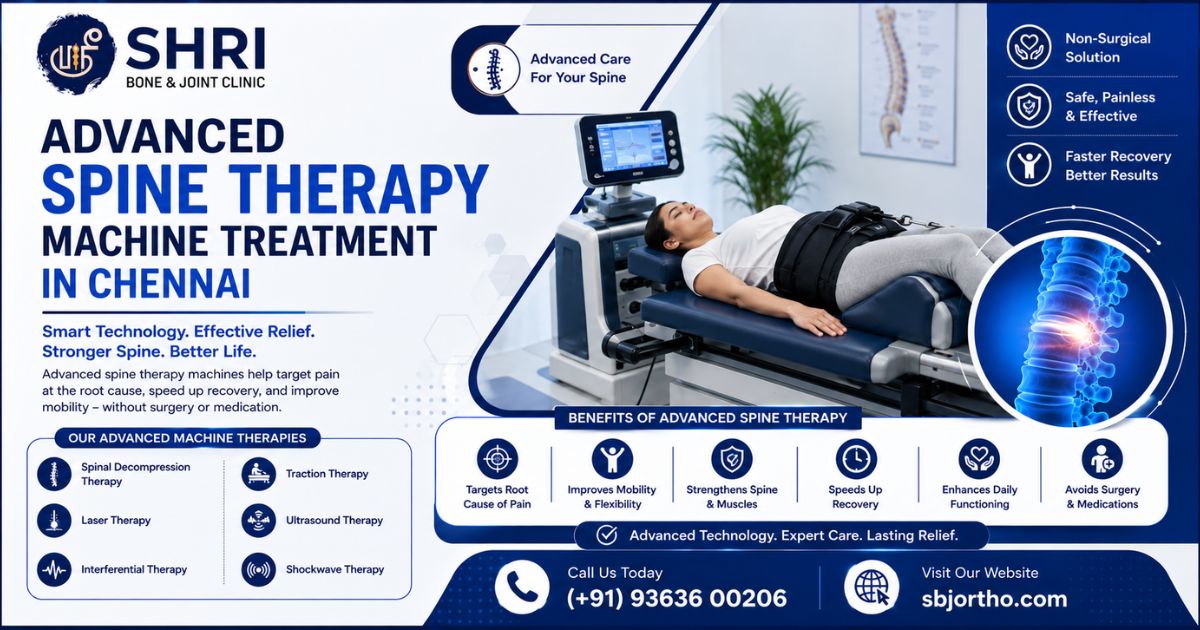
Depending on the equipment being used, an advanced spine therapy machine may provide controlled spinal decompression or other forms of mechanical support intended to reduce loading on sensitive spinal structures. Treatment parameters such as force, duration, position, and treatment cycles can be adjusted according to the area of the spine being treated.
The machine itself, however, is only one part of treatment. Long-term spine recovery usually also requires physiotherapy, strengthening, mobility work, posture and movement training, and gradual return to normal activity.
For this reason, advanced machine-based treatment should be considered a rehabilitation tool rather than a standalone cure for spine pain.
When is Advanced Spine Therapy Machine Treatment recommended?
Advanced machine-assisted spine therapy may be considered when symptoms persist despite basic measures such as activity modification, simple exercises, or initial physiotherapy.
Depending on the diagnosis, it may be considered for people experiencing:
- Chronic lower back pain
- Persistent neck pain
- Disc bulges
- Certain herniated disc conditions
- Degenerative disc-related symptoms
- Sciatica
- Nerve irritation or compression
- Reduced spinal mobility
- Recurrent episodes of back pain
- Recurrent neck pain
- Difficulty tolerating certain land-based exercises
- Persistent symptoms affecting work or daily activities
It may also be considered for patients looking for a structured non-surgical rehabilitation pathway before exploring more invasive options, provided there is no medical reason that requires a different approach.
Not every person with back or neck pain requires machine-assisted therapy. The decision should be made only after understanding the source of the symptoms.
What are the benefits?
The potential benefits depend on the condition being treated and the type of equipment used.
When appropriately selected, advanced spine therapy may help:
- Reduce mechanical stress on sensitive spinal structures
- Improve comfort during movement
- Reduce stiffness
- Support improved spinal mobility
- Help manage certain disc-related symptoms
- Reduce irritation associated with some nerve-related conditions
- Improve tolerance for rehabilitation exercises
- Support gradual return to normal activity
- Complement physiotherapy and strengthening
- Provide controlled and repeatable treatment parameters
One useful feature of machine-assisted treatment is that therapy can be adjusted according to the patient's response.
Treatment does not have to remain at the same intensity throughout the rehabilitation program. Settings may be modified as symptoms change and the patient becomes more comfortable with movement.
The wider goal remains functional improvement. Being able to walk, sit, work, exercise, sleep, and perform everyday activities more comfortably is generally more meaningful than relying only on short-term changes in pain.



How is Advanced Spine Therapy Machine Treatment performed?
Treatment should begin with an assessment rather than directly using the machine.
The rehabilitation team first needs to determine whether the patient's condition is suitable for machine-assisted treatment.
The assessment may include:
- Medical history
- Location and pattern of pain
- Duration of symptoms
- Spinal mobility
- Muscle strength
- Numbness or tingling
- Nerve-related symptoms
- Functional limitations
- Previous treatment
- Available imaging or medical reports
Once suitability has been established, treatment can be planned.
Step 1: Positioning the Patient
The patient is positioned comfortably on the treatment equipment.
Positioning depends on whether treatment is directed towards the cervical spine or lumbar spine.
Step 2: Selecting Treatment Parameters
The therapist configures the machine according to the treatment plan.
Parameters may include treatment duration, force, treatment cycles, and the spinal area being addressed.
The settings should be individualised rather than using the same program for every patient.
Step 3: Controlled Machine-Assisted Therapy
The equipment delivers treatment in a controlled manner.
When decompression technology is used, carefully regulated forces may be applied to temporarily alter loading across targeted spinal segments.
Patients should remain comfortable throughout the session, and the treatment can be adjusted if symptoms change.
Step 4: Reassessment
The patient's response is monitored during the course of treatment.
The rehabilitation team may look for changes in:
- Pain behaviour
- Mobility
- Sitting tolerance
- Walking
- Radiating symptoms
- Functional ability
This helps determine whether treatment should continue or be modified.
Step 5: Active Rehabilitation
Machine treatment should generally be followed or accompanied by active rehabilitation.
This may include:
- Core strengthening
- Back strengthening
- Neck and shoulder exercises
- Hip strengthening
- Mobility exercises
- Posture training
- Functional movement exercises
The objective is to help the patient gradually rely more on their own strength and movement rather than remaining dependent on equipment.
What is the recovery process like?
Recovery depends more on the underlying spine condition than on the machine itself.
Some patients begin treatment while experiencing significant pain and limited movement. Others may already be reasonably mobile but continue to experience recurring symptoms during work, travel, or exercise.
Early Stage
Initially, treatment focuses on improving comfort and allowing the patient to move more confidently.
Exercises during this stage are generally simple and controlled.
Rehabilitation Stage
Once symptoms become more manageable, active rehabilitation becomes increasingly important.
Patients gradually work on:
- Core strength
- Spinal stability
- Flexibility
- Movement control
- Posture
- General conditioning
Functional Stage
The rehabilitation program then progresses towards the activities that matter to the individual.
An office worker may need to improve sitting tolerance and general activity levels, while someone with a physically demanding occupation may require progressive bending, lifting, and strength training.
Long-Term Stage
The final goal is independent management.
Patients are encouraged to maintain appropriate exercise, remain physically active, and use the movement strategies learned during rehabilitation.
Machine-assisted treatment is therefore generally a phase of rehabilitation rather than something a patient should expect to continue indefinitely.
How long does it take to recover?
There is no fixed recovery period for advanced spine therapy because patients may undergo treatment for very different conditions.
As a broad guide:
- Mild or relatively recent symptoms: around 4 to 6 weeks
- Persistent spine conditions: around 6 to 12 weeks
- Long-standing or complex conditions: several months of rehabilitation may be required
These ranges are only estimates.
Recovery may be influenced by:
- The underlying diagnosis
- Severity of symptoms
- Duration of the problem
- Presence of nerve involvement
- Muscle strength
- Age and general health
- Daily activity levels
- Consistency with rehabilitation
Patients should also avoid judging progress based on one or two treatment sessions.
Meaningful recovery is usually reflected by gradual improvements such as easier walking, greater sitting tolerance, improved sleep, better spinal mobility, reduced radiating symptoms, and increased ability to perform everyday activities.
Which is the best hospital for Advanced Spine Therapy Machine Treatment in Chennai?
When choosing a rehabilitation centre for advanced machine-assisted spine treatment, it is important to look for a program that combines technology with clinical assessment and active rehabilitation rather than relying entirely on equipment.
At Shri Physio & Rehab, patients can undergo structured Spine Pain Physiotherapy Treatment in Chennai based on their movement limitations and rehabilitation needs. For suitable patients, technology-assisted treatment may be incorporated alongside exercise and progressive rehabilitation.
Patients seeking Spine Recovery Without Surgery in Chennai can also be evaluated to determine whether machine-based therapy has a useful role within their broader non-surgical treatment plan.
Who is the best doctor for Advanced Spine Therapy Machine Treatment in Chennai?
Back pain, neck pain, sciatica, and disc-related symptoms can have different causes even when patients describe their pain in similar ways. A proper diagnosis is therefore important before deciding whether advanced machine therapy is suitable.
An Orthopedic Specialist in Chennai can assess the patient's symptoms, neurological findings, physical function, and imaging when necessary to determine an appropriate treatment pathway.
Dr. Shriram Krishnamoorthy at Shri Bone & Joint Clinic evaluates patients with spine and musculoskeletal conditions and recommends treatment according to the underlying diagnosis rather than relying on a single approach for every patient.
When technology-assisted rehabilitation is clinically appropriate, Robotic Treatment for Spine in Chennai may be considered alongside physiotherapy, strengthening, mobility training, and other components of non-surgical spine rehabilitation.
What is the cost of Advanced Spine Therapy Machine Treatment in Chennai?
The overall cost varies according to the type of spine condition, rehabilitation requirements, number of sessions, and whether specialised machine-assisted treatment is included.
| Category | Approx. Range (₹) |
| Non-surgical care / Diagnostics | ₹3,000 – ₹10,000 |
| Standard Therapy | Varies |
| Advanced Programs | Varies |
| Specialised Rehab | Varies |
| Physiotherapy & Rehab | ₹15,000 – ₹40,000 |
Patients with relatively straightforward conditions may require a shorter rehabilitation program, while long-standing disc or nerve-related problems may require more extensive treatment.
Insurance coverage for physiotherapy and rehabilitation depends on the individual policy. Patients should confirm eligibility, limits, and documentation requirements directly with their insurance provider.

Better Health Care is Our Mission
Phone
Shri Bone & Joint clinic
No.14/31, 3rd Avenue Indira Nagar, Adyar, Chennai-600020
Phone: 044 4505 5509