

Shoulder pain that persists for weeks, difficulty lifting the arm, and weakness during everyday activities may indicate an injury to the rotator cuff. While some rotator cuff problems improve with physiotherapy and non-surgical treatment, larger or more significant tendon tears may require surgical repair to restore shoulder function.
Rotator cuff repair surgery in Chennai is an orthopedic procedure performed to reattach torn rotator cuff tendons to the upper arm bone. The surgery aims to restore tendon attachment, improve shoulder strength, reduce pain, and support long-term joint function.
At Shri Bone & Joint Clinic, Dr. Shriram Krishnamoorthy provides orthopedic evaluation and treatment planning for patients experiencing rotator cuff injuries, persistent shoulder pain, and restricted arm movement. Treatment decisions are based on the type of tendon tear, severity of symptoms, shoulder function, patient age, activity requirements, and response to previous treatments.
What Is Rotator Cuff Repair Surgery?
Rotator cuff repair surgery is a procedure used to repair torn tendons that help stabilise and move the shoulder joint.
The rotator cuff consists of four muscles and their associated tendons:
- Supraspinatus: Helps lift the arm away from the body.
- Infraspinatus: Supports outward rotation of the shoulder.
- Teres minor: Assists with external rotation and shoulder stability.
- Subscapularis: Supports inward rotation of the arm.
These tendons surround the head of the upper arm bone, known as the humerus, and help maintain shoulder stability during movement.
A rotator cuff tear occurs when one or more of these tendons become partially or completely damaged.
Tears may develop gradually through tendon degeneration or occur suddenly following an injury.
During rotator cuff repair surgery, the orthopedic surgeon reattaches the torn tendon to its normal attachment area on the humerus, usually using specialised sutures and anchors.
The procedure is commonly performed through shoulder arthroscopy, although mini-open or open surgery may be required for selected injuries.
What Are the Different Types of Rotator Cuff Tears?
Rotator cuff tears are classified according to their depth, size, location, and underlying cause.
Partial-Thickness Rotator Cuff Tear
A partial-thickness tear damages part of the tendon without completely separating it from its attachment.
Some partial tears can be managed successfully with physiotherapy and other non-surgical treatments.
Full-Thickness Rotator Cuff Tear
A full-thickness tear extends through the entire thickness of the tendon.
Depending on the tear size and location, the tendon may remain partially attached or retract away from the bone.
Acute Traumatic Rotator Cuff Tear
An acute tear may occur after a fall, sudden lifting injury, shoulder dislocation, or other traumatic event.
Patients may experience sudden pain and weakness, particularly when attempting to lift the arm.
Degenerative Rotator Cuff Tear
Degenerative tears develop gradually as tendon quality changes over time.
They are more common with increasing age and may occur without a specific injury.
Massive Rotator Cuff Tear
A massive tear involves extensive tendon damage, often affecting multiple rotator cuff tendons.
These injuries may be more difficult to repair, particularly when associated with tendon retraction, muscle atrophy, or fatty degeneration.
When Is Rotator Cuff Repair Surgery Recommended?
Not every rotator cuff tear requires surgery.
The decision depends on the patient's symptoms, tear characteristics, functional limitations, and response to appropriate conservative treatment.
Persistent Shoulder Pain Despite Treatment
Patients with rotator cuff tears may initially receive physiotherapy, medication, and activity modification.
When pain remains significant despite an appropriate treatment programme, surgical repair may be considered.
The decision also depends on whether the tear is repairable and whether surgery is likely to provide meaningful functional improvement.
Full-Thickness Rotator Cuff Tears
Some full-thickness tears may benefit from surgical repair, particularly when associated with substantial weakness or functional limitations.
However, the presence of a full-thickness tear does not automatically mean surgery is necessary.
The surgeon considers tear size, tendon quality, symptoms, activity requirements, and patient preferences.
Sudden Shoulder Weakness After an Injury
A traumatic rotator cuff tear may cause sudden weakness and difficulty lifting the arm.
Patients who develop significant weakness following a fall, shoulder dislocation, or lifting injury should seek prompt orthopedic evaluation.
Early assessment is particularly important for potentially repairable acute traumatic tears.
Difficulty Lifting or Rotating the Arm
Rotator cuff injuries can interfere with overhead reaching, dressing, carrying objects, and other daily movements.
Surgical treatment may be considered when functional limitations remain substantial despite appropriate rehabilitation.
Progressive Tendon Damage
Some rotator cuff tears enlarge over time.
The orthopedic surgeon may recommend surgery when tear progression, tendon retraction, or worsening weakness raises concerns about future repairability.
Not all tears progress, so treatment decisions require individual assessment.
Physically Demanding Work or Sports
Patients who regularly perform overhead activities, heavy lifting, or demanding sports may have different functional requirements.
Surgical repair may be considered when a symptomatic tear significantly limits these activities and the expected benefits outweigh the risks.
What Are the Benefits of Rotator Cuff Repair Surgery?
The main objective of rotator cuff repair is to restore tendon attachment and improve shoulder function.
Potential benefits depend on the size of the tear, tendon quality, surgical technique, rehabilitation, and individual healing.
Restoration of Tendon Attachment
Rotator cuff repair surgery aims to reattach the damaged tendon to the upper arm bone.
This provides an opportunity for the tendon to heal to the bone and regain its functional role.
Reduction in Shoulder Pain
Successful repair and rehabilitation may reduce pain associated with a symptomatic rotator cuff tear.
However, pain improvement varies, and some patients may experience residual discomfort.
Improved Shoulder Strength
The rotator cuff plays an important role in lifting and rotating the arm.
Repairing a suitable tear may improve shoulder strength as healing and rehabilitation progress.
Better Shoulder Movement
Patients may experience improved ability to lift the arm, reach overhead, and perform routine activities.
The extent of improvement depends on preoperative stiffness, muscle condition, tear severity, and rehabilitation.
Improved Daily Function
Rotator cuff repair may help patients return to activities such as dressing, household tasks, work, and selected recreational activities.
Potential to Address Progressive Tendon Dysfunction
In selected patients, repairing a symptomatic tendon tear may help restore function before further deterioration occurs.
However, surgery cannot guarantee that the tendon will heal completely or prevent future tears.



How Is Rotator Cuff Repair Surgery Performed?
Rotator cuff repair may be performed arthroscopically, through a mini-open approach, or using open surgery.
The technique depends on the size and location of the tear, tendon condition, associated shoulder problems, and surgeon's assessment.
Step 1: Shoulder Examination and Diagnosis
The orthopedic surgeon evaluates shoulder pain, movement, strength, and functional limitations.
The assessment may include:
- Shoulder range-of-motion testing
- Rotator cuff strength assessment
- Examination for shoulder stiffness
- Evaluation of painful movements
- Assessment of previous injuries
- Examination for associated shoulder conditions
X-rays may be used to assess bone-related changes.
Ultrasound or MRI may be recommended to identify the location, size, and characteristics of a rotator cuff tear.
MRI can also provide information about tendon retraction, muscle atrophy, and fatty degeneration.
Step 2: Preoperative Assessment
When surgery is recommended, the patient undergoes appropriate medical evaluation.
The surgeon reviews existing medical conditions, medications, imaging findings, and factors that may influence tendon healing.
Patients are also informed about the expected rehabilitation period and postoperative movement restrictions.
Step 3: Anaesthesia and Surgical Preparation
Rotator cuff repair is commonly performed under general anaesthesia, often with a regional nerve block for postoperative pain management.
The surgical team positions the patient and prepares the shoulder.
Step 4: Arthroscopic Shoulder Examination
During arthroscopic repair, the surgeon introduces a small camera called an arthroscope through a small incision.
The camera provides a view of the structures inside the shoulder.
Additional small incisions allow surgical instruments to be introduced.
The surgeon evaluates the rotator cuff tear and checks for associated problems.
Step 5: Preparation of the Torn Tendon
The damaged tendon is assessed for mobility and tissue quality.
The surgeon may remove unhealthy tissue and prepare the attachment area on the upper arm bone.
The objective is to create suitable conditions for tendon reattachment and healing.
Step 6: Tendon Repair Using Sutures and Anchors
Specialised sutures and anchors are commonly used to secure the torn tendon to the bone.
Depending on the tear, the surgeon may use a single-row, double-row, or another appropriate repair configuration.
The technique is selected according to tendon quality, tear pattern, and surgical requirements.
Step 7: Treatment of Associated Shoulder Conditions
Some patients have additional problems, such as biceps tendon pathology or other shoulder injuries.
These may be addressed during the same operation when clinically indicated.
Routine subacromial decompression is not necessary for every rotator cuff repair.
Step 8: Surgical Closure and Shoulder Protection
After completing the repair, the incisions are closed.
The arm is commonly supported in a sling or shoulder immobiliser to protect the repaired tendon during early healing.
The duration of immobilisation depends on the repair and surgeon's protocol.
Step 9: Postoperative Rehabilitation
Rehabilitation begins according to the surgeon's instructions.
The programme progresses through protected movement, active shoulder exercises, strengthening, and gradual return to functional activities.
What Is Recovery Like After Rotator Cuff Repair Surgery?
Recovery after rotator cuff repair is gradual because the repaired tendon requires time to heal securely to the bone.
The recovery process differs from rehabilitation for uncomplicated shoulder pain because excessive loading during early healing may compromise the repair.
Early Protection of the Repaired Tendon
During the initial postoperative period, patients commonly wear a sling or shoulder immobiliser.
The surgeon may restrict active shoulder movement and lifting to protect the repaired tendon.
Hand, wrist, and elbow movements may be encouraged when appropriate.
Pain and Swelling Management
Postoperative pain and swelling are expected during early recovery.
Patients receive instructions regarding medication, wound care, and safe positioning.
Pain should generally become more manageable as healing progresses, although recovery varies.
Passive Shoulder Movement
Depending on the repair, gentle passive shoulder movements may be introduced during the early rehabilitation phase.
These exercises are performed without actively loading the repaired tendon.
The timing depends on tear size, tissue quality, and the surgeon's protocol.
Active Shoulder Movement
As healing progresses, patients gradually begin moving the shoulder using their own muscles.
The physiotherapist guides the progression to avoid excessive stress on the repair.
Progressive Strengthening
Strengthening exercises are introduced after the repaired tendon has undergone sufficient early healing.
Exercises may focus on:
- Rotator cuff activation
- Shoulder blade stabilisation
- Gentle resistance training
- Shoulder mobility
- Functional reaching
- Progressive lifting activities
- Movement coordination
At Shri Physio & Rehab, postoperative rehabilitation support can be planned according to the patient's surgical procedure and treating surgeon's recommendations.
Returning to Work and Sports
Patients with desk-based work may return earlier than those whose jobs require lifting or repetitive overhead activity.
Heavy physical work and demanding sports generally require a longer rehabilitation period.
Return to these activities should be based on healing, strength, movement, and medical clearance.
How Long Does Recovery Take After Rotator Cuff Repair Surgery?
Recovery depends on tear size, tendon quality, surgical technique, age, medical conditions, and rehabilitation progress.
| Recovery Stage | General Timeline |
| Immediate postoperative recovery | First 1–2 weeks |
| Sling protection and controlled movement | Commonly 4–6 weeks, depending on repair |
| Progressive active shoulder movement | Approximately 6–12 weeks |
| Gradual strengthening | Often begins around 10–12 weeks or later |
| Return to selected daily activities | Usually progresses over 3–4 months |
| Return to demanding physical work or sports | Often 6 months or longer |
| Continued strength and functional improvement | May continue for 6–12 months |
These are general estimates rather than fixed milestones.
Large or complex tears may require a more protective rehabilitation programme.
Some patients need longer recovery because of tendon retraction, poor tissue quality, stiffness, diabetes, or other factors affecting healing.
Following the prescribed rehabilitation programme is important because returning to heavy activity too early may increase the risk of repair failure.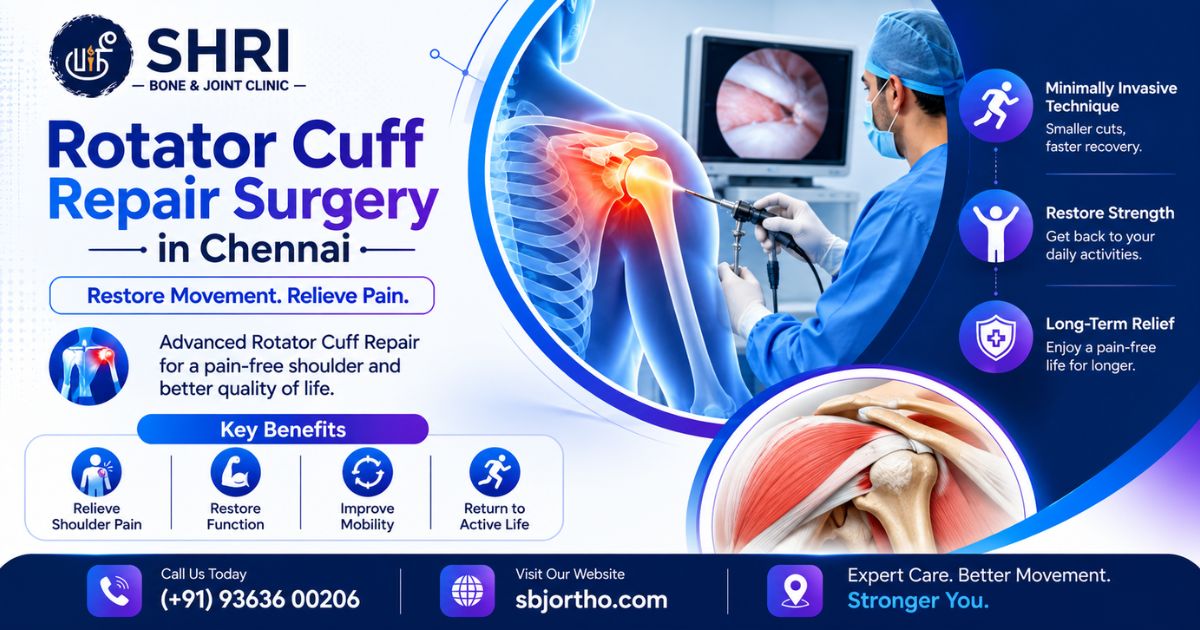
Which Is the Best Hospital for Rotator Cuff Repair Surgery in Chennai?
Patients considering rotator cuff repair should choose an orthopedic centre that provides accurate shoulder diagnosis, appropriate imaging, experienced surgical evaluation, and structured postoperative rehabilitation.
Shri Bone & Joint Clinic in Chennai provides orthopedic consultation and treatment planning for patients with rotator cuff injuries, shoulder pain, and restricted movement.
The treatment approach begins with determining whether symptoms are caused by tendon inflammation, a partial tear, a full-thickness tear, or another shoulder condition.
Patients experiencing shoulder pain without a confirmed tendon tear can explore Shoulder Impingement Syndrome Treatment in Chennai to understand the role of physiotherapy, strengthening, medication, and other non-surgical approaches.
Patients with degenerative conditions affecting other joints can also learn about Knee Osteoarthritis Treatment in Chennai, where treatment may range from conservative management to joint replacement depending on disease severity.
For rotator cuff injuries, surgery is recommended only when the clinical findings, tear characteristics, and functional requirements support operative treatment.
Who Is the Best Doctor for Rotator Cuff Repair Surgery in Chennai?
Choosing an appropriate orthopedic surgeon is important because rotator cuff tears vary considerably in size, location, tendon quality, and repairability.
A thorough assessment helps determine whether the patient is likely to benefit from physiotherapy or requires surgical repair.
Dr. Shriram Krishnamoorthy at Shri Bone & Joint Clinic provides orthopedic evaluation and treatment planning for patients experiencing shoulder pain, tendon injuries, and other musculoskeletal conditions.
Patients searching for an Orthopedic Specialist in Chennai can consult Dr. Shriram for a detailed assessment of shoulder symptoms, imaging findings, and available treatment options.
Patients interested in other orthopedic surgical procedures can also explore Robotic Bilateral Knee Replacement in Chennai, which explains the treatment considerations involved when advanced arthritis affects both knee joints.
For rotator cuff repair, important factors include the surgeon's assessment of tendon repairability, appropriate surgical planning, patient counselling, and a carefully supervised rehabilitation programme.
What Is the Cost of Rotator Cuff Repair Surgery in Chennai?
The cost of rotator cuff repair surgery depends on the size and complexity of the tear, surgical technique, hospital facilities, anaesthesia, implant or anchor requirements, and postoperative rehabilitation.
Arthroscopic repair may involve specialised equipment and suture anchors, while complex tears may require additional surgical procedures.
| Category | Approx. Range (₹) |
| Non-surgical care / Diagnostics | ₹3,000 – ₹10,000 |
| Standard Therapy | Varies |
| Advanced Programs | Varies |
| Specialised Rehab | Varies |
| Physiotherapy & Rehab | ₹15,000 – ₹40,000 |
These figures are illustrative estimates for selected diagnostic, non-surgical, and rehabilitation services. They are not verified clinic prices or a quotation for rotator cuff repair surgery.
The actual surgical cost may include:
- Preoperative investigations
- Hospital admission
- Operating-room charges
- Arthroscopic equipment
- Suture anchors and other surgical materials
- Surgeon fees
- Anaesthesia charges
- Medications
- Postoperative physiotherapy
A personalised estimate should be obtained after the surgeon evaluates the tear and recommends a specific treatment plan.
Does Health Insurance Cover Rotator Cuff Repair Surgery?
Medically necessary rotator cuff repair may qualify for coverage under certain health insurance policies.
Coverage depends on the insurer, policy terms, medical indication, hospital arrangements, and applicable exclusions.
Patients should confirm pre-authorisation requirements, waiting periods, implant or consumable limits, and potential out-of-pocket expenses before surgery.
FAQs
1. Can a rotator cuff tear heal without surgery?
Some patients with partial or degenerative rotator cuff tears can achieve meaningful pain relief and functional improvement through physiotherapy and non-surgical treatment.
However, a complete tendon tear generally does not reattach itself to the bone without surgical repair. Even so, not every full-thickness tear requires surgery, because treatment depends on symptoms, function, tear characteristics, and patient requirements.
2. Is arthroscopic rotator cuff repair better than open surgery?
Arthroscopic repair uses small incisions and a camera to visualise and repair the torn tendon.
It is commonly used for many rotator cuff tears, but open or mini-open surgery may be appropriate for selected complex cases. The most suitable technique depends on the injury and surgeon's assessment rather than incision size alone.
3. Is rotator cuff repair surgery painful?
Patients may experience pain and discomfort during the early postoperative period, particularly as the effects of anaesthesia or a nerve block wear off.
Appropriate medication, shoulder protection, and rehabilitation guidance help manage symptoms. Pain levels vary according to the procedure, tear size, and individual response.
4. How long should I wear a sling after rotator cuff repair surgery?
A sling is commonly recommended for approximately four to six weeks after many rotator cuff repairs.
However, the duration may be shorter or longer depending on tear size, tendon quality, repair strength, and the surgeon's rehabilitation protocol. Patients should not discontinue the sling without appropriate medical guidance.
5. Can a repaired rotator cuff tear happen again?
Yes. A repaired rotator cuff tendon can fail to heal completely or develop another tear.
The risk depends on factors such as tear size, tendon quality, age, smoking, diabetes, rehabilitation, and premature heavy loading. Following postoperative restrictions and a structured strengthening programme can help protect the repair during recovery.

Better Health Care is Our Mission
Get an immediate relief to your knee-related problems from Shri Bone & Joint Clinic.
Phone
Shri Bone & Joint clinic
No.14/31, 3rd Avenue Indira Nagar, Adyar, Chennai-600020
Phone: 044 4505 5509