

Spinal decompression therapy in Chennai is a non-surgical treatment approach designed to help selected patients manage back pain, neck pain, and symptoms associated with certain spinal disc conditions. It uses controlled mechanical traction to apply a gentle pulling force to the spine, with the aim of reducing mechanical stress and improving comfort.
People experiencing persistent lower back pain, sciatica, cervical disc problems, or nerve-related symptoms may consider spinal decompression therapy as part of a comprehensive rehabilitation programme. However, the treatment is not suitable for every spinal condition, and its effectiveness varies depending on the underlying diagnosis.
At Shri Bone & Joint Clinic and Shri Physio & Rehab, spinal pain management focuses on identifying the cause of symptoms and selecting appropriate non-surgical treatment and rehabilitation strategies. Patients can undergo an orthopedic assessment to determine whether spinal decompression therapy may be suitable for their condition.
What Is Spinal Decompression Therapy?
Spinal decompression therapy is a treatment that uses controlled traction to apply a stretching force to selected regions of the spine. It is commonly discussed as a non-surgical option for patients experiencing neck pain, lower back pain, and certain disc-related symptoms.
The spine consists of vertebrae separated by intervertebral discs, which help distribute loads and allow movement. When discs or surrounding structures become irritated or damaged, patients may experience localised pain or symptoms extending into the arms or legs.
Mechanical spinal decompression devices apply controlled traction forces while the patient lies on a treatment table. Depending on the system, the force, duration, and treatment position may be adjusted.
How Does Spinal Decompression Therapy Work?
The treatment aims to temporarily reduce mechanical loading on selected spinal structures.
Potential effects include:
- Gentle stretching of spinal tissues.
- Temporary changes in pressure and loading.
- Reduced muscle guarding in some patients.
- Short-term symptom relief.
- Improved tolerance to movement in selected individuals.
Some devices are marketed as creating negative pressure inside spinal discs. However, reliable clinical evidence has not established that non-surgical decompression consistently retracts herniated discs, permanently restores disc height, or reverses disc degeneration.
Evidence for mechanical traction in lower back pain is mixed, and routine traction is not recommended by several major clinical guidelines for most patients with low back pain.
Therefore, spinal decompression should be considered only after an appropriate assessment and should not replace evidence-based rehabilitation.
When Is Spinal Decompression Therapy Recommended?
Spinal decompression therapy may be considered for selected patients with persistent spinal symptoms after clinical evaluation.
The decision depends on the diagnosis, symptom pattern, medical history, and whether traction is likely to provide a reasonable benefit.
1. Herniated Disc
A herniated disc occurs when disc material extends beyond its normal boundaries and may irritate nearby nerves.
Patients may experience back or neck pain, radiating discomfort, tingling, or weakness.
Selected patients may be considered for a supervised trial of traction, although the treatment does not reliably reverse a herniated disc.
2. Bulging Disc
A bulging disc involves an extension of disc tissue beyond its usual margins.
Not every bulging disc causes symptoms.
When symptoms are present, treatment should be based on clinical findings rather than imaging results alone.
3. Sciatica
Sciatica describes pain or other symptoms that travel along the distribution of the sciatic nerve, commonly from the lower back into the buttock or leg.
Some patients with nerve-related symptoms may experience temporary relief with traction.
However, exercise-based rehabilitation and appropriate medical management remain important.
4. Cervical Radiculopathy
Cervical radiculopathy occurs when a nerve root in the neck becomes irritated or compressed.
Symptoms may include:
- Neck pain.
- Arm pain.
- Tingling.
- Numbness.
- Muscle weakness.
Mechanical cervical traction may be considered as an adjunct to physiotherapy in selected patients.
5. Persistent Mechanical Back or Neck Pain
Some patients with ongoing spinal discomfort may be evaluated for traction-based treatment.
However, spinal decompression is not routinely recommended for uncomplicated mechanical lower back pain because evidence of sustained benefit is limited.
When Should Spinal Decompression Be Avoided?
Spinal traction may be inappropriate for patients with:
- Spinal fractures or instability.
- Certain spinal tumours.
- Spinal infections.
- Severe osteoporosis.
- Significant spinal cord compression.
- Certain inflammatory or structural spinal disorders.
- Recent spinal surgery without specialist clearance.
Patients with progressive neurological weakness, suspected cauda equina syndrome, or spinal cord dysfunction require urgent medical evaluation rather than routine decompression sessions.
Benefits of Spinal Decompression Therapy
Spinal decompression therapy may offer symptom relief for some appropriately selected patients, but outcomes are variable.
Its benefits should be discussed realistically.
1. Non-Surgical Treatment Approach
Mechanical traction does not require surgical incisions or general anaesthesia.
It may be considered as part of conservative care when clinically appropriate.
2. Possible Short-Term Pain Relief
Some patients experience temporary improvement in back or neck discomfort following traction.
However, symptom relief is not guaranteed, and long-term benefits remain uncertain for many spinal conditions.
3. Reduced Muscle Guarding
Gentle traction may help some patients feel more relaxed and comfortable during movement.
This response varies between individuals.
4. Support for Rehabilitation
When a patient responds positively, traction may sometimes be used alongside strengthening, mobility exercises, and education.
It should not replace active rehabilitation.
5. Individualised Treatment Parameters
Certain mechanical traction systems allow clinicians to adjust the force, position, and treatment duration.
These settings should be selected according to the patient's diagnosis, comfort, and safety.
6. Non-Invasive Symptom Management
For selected patients, a supervised trial of traction may be considered before more invasive treatment options.
However, traction should not delay necessary investigation or surgery when serious neurological problems are present.
How Is Spinal Decompression Therapy Performed?
Spinal decompression therapy generally involves a clinical assessment followed by controlled traction using a specialised treatment table or mechanical device.
Step 1: Initial Spine Assessment
The clinician reviews the patient's symptoms, medical history, and previous treatments.
The assessment may include:
- Spine movement examination.
- Muscle strength testing.
- Reflex examination.
- Sensory assessment.
- Evaluation of radiating pain.
- Screening for neurological warning signs.
MRI or other imaging may be recommended when clinically indicated.
Step 2: Determining Treatment Suitability
The clinician determines whether mechanical traction is appropriate.
The decision should account for the underlying spinal condition and any contraindications.
Step 3: Patient Positioning
The patient is positioned on a treatment table.
For lumbar traction, the patient may lie on their back or in another suitable position.
For cervical traction, the device is configured to apply a controlled force to the neck.
Support straps or harnesses may be used depending on the system.
Step 4: Controlled Traction
The device applies a gradual pulling force to the selected spinal region.
Some systems use intermittent traction cycles, while others apply sustained traction.
The force and duration are adjusted according to clinical judgement and patient tolerance.
Step 5: Monitoring During Treatment
The clinician monitors the patient's comfort and response.
Treatment should be stopped if symptoms worsen significantly or new neurological symptoms develop.
Step 6: Post-Treatment Rehabilitation
Patients may receive an individualised rehabilitation programme involving:
- Core strengthening.
- Spinal mobility exercises.
- Hip and lower-limb strengthening.
- Neck stabilisation exercises.
- Posture variation and ergonomic advice.
- Gradual return to physical activity.
Long-term recovery generally depends on addressing functional limitations rather than relying on passive treatment alone.






Recovery Process After Spinal Decompression Therapy
Unlike surgery, non-surgical spinal decompression generally does not require a formal wound-healing or postoperative recovery period.
Patients can often return to suitable daily activities after a session, depending on their symptoms and the clinician's recommendations.
Immediate Response After Treatment
Some patients may experience temporary relief.
Others may notice no meaningful change.
Mild soreness can occur, but substantial increases in pain or new neurological symptoms require reassessment.
Gradual Return to Movement
Patients are generally encouraged to remain appropriately active rather than resting for prolonged periods.
Activities should be modified according to symptoms.
Physiotherapy and Strengthening
Rehabilitation may focus on improving the strength and endurance of muscles supporting the spine.
Exercises may include:
- Gentle spinal mobility.
- Core muscle strengthening.
- Hip strengthening.
- Functional movement training.
- Walking.
- Individualised neck exercises.
Activity Modification
Patients may benefit from temporarily adjusting activities that aggravate symptoms.
This can include modifying lifting technique, reducing prolonged static positions, and gradually increasing physical demands.
Monitoring Symptoms
The treatment plan should be reviewed if symptoms fail to improve.
Persistent pain, worsening weakness, or progressive neurological symptoms may require additional investigation.
How Long Does Recovery Take?
The duration of improvement depends on the underlying spinal condition rather than the decompression device alone.
Some patients experience short-term symptom changes after a session, while others require several weeks of active rehabilitation.
| Treatment Stage | General Timeline | Main Focus |
| Initial assessment | First consultation | Diagnosis and suitability |
| Trial of treatment | As clinically appropriate | Evaluate response to traction |
| Early rehabilitation | First 1–3 weeks | Symptom management and gentle activity |
| Progressive rehabilitation | Weeks 3–6 | Strengthening and functional movement |
| Continued recovery | Weeks 6–12 or longer | Endurance, mobility and activity tolerance |
These timelines are illustrative and are not guaranteed recovery periods.
For some disc-related conditions, symptoms improve gradually over several weeks or months with appropriate conservative management.
Patients should not assume that a fixed number of decompression sessions will permanently correct a spinal disc problem.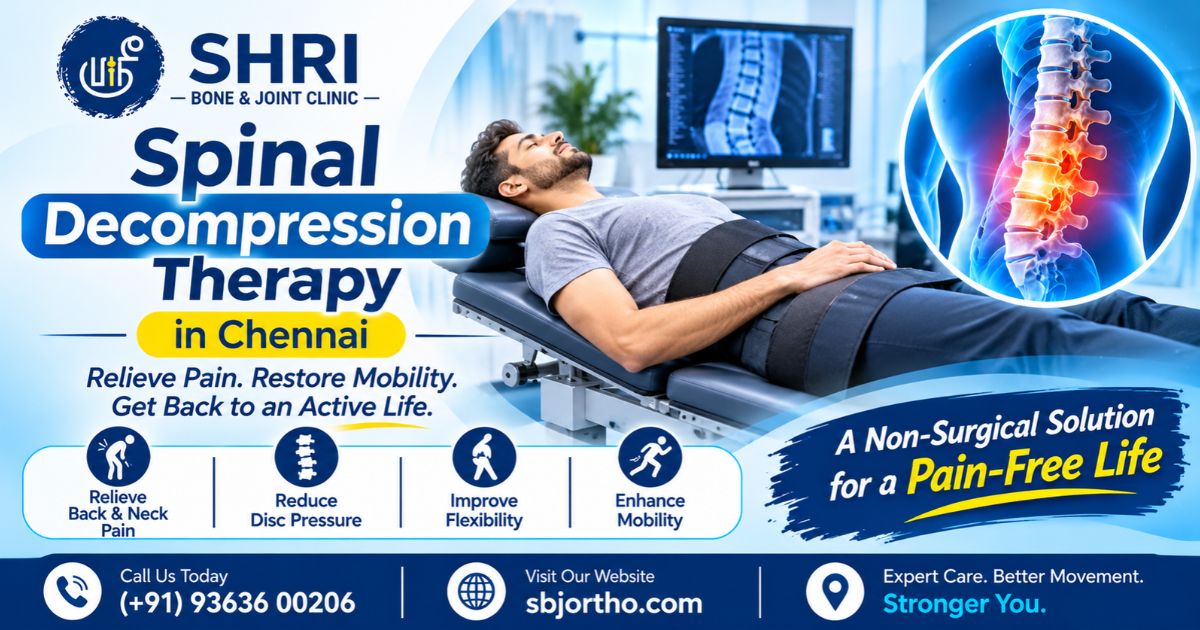
Which is the Best Hospital for Spinal Decompression Therapy in Chennai?
Choosing a hospital or rehabilitation facility for spinal decompression therapy requires more than selecting a centre with a traction machine.
The most important factor is whether the facility provides an appropriate clinical assessment and an evidence-informed treatment plan.
Patients should consider:
- Access to orthopedic evaluation.
- Assessment of nerve-related symptoms.
- Appropriate imaging referrals.
- Screening for contraindications.
- Qualified physiotherapy supervision.
- Individualised rehabilitation programmes.
- Monitoring of treatment response.
- Referral pathways for serious spinal conditions.
Shri Bone & Joint Clinic and Shri Physio & Rehab in Chennai provide orthopedic and rehabilitation services for patients with musculoskeletal and spine-related concerns.
Patients considering spinal decompression therapy can seek an assessment to determine whether traction-based treatment is appropriate or whether another approach is more suitable.
Treatment recommendations should be based on the underlying diagnosis and the patient's functional needs.
A comprehensive programme may include physiotherapy, exercise-based rehabilitation, pain management, and specialist review when necessary.
Who is the Best Doctor for Spinal Decompression Therapy in Chennai?
The appropriate doctor for spinal decompression therapy should have experience evaluating spinal disorders and identifying conditions that require medical or surgical intervention.
Patients should look for a specialist who can assess:
- Persistent neck or lower back pain.
- Herniated or bulging discs.
- Nerve-related symptoms.
- Spinal movement restrictions.
- Neurological warning signs.
- Suitability for non-surgical rehabilitation.
- Need for advanced imaging or specialist referral.
Dr. Shriram Krishnamoorthy, associated with Shri Bone & Joint Clinic, provides orthopedic assessment and treatment guidance for musculoskeletal conditions.
Patients looking for an Orthopedic Specialist in Chennai can undergo an evaluation to understand the cause of spinal pain and discuss suitable treatment options.
Some patients experience difficulty walking or standing because of lower-limb joint disease rather than a spinal condition.
Depending on the diagnosis, orthopedic treatment may include Total Knee Replacement in Chennai, Partial Knee Replacement in Chennai, or other joint-specific procedures.
Similarly, Limb Lengthening Surgery in Chennai addresses selected limb-length discrepancies and bone deformities rather than disc-related spinal pain.
These treatments serve different clinical purposes, and an accurate diagnosis is essential before recommending any procedure.
What is the Cost of Spinal Decompression Therapy in Chennai?
The cost of spinal decompression therapy in Chennai varies according to the treatment facility, equipment, clinical assessment, and number of sessions recommended.
A fixed treatment package may not be appropriate for every patient because not all spinal conditions respond to traction.
Factors Affecting Spinal Decompression Therapy Cost
|
Cost Factor |
Description |
|
Initial consultation |
Orthopedic or physiotherapy assessment |
|
Type of treatment |
Cervical or lumbar mechanical traction |
|
Equipment used |
Type of traction or decompression system |
|
Session duration |
Length of the supervised treatment |
|
Number of sessions |
Determined by clinical response and treatment goals |
|
Physiotherapy programme |
Additional exercise-based rehabilitation |
|
Diagnostic investigations |
Imaging or tests when medically necessary |
|
Follow-up evaluation |
Monitoring symptoms and functional progress |
Is Spinal Decompression Therapy Covered by Insurance?
Insurance coverage varies according to the policy and whether the treatment is included under outpatient physiotherapy or rehabilitation benefits.
Some policies may cover selected physiotherapy services, while others exclude specific traction-based treatments.
Patients should verify eligibility, reimbursement limits, and required documentation with their insurer.
How to Get an Accurate Treatment Estimate
Before beginning treatment, patients should request information about:
- Consultation charges.
- Cost per session.
- Whether supervised physiotherapy is included.
- Recommended treatment duration.
- Follow-up charges.
- Any additional rehabilitation expenses.
Patients should also ask how treatment effectiveness will be assessed and when the plan will be reviewed.
The decision to continue therapy should depend on measurable clinical improvement rather than a predetermined number of sessions.
FAQs
1. Is spinal decompression therapy effective for a herniated disc?
Spinal decompression therapy may provide temporary symptom relief for selected patients, but evidence of consistent long-term benefit is limited. It has not been reliably shown to retract herniated discs or permanently reverse disc damage. Treatment should be based on clinical assessment and may include exercise-based physiotherapy, medication, and other appropriate care.
2. How many spinal decompression sessions are required?
There is no universally recommended number of sessions. The appropriate duration depends on the diagnosis, symptom severity, response to treatment, and rehabilitation goals. If traction does not provide meaningful improvement, the treatment plan should be reassessed rather than continuing sessions automatically.
3. Is spinal decompression therapy painful?
Mechanical traction is generally intended to be tolerable, but some patients may experience discomfort or increased symptoms. Treatment should not cause severe pain, new weakness, or worsening numbness. The clinician should adjust or stop traction if concerning symptoms occur.
4. Can spinal decompression therapy prevent spine surgery?
Some spinal conditions improve with conservative treatment, allowing patients to avoid surgery. However, this improvement cannot necessarily be attributed to spinal decompression therapy. Patients with progressive neurological weakness, serious nerve compression, or other urgent spinal conditions may require specialist surgical evaluation.
5. Who should avoid spinal decompression therapy?
Patients with spinal instability, fractures, certain tumours or infections, severe osteoporosis, or significant spinal cord compression may not be suitable candidates. Anyone experiencing new bladder or bowel dysfunction, numbness around the groin, or progressive leg weakness should seek urgent medical care rather than undergoing routine traction treatment.

Better Health Care is Our Mission
Get an immediate relief to your knee-related problems from Shri Bone & Joint Clinic.
Phone
Shri Bone & Joint clinic
No.14/31, 3rd Avenue Indira Nagar, Adyar, Chennai-600020
Phone: 044 4505 5509