Introduction
Many people use the terms “pinched nerve” and “slip disc” interchangeably. It is common to hear someone say, “I have a slipped disc,” when they are actually experiencing a pinched nerve, or vice versa. Although these conditions are closely related, they are not the same.
This confusion often begins after an MRI scan or a visit to the doctor. Some patients are told they have a disc bulge, while others are informed that a nerve is compressed. Since both conditions can cause pain, numbness, tingling, and weakness, it is easy to assume they are identical.
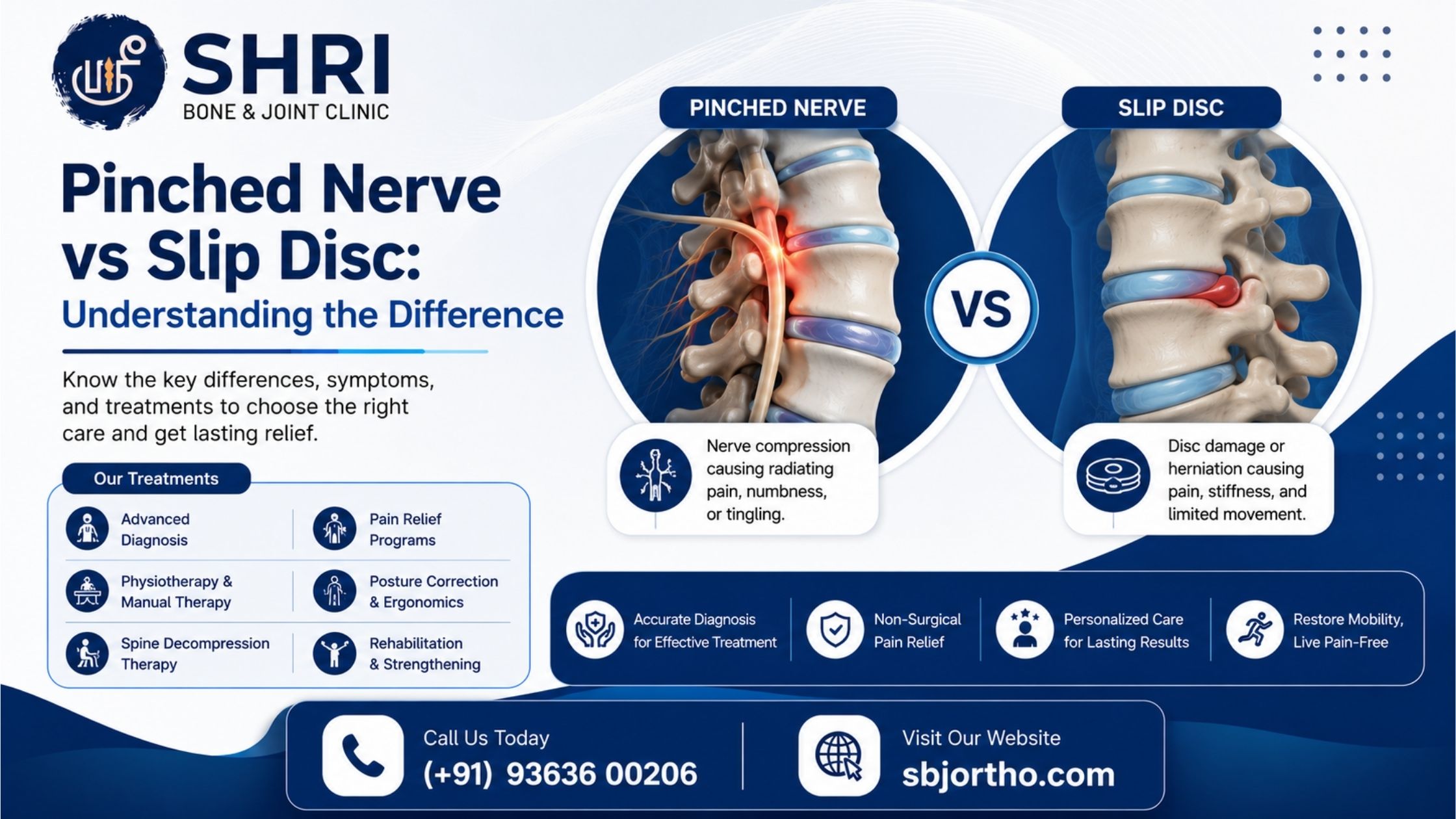
The important thing to understand is that a slip disc is a structural problem, whereas a pinched nerve is the effect of pressure on a nerve. In many cases, a slipped disc is actually one of the reasons a pinched nerve develops, but it is not the only cause.
Knowing the difference is important because treatment decisions depend on the actual source of the symptoms rather than the name of the condition.
In this guide, we’ll explain how these conditions differ, how they are connected, what symptoms they produce, how doctors diagnose them, and what non-surgical treatment options are commonly considered.
Understanding the Spine
Before comparing these conditions, it helps to understand how the spine is built.
The spine consists of:
- Vertebrae (bones)
- Spinal discs
- Facet joints
- Ligaments
- Muscles
- Spinal nerves
Between every two vertebrae sits a soft spinal disc.
These discs have two important jobs:
- Absorb shock during movement
- Allow the spine to bend and rotate comfortably
Nearby spinal nerves exit through small openings and travel to different parts of the body.
When either the disc or surrounding structures interfere with these nerves, symptoms can develop.
What Is a Slip Disc?
Despite the name, a disc does not actually slip.
The medical terms commonly used include:
- Disc bulge
- Herniated disc
- Prolapsed disc
- Disc protrusion
A spinal disc has:
- A tough outer layer
- A softer gel-like centre
Over time or after an injury, the outer layer may weaken.
This can allow part of the inner material to push outward.
When this occurs, it is commonly referred to as a slip disc.
The amount of bulging varies considerably.
Some people have:
- Small disc bulges
- Moderate herniations
- Larger disc protrusions
Interestingly, not every slipped disc causes symptoms.
Many people discover disc bulges only after having scans performed for unrelated reasons.
What Is a Pinched Nerve?
A pinched nerve occurs when excessive pressure is placed on a nerve.
This pressure interferes with the nerve’s ability to function normally.
Unlike a slipped disc, a pinched nerve is not a diagnosis describing a structure.
Instead, it describes what is happening to the nerve.
Pressure on a nerve may lead to:
- Pain
- Tingling
- Numbness
- Burning sensations
- Muscle weakness
The nerve becomes irritated because something around it is compressing or inflaming it.
Can a Slip Disc Cause a Pinched Nerve?
Yes.
In fact, this is one of the most common reasons people develop a pinched nerve.
When a disc bulges outward, it may occupy space where nearby nerves normally pass.
If the bulging disc presses against one of these nerves, symptoms may develop.
However, it is important to remember that not every slipped disc causes nerve compression.
Likewise, not every pinched nerve is caused by a slipped disc.
Other Causes of a Pinched Nerve
Several conditions besides a slipped disc can compress a nerve.
These include:
Degenerative Disc Disease
Age-related changes may reduce the space available for spinal nerves.
Arthritis
Bone spurs associated with arthritis may narrow nerve pathways.
Spinal Stenosis
Narrowing of the spinal canal can compress spinal nerves.
Thickened Ligaments
Changes in spinal ligaments may reduce available space around nerves.
Muscle Tightness
Severe muscle spasm occasionally contributes to nerve irritation.
Poor Posture
Long-term postural problems may increase stress on spinal structures and surrounding nerves.
Symptoms of a Slip Disc
Symptoms depend on:
- Location of the disc
- Size of the bulge
- Whether nearby nerves are affected
Common symptoms include:
Local Back Pain
Pain may remain limited to the neck or lower back.
Reduced Flexibility
Movement may become stiff or uncomfortable.
Pain During Bending
Forward bending or lifting often aggravates symptoms.
Muscle Tightness
Protective muscle spasm commonly develops.
If the disc also compresses a nerve, additional nerve-related symptoms may appear.
Symptoms of a Pinched Nerve
Because nerves supply different parts of the body, symptoms often travel beyond the spine itself.
Common symptoms include:
Pain Radiating into the Arm or Leg
Pain may travel along the pathway of the affected nerve.
Tingling
Many people describe “pins and needles.”
Numbness
Reduced sensation may develop in specific areas.
Burning Sensations
Some patients report sharp or burning discomfort.
Weakness
Compressed nerves may reduce muscle strength over time.
Key Differences Between a Pinched Nerve and a Slip Disc
| Slip Disc | Pinched Nerve |
| Structural disc problem | Nerve-related problem |
| May or may not cause symptoms | Usually produces symptoms |
| Can exist without nerve compression | Always involves nerve irritation |
| MRI often identifies the disc | Clinical examination identifies nerve involvement |
| One possible cause of nerve compression | Can result from many different conditions |
Understanding this distinction helps patients better understand their diagnosis.
How Are These Conditions Diagnosed?
Diagnosis usually begins with a detailed medical history and physical examination.
Doctors often assess:
- Pain location
- Movement limitations
- Muscle strength
- Sensation
- Reflexes
If required, imaging studies such as MRI scans help evaluate:
- Disc health
- Nerve compression
- Spinal alignment
- Degenerative changes
Importantly, MRI findings are interpreted together with symptoms rather than independently.
Does Every Slip Disc Need Surgery?
No.
This is one of the biggest misconceptions.
Many slipped discs improve with conservative treatment.
Surgery is generally considered only when:
- Significant neurological deficits develop
- Progressive weakness occurs
- Severe symptoms fail to improve despite appropriate treatment
- Specific emergency conditions are present
The majority of patients are initially managed without surgery.
Non-Surgical Treatment Approaches
Treatment depends on the underlying diagnosis rather than simply the symptoms.
Common rehabilitation approaches may include:
Physiotherapy
Improves movement, flexibility, and muscle function.
Strengthening Exercises
Help support the spine and reduce recurring strain.
Postural Correction
Improves body mechanics during work and daily activities.
Activity Modification
Allows patients to remain active while avoiding movements that worsen symptoms.
Spine Rehabilitation
Comprehensive rehabilitation combines several approaches to improve long-term function.
Can These Conditions Heal Naturally?
Recovery varies between individuals.
Many people improve through:
- Appropriate rehabilitation
- Exercise
- Activity modification
- Time
- Gradual return to normal movement
The body often adapts remarkably well when movement patterns improve and supporting muscles become stronger.
When Should You Seek Medical Evaluation?
Medical assessment is recommended if symptoms:
- Continue for several weeks
- Frequently recur
- Radiate into the arms or legs
- Cause weakness
- Affect walking
- Interfere with work or daily activities
Early diagnosis often allows treatment to begin before symptoms become more severe.
Why Accurate Diagnosis Matters
Treating a pinched nerve without understanding its cause may not provide lasting improvement.
Similarly, finding a disc bulge on an MRI does not automatically explain every symptom.
A comprehensive clinical evaluation helps determine:
- Whether symptoms arise from the disc
- Whether a nerve is compressed
- Whether other structures are involved
- Which treatment approach is most appropriate
This is why treatment should always be individualised.
Conclusion
Although the terms pinched nerve and slip disc are often used interchangeably, they describe two different aspects of spinal health. A slip disc refers to changes in the spinal disc itself, while a pinched nerve occurs when a nerve is compressed by surrounding structures. One condition can lead to the other, but they are not always directly connected.
Understanding this difference helps patients make better treatment decisions and reduces unnecessary anxiety after receiving an MRI report. Many individuals improve through structured rehabilitation, movement-based therapy, and non-surgical care without requiring an operation.
If you are experiencing persistent back pain, neck pain, tingling, numbness, or radiating leg or arm pain, consulting an experienced Orthopedic Specialist in Chennai can help determine the exact cause of your symptoms. Patients exploring conservative spine care may also benefit from learning more about Nerve Compression Treatment Without Surgery in Chennai and Pinched Nerve Treatment Without Surgery in Chennai to understand the rehabilitation options available.
FAQs
Is a slipped disc the same as a pinched nerve?
No. A slipped disc is a structural problem involving the spinal disc, whereas a pinched nerve occurs when a nerve is compressed. A slipped disc may cause a pinched nerve, but they are not the same condition.
Can I have a slipped disc without any symptoms?
Yes. Many people have disc bulges or degenerative changes visible on MRI scans without experiencing pain or other symptoms. Treatment decisions are based on both clinical findings and imaging results.
Does every pinched nerve require surgery?
No. Many cases of nerve compression can be managed successfully with non-surgical treatment, including rehabilitation, physiotherapy, strengthening exercises, and activity modification, depending on the underlying cause.
How do doctors know whether my symptoms are coming from a slipped disc or a pinched nerve?
Doctors combine your medical history, physical examination, neurological assessment, and imaging studies such as MRI scans to identify the exact source of your symptoms and develop an appropriate treatment plan.
Can exercise help both conditions?
Yes. When prescribed appropriately, exercise plays an important role in improving spinal support, strengthening muscles, enhancing mobility, and reducing the likelihood of recurring symptoms. The type of exercise depends on the individual’s diagnosis and stage of recovery.