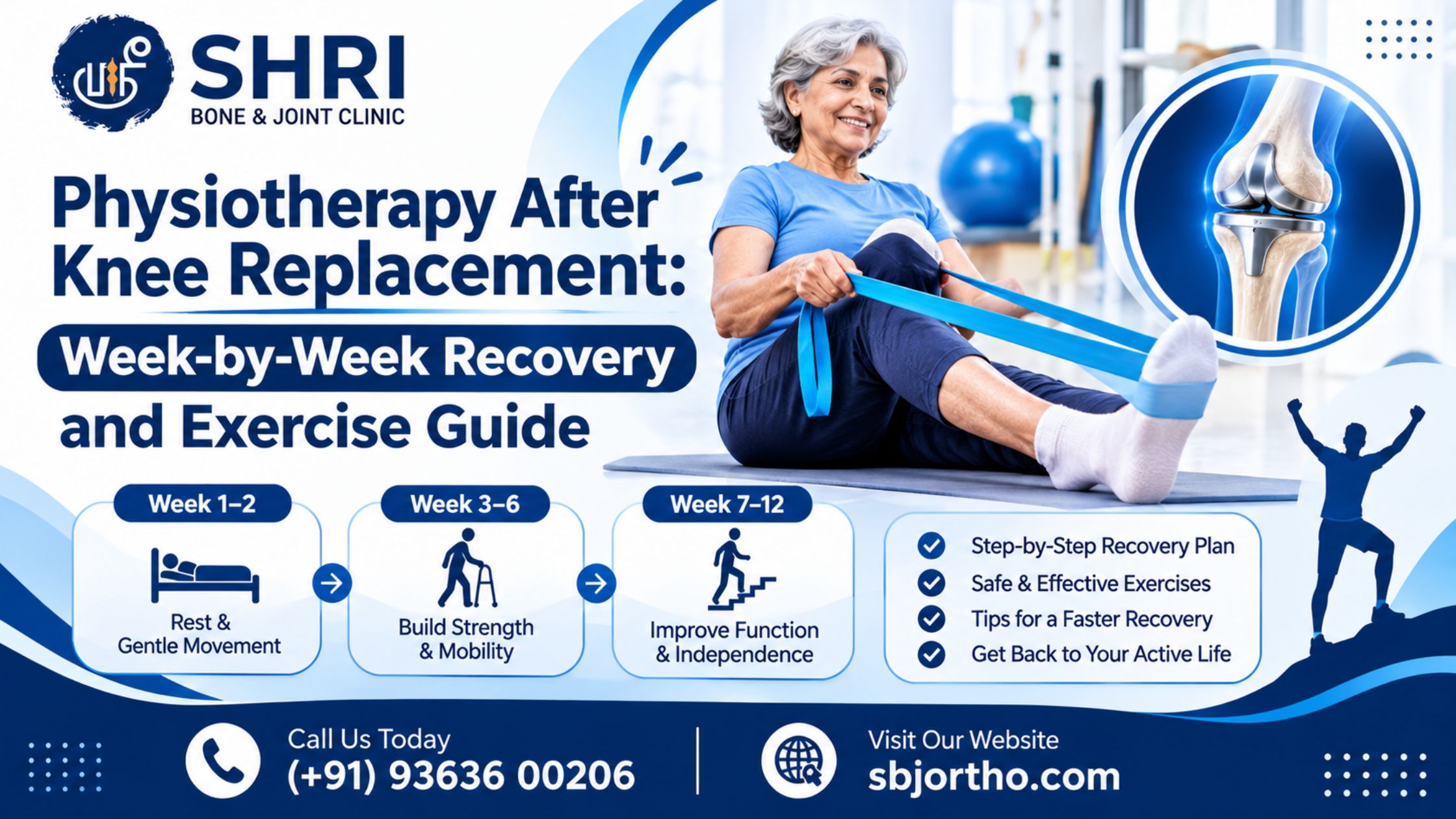
Physiotherapy after knee replacement is an essential part of recovery. While surgery replaces the damaged joint surfaces, rehabilitation helps patients regain knee movement, rebuild muscle strength, improve walking ability, and return to everyday activities.
Most patients begin gentle movement and assisted walking within the first 24 hours after knee replacement, provided they are medically stable. Rehabilitation then progresses gradually from swelling management and basic exercises to strengthening, balance training, stair climbing, and independent movement.
The first six weeks are particularly important for developing a consistent rehabilitation routine. However, recovery continues well beyond this period, with improvements in strength, comfort, and function often occurring over several months.
A successful recovery depends on several factors, including the patient’s condition before surgery, surgical technique, pain management, muscle strength, and participation in physiotherapy.
This week-by-week guide explains what patients can generally expect after total knee replacement, which exercises may be recommended, how rehabilitation progresses, and which warning signs require medical attention.
Physiotherapy After Knee Replacement: Week-by-Week Recovery Timeline
Total knee replacement involves removing damaged joint surfaces and positioning artificial components designed to improve joint function.
Although the damaged surfaces are replaced during surgery, the surrounding muscles, ligaments, and soft tissues still require time to recover.
Patients may initially experience:
- Knee pain and swelling.
- Difficulty bending or straightening the knee.
- Weakness in the thigh muscles.
- Reduced walking confidence.
- Difficulty standing from a chair.
- Limited walking endurance.
- Temporary changes in balance.
- Difficulty climbing stairs.
Physiotherapy addresses these limitations through a progressive rehabilitation programme.
The following timeline provides general guidance for uncomplicated total knee replacement recovery. Individual instructions from the operating surgeon and physiotherapist always take priority.
Day 0–3: Early Mobilisation After Knee Replacement
The first few days after surgery focus on medical stability, pain management, circulation, and safe movement.
Many patients begin assisted standing and walking on the day of surgery or the following day, depending on their condition.
Main Rehabilitation Goals
- Manage pain and swelling.
- Begin gentle knee movement.
- Activate the quadriceps muscles.
- Improve circulation.
- Learn safe transfers from bed to chair.
- Begin walking with an appropriate aid.
- Understand postoperative precautions.
Exercise 1: Ankle Pumps
Ankle pumps involve moving the feet upward and downward while sitting or lying down.
How to perform:
- Lie comfortably with your legs supported.
- Move your toes toward your body.
- Point your toes gently away.
- Repeat the movement in a controlled manner.
Ankle pumps encourage lower-limb movement and circulation.
They are commonly included in early rehabilitation but do not replace prescribed blood-clot prevention measures.
Exercise 2: Quadriceps Sets
Quadriceps sets help activate the thigh muscles that support knee stability.
How to perform:
- Lie with your operated leg supported.
- Gently tighten the muscles at the front of your thigh.
- Try to straighten the knee without forcing it.
- Hold briefly.
- Relax.
A physiotherapist may recommend several gentle repetitions throughout the day.
Exercise 3: Gentle Heel Slides
Heel slides encourage knee bending.
How to perform:
- Lie on your back.
- Slowly slide your heel toward your body.
- Bend the knee within the permitted range.
- Hold briefly if comfortable.
- Slide the heel back.
Avoid forcing the knee into painful bending.
Exercise 4: Assisted Walking
Walking usually begins with a walker, crutches, or another recommended mobility aid.
The physiotherapist helps patients practise:
- Standing safely.
- Taking controlled steps.
- Turning.
- Sitting down.
- Managing weight-bearing according to surgical instructions.
Walking should begin under supervision when medically appropriate.
Week 1: Reducing Swelling and Restoring Basic Knee Movement
During the first week, patients continue working on knee movement and muscle activation.
Swelling and discomfort are common, particularly after walking or exercise.
The focus is on gentle, consistent rehabilitation rather than achieving aggressive movement targets.
Main Rehabilitation Goals
- Improve knee bending and straightening.
- Continue quadriceps activation.
- Walk short distances safely.
- Manage postoperative swelling.
- Practise basic daily activities.
- Follow wound-care instructions.
- Develop a home exercise routine.
Recommended Exercises
- Ankle Pumps
Continue gentle ankle movements as recommended.
- Quadriceps Sets
Practise tightening the thigh muscles without holding your breath.
- Heel Slides
Continue controlled knee bending within the permitted range.
- Gluteal Sets
Gently tighten the buttock muscles while lying down.
Hold briefly and relax.
- Supported Knee Extension
Position the leg as advised to encourage comfortable knee straightening.
Avoid placing a pillow continuously under the knee in a bent position unless specifically instructed.
Walking During Week 1
Patients generally continue using a walking aid.
Walking distances should increase gradually according to pain, swelling, balance, and medical fitness.
Short, frequent walks may be more manageable than one long walking session.
Week 2: Improving Knee Flexion and Walking Confidence
By the second week, many patients begin noticing improvements in walking confidence and knee movement.
However, swelling, stiffness, and discomfort may still be present.
The rehabilitation programme continues to focus on restoring movement while introducing more controlled strengthening.
Main Rehabilitation Goals
- Improve knee range of motion.
- Strengthen the quadriceps.
- Increase walking tolerance.
- Improve transfers from sitting to standing.
- Maintain safe movement patterns.
- Continue swelling management.
Exercise 1: Seated Knee Flexion
How to perform:
- Sit on a stable chair.
- Place your operated foot on the floor.
- Slowly slide the foot backward.
- Bend the knee as comfortably as possible.
- Return to the starting position.
Avoid forcing the knee beyond the recommended range.
Exercise 2: Seated Knee Extension
How to perform:
- Sit upright in a chair.
- Slowly straighten the operated knee.
- Hold briefly if comfortable.
- Lower the foot gradually.
This exercise helps strengthen the quadriceps and improve knee control.
Exercise 3: Supported Sit-to-Stand
How to perform:
- Sit on a stable chair with armrests.
- Position your feet comfortably.
- Use the armrests for support.
- Stand up slowly.
- Sit down with control.
A physiotherapist should determine whether this exercise is appropriate based on strength and balance.
Can You Walk Without a Walker After Two Weeks?
Some patients may begin progressing from a walker to a cane or another less supportive walking aid.
Others require a walker for longer.
The decision depends on:
- Knee stability.
- Quadriceps strength.
- Walking balance.
- Pain.
- Swelling.
- Ability to walk without excessive limping.
Patients should not stop using a walking aid simply because a particular number of days has passed.
Week 3: Building Strength and Improving Functional Movement
During the third week, rehabilitation may become more focused on controlled strengthening and functional activities.
Patients often continue working on knee movement while gradually increasing exercise difficulty.
Main Rehabilitation Goals
- Improve quadriceps strength.
- Increase walking endurance.
- Improve knee control.
- Practise standing and sitting.
- Begin selected balance exercises.
- Improve independence in daily activities.
Exercise 1: Straight Leg Raises
Straight leg raises may be introduced when the patient can maintain knee control without significant extension lag.
How to perform:
- Lie on your back.
- Keep the operated knee straight.
- Tighten the thigh muscles.
- Lift the leg slightly.
- Lower slowly.
If the knee bends or the leg cannot be controlled, the exercise may need to be delayed or modified.
Exercise 2: Supported Mini-Squats
How to perform:
- Stand holding a stable support.
- Keep your feet comfortably apart.
- Bend your knees slightly.
- Maintain control.
- Return to standing.
The movement should remain shallow and comfortable.
Exercise 3: Standing Hip Abduction
How to perform:
- Stand beside a stable support.
- Keep your body upright.
- Slowly move the operated leg sideways.
- Return with control.
This exercise helps strengthen the hip muscles involved in walking and balance.
Walking Progression
Walking may become more comfortable as muscle strength and confidence improve.
Patients should increase walking duration gradually and monitor their response.
A substantial increase in swelling or pain after activity may indicate that the exercise load needs adjustment.
Week 4: Improving Balance and Everyday Mobility
By the fourth week, many patients are becoming more independent with basic activities.
However, recovery varies, and some patients may still require substantial assistance.
Rehabilitation focuses on improving strength, walking quality, and balance.
Main Rehabilitation Goals
- Improve walking symmetry.
- Increase lower-limb strength.
- Develop better balance.
- Improve sit-to-stand movement.
- Practise safe stair climbing.
- Increase tolerance to everyday activities.
Exercise 1: Supported Step-Ups
How to perform:
- Stand in front of a low, stable step.
- Hold a handrail or suitable support.
- Step up using the technique recommended by your physiotherapist.
- Return slowly.
- Repeat with control.
Step height and repetition count should match the patient’s current ability.
Exercise 2: Supported Heel Raises
How to perform:
- Stand holding a stable support.
- Slowly raise your heels.
- Pause briefly.
- Lower with control.
Heel raises help strengthen the calf muscles and support walking function.
Exercise 3: Weight-Shifting Exercises
How to perform:
- Stand with both feet on the floor.
- Hold a stable support.
- Slowly shift your body weight from one leg toward the other.
- Return to the centre.
This exercise helps improve balance and confidence when standing.
Stair-Climbing Practice
Patients may begin or continue stair training under professional guidance.
A common early technique is:
- Going upstairs: lead with the stronger leg.
- Going downstairs: lead with the operated leg.
This is a general early-rehabilitation strategy. The physiotherapist may recommend a different pattern as strength and balance improve.
Week 5: Increasing Strength and Walking Endurance
By the fifth week, rehabilitation may include more demanding functional activities.
Patients who are progressing well may begin increasing resistance and walking duration.
However, exercise intensity should be determined by the individual’s symptoms and recovery.
Main Rehabilitation Goals
- Improve knee strength.
- Increase walking endurance.
- Develop greater confidence on stairs.
- Improve balance.
- Reduce dependence on walking aids when appropriate.
- Return gradually to routine activities.
Exercise 1: Resistance-Band Knee Extension
A physiotherapist may introduce light resistance to strengthen the quadriceps.
The exercise should be performed through a controlled, comfortable range.
Exercise 2: Supported Standing Knee Flexion
How to perform:
- Stand holding a stable support.
- Slowly bend the operated knee.
- Bring the heel toward the back of the thigh within a comfortable range.
- Lower gradually.
This exercise helps strengthen the hamstrings and improve knee control.
Exercise 3: Stationary Cycling
Stationary cycling may be introduced when knee movement, comfort, and surgical instructions allow.
The seat height and resistance should be adjusted appropriately.
Patients may begin with low resistance and short sessions.
Cycling should not be forced if the knee cannot comfortably complete the movement.
Week 6: Progressing Toward Greater Independence
At approximately six weeks, many patients have made meaningful improvements in walking and daily function.
However, the knee may still feel stiff, swollen, or uncomfortable after activity.
Recovery is not complete at this stage.
Main Rehabilitation Goals
- Improve functional knee movement.
- Increase muscle strength.
- Develop better walking endurance.
- Improve balance.
- Practise more demanding daily activities.
- Progress exercise resistance safely.
Recommended Exercises
Exercises may include:
- Progressive sit-to-stand training.
- Supported step-ups.
- Stationary cycling.
- Resistance-band strengthening.
- Balance exercises.
- Walking endurance training.
- Functional stair practice.
The programme should be adapted according to pain, swelling, strength, and movement quality.
Can You Walk Normally After Six Weeks?
Some patients walk independently by six weeks, while others still require a cane or walker.
Walking quality depends on:
- Quadriceps strength.
- Knee movement.
- Balance.
- Pain control.
- Swelling.
- Preoperative walking ability.
- Other medical conditions.
Walking without a mobility aid is not necessarily a sign of complete recovery.
Weeks 7–8: Strengthening and Functional Rehabilitation
During weeks seven and eight, rehabilitation generally becomes more focused on improving endurance, balance, and strength.
Patients may gradually return to more demanding household activities.
Main Rehabilitation Goals
- Improve lower-limb muscle strength.
- Increase walking distance.
- Develop better stair-climbing ability.
- Improve balance and coordination.
- Reduce compensatory walking patterns.
- Build confidence in daily movement.
Exercise Progression
Depending on recovery, physiotherapy may include:
Progressive Resistance Training
Resistance is gradually increased for the quadriceps, hamstrings, and hip muscles.
Functional Squatting
Supported partial squats may be progressed within a comfortable range.
Step Training
Step height and difficulty may increase gradually.
Balance Exercises
Patients may practise supported single-leg balance or other exercises selected by the physiotherapist.
Stationary Cycling
Cycling duration and resistance may increase as tolerated.
Exercise progression should not cause substantial or persistent increases in swelling or pain.
Weeks 9–12: Returning to More Demanding Daily Activities
During the third month, many patients continue improving their strength and mobility.
Rehabilitation increasingly focuses on functional independence.
Main Rehabilitation Goals
- Improve walking endurance.
- Strengthen the operated leg.
- Improve stair climbing.
- Increase balance and stability.
- Return to suitable recreational activities.
- Build confidence in everyday movement.
Functional Exercises
The programme may include:
- Progressive resistance exercises.
- Sit-to-stand training.
- Step-ups and controlled step-downs.
- Balance exercises.
- Stationary cycling.
- Walking on different surfaces.
- Functional lifting and carrying within safe limits.
Patients should continue avoiding sudden increases in activity intensity.
Months 3–6: Advanced Strengthening and Long-Term Recovery
By three months, many patients have regained substantial independence.
However, muscle strength and endurance may remain below their pre-arthritis or desired levels.
Continued rehabilitation may focus on:
- Quadriceps strengthening.
- Hip and calf strengthening.
- Walking endurance.
- Balance and coordination.
- Stair-climbing efficiency.
- Return to suitable low-impact activities.
- Improving confidence in everyday movement.
Some patients may return to activities such as recreational cycling, swimming, or longer walks when medically appropriate.
Higher-impact activities should be discussed with the surgeon.
Months 6–12: Continued Improvement in Strength and Mobility
Recovery after knee replacement can continue for many months.
Patients may notice gradual improvements in:
- Knee comfort.
- Walking endurance.
- Muscle strength.
- Stair-climbing ability.
- Functional movement.
- Confidence during daily activities.
Some residual stiffness or swelling may persist during recovery.
However, persistent or worsening symptoms should be assessed rather than assumed to be normal.
Long-term exercise remains important for maintaining strength, balance, and overall physical health.
Knee Replacement Recovery Timeline at a Glance
| Recovery Period | Main Physiotherapy Focus | General Functional Goals |
| Days 0–3 | Gentle movement, circulation, assisted walking | Safe mobilisation |
| Week 1 | Swelling control, knee movement, muscle activation | Basic walking and transfers |
| Week 2 | Knee flexion, extension, early strengthening | Improved walking confidence |
| Week 3 | Quadriceps and hip strengthening | Better functional movement |
| Week 4 | Balance, step training, walking quality | Greater daily independence |
| Week 5 | Progressive strengthening, endurance | Improved activity tolerance |
| Week 6 | Functional exercises, walking progression | Greater mobility and confidence |
| Weeks 7–8 | Strength, balance, endurance | Improved walking and stair ability |
| Weeks 9–12 | Advanced functional training | Return to more daily activities |
| Months 3–6 | Progressive strengthening | Improved endurance and function |
| Months 6–12 | Long-term conditioning | Continued recovery and independence |
These timelines are general estimates. Recovery should be guided by individual progress and the surgeon’s postoperative instructions.
Best Exercises, Recovery Precautions and Common Questions After Knee Replacement
Physiotherapy after knee replacement is not simply about bending the knee.
An effective programme also addresses muscle weakness, balance, walking patterns, swelling, and the ability to perform everyday tasks.
Exercise selection changes as the patient recovers.
What Are the Best Exercises After Knee Replacement?
The most appropriate exercises depend on the recovery stage.
Commonly recommended exercises include:
1. Ankle Pumps
Help maintain gentle lower-limb movement during early recovery.
2. Quadriceps Sets
Help activate the thigh muscles that support knee movement and stability.
3. Heel Slides
Encourage controlled knee bending.
4. Seated Knee Extensions
Help improve quadriceps strength and knee control.
5. Straight Leg Raises
May be introduced when the patient can maintain adequate knee control.
6. Sit-to-Stand Exercises
Improve functional strength needed for getting up from chairs and beds.
7. Supported Mini-Squats
Help develop lower-limb strength when appropriate.
8. Step-Ups
Support stair-climbing ability and functional leg strength.
9. Stationary Cycling
May improve knee mobility and endurance once sufficient movement is available.
10. Balance Training
Helps improve stability and confidence during walking and everyday activities.
No single exercise programme is suitable for every patient.
The physiotherapist should adjust exercises according to surgical precautions, pain, swelling, strength, and mobility.
How Much Should You Bend Your Knee After Replacement?
Knee flexion is an important part of rehabilitation.
However, there is no single bending target that every patient must achieve by a particular day or week.
Movement goals depend on:
- Preoperative knee stiffness.
- Surgical factors.
- Pain and swelling.
- Muscle strength.
- Rehabilitation progress.
- Individual functional requirements.
Many everyday activities require different degrees of knee bending.
For example:
| Activity | Approximate Knee Flexion Commonly Needed |
| Level walking | Around 60–70° |
| Stair climbing | Around 80–100° |
| Sitting comfortably in a chair | Around 90–100° |
| Rising from a low chair | Often around 100° or more |
| Deep squatting | Substantially greater flexion, often difficult after replacement |
These are approximate biomechanical ranges, not postoperative targets.
Patients should avoid aggressively forcing knee bending to reach a particular number.
Why Is Knee Straightening Important After Replacement?
Restoring knee extension is important for walking and standing.
Difficulty fully straightening the knee may contribute to:
- Limping.
- Increased muscular effort during walking.
- Reduced standing comfort.
- Difficulty maintaining balance.
- Altered walking mechanics.
Physiotherapy may include gentle extension exercises and quadriceps strengthening.
Patients should follow professional guidance rather than applying excessive force to the joint.
How Often Should You Do Physiotherapy After Knee Replacement?
The frequency of rehabilitation depends on the patient’s recovery and the treatment plan.
Many patients perform gentle home exercises regularly while attending supervised physiotherapy sessions as recommended.
A programme may include:
- Gentle mobility exercises throughout the day.
- Short walking sessions.
- Muscle activation exercises.
- Progressive strengthening.
- Balance and functional training.
More exercise is not always better.
Excessive activity may increase swelling and pain, which can interfere with recovery.
The appropriate programme balances movement, strengthening, and rest.
How Much Walking Is Recommended After Knee Replacement?
Walking is an important part of rehabilitation, but there is no universal daily step target.
During early recovery, short and frequent walks may be appropriate.
Walking duration can gradually increase according to:
- Pain.
- Swelling.
- Muscle strength.
- Balance.
- Cardiovascular fitness.
- Walking quality.
- Medical advice.
Patients should avoid abruptly increasing walking distances.
If the knee becomes substantially more swollen or painful after activity, the walking programme may need adjustment.
How to Reduce Swelling After Knee Replacement
Swelling is common during the early postoperative period.
It may increase after prolonged standing, walking, or exercise.
Management may include:
Cold Therapy
Apply a cold pack according to medical advice, using a protective layer between the skin and the cold source.
Leg Elevation
Elevate the leg appropriately when resting.
Gentle Movement
Ankle pumps and prescribed exercises encourage lower-limb movement.
Activity Pacing
Alternate exercise and walking with suitable rest periods.
Compression
Use compression stockings or other devices only as prescribed.
Swelling should generally improve over time, although fluctuations can occur.
Sudden or marked swelling, especially with calf pain, redness, or warmth, requires medical assessment.
What Exercises Should You Avoid After Knee Replacement?
During early recovery, certain activities may place unnecessary stress on healing tissues.
Exercises or activities that may need to be avoided or delayed include:
- Deep squats.
- Forceful knee bending.
- Heavy resistance training.
- Running and jumping.
- High-impact sports.
- Sudden twisting movements.
- Unsupported balance exercises.
- Kneeling before the surgeon permits it.
These restrictions may change as recovery progresses.
Patients should follow their surgeon’s specific advice regarding activity and implant-related precautions.
Can You Climb Stairs After Knee Replacement?
Many patients begin stair training during early rehabilitation when medically appropriate.
Initially, patients may use a handrail and a step-to pattern.
A commonly taught early technique is:
- Going upstairs: lead with the stronger leg.
- Going downstairs: lead with the operated leg.
As strength and balance improve, some patients progress toward a more natural alternating stair pattern.
Stair-climbing ability depends on quadriceps strength, knee movement, balance, and confidence.
When Can You Stop Using a Walker After Knee Replacement?
The transition from a walker to a cane or independent walking depends on functional ability.
A physiotherapist may assess whether the patient can:
- Walk safely without losing balance.
- Maintain adequate knee control.
- Bear weight according to surgical instructions.
- Avoid excessive limping.
- Turn and change direction safely.
- Manage daily activities confidently.
Some patients progress quickly, while others require walking aids for several weeks or longer.
There is no fixed deadline.
When Can You Return to Work After Knee Replacement?
The timing depends on the physical demands of the job and individual recovery.
Desk-based work may be possible earlier than work involving prolonged standing, heavy lifting, or frequent stair climbing.
Factors influencing return to work include:
- Pain and swelling.
- Walking ability.
- Sitting tolerance.
- Medication use.
- Commuting requirements.
- Job responsibilities.
- Surgeon clearance.
Patients should discuss return-to-work planning with their medical team.
When Can You Drive After Knee Replacement?
Driving should resume only when the patient can safely control the vehicle and has received appropriate medical clearance.
Important considerations include:
- Which knee was operated on.
- Whether the vehicle has automatic or manual transmission.
- Ability to perform emergency braking.
- Knee movement and strength.
- Pain.
- Use of sedating medication.
- Surgeon recommendations.
Patients should not drive while taking medications that impair alertness or reaction time.
Is Pain During Physiotherapy Normal After Knee Replacement?
Mild discomfort and temporary stiffness can occur during rehabilitation.
However, exercises should not cause severe or progressively worsening pain.
A useful approach is to monitor symptoms during and after exercise.
Generally manageable responses may include:
- Mild discomfort during movement.
- Temporary muscle fatigue.
- Slight stiffness that settles.
- No substantial increase in swelling the following day.
Concerning responses include:
- Sharp or severe pain.
- Increasing swelling.
- Sudden loss of movement.
- New instability.
- Persistent worsening after exercise.
If symptoms increase, reduce exercise intensity and consult the physiotherapist or surgeon.
What Are the Warning Signs After Knee Replacement?
Most patients recover without major complications, but certain symptoms require prompt attention.
Contact the surgical team urgently if you experience:
- Increasing redness around the wound.
- Wound discharge.
- Fever with worsening knee pain.
- Sudden significant swelling.
- Severe calf pain or swelling.
- New inability to bear weight.
- Increasing pain that does not improve with prescribed treatment.
- Sudden loss of knee function.
Seek emergency medical care for chest pain, sudden shortness of breath, fainting, or coughing up blood, as these may indicate a serious complication such as pulmonary embolism.
Early recognition and treatment of complications are important.
Does Robotic Knee Replacement Require Less Physiotherapy?
Robotic-assisted knee replacement uses technology to support selected surgical planning and implant positioning steps.
However, the surrounding muscles and soft tissues still require recovery.
Patients undergoing robotic-assisted knee replacement generally need rehabilitation addressing:
- Knee mobility.
- Quadriceps strength.
- Walking ability.
- Balance.
- Swelling management.
- Functional activities.
Robotic assistance does not eliminate the need for physiotherapy or guarantee faster rehabilitation.
The recovery programme should be based on the patient’s condition and postoperative progress.
Why Do Some Patients Recover Faster Than Others?
Recovery speed varies significantly.
Important factors include:
Preoperative Muscle Strength
Patients with better strength before surgery may find certain rehabilitation activities easier.
Preoperative Knee Movement
Severe stiffness before surgery may influence postoperative mobility.
Age and Medical Fitness
Overall health can affect healing, exercise tolerance, and recovery.
Pain Management
Adequate pain control can help patients participate in rehabilitation.
Consistency With Exercises
Regular, appropriate exercise supports gradual improvements in movement and strength.
Complications
Infection, blood clots, or other postoperative complications can delay recovery.
Individual Healing Response
Swelling, tissue healing, and functional progress vary between patients.
Patients should avoid comparing their recovery directly with someone else’s timeline.
How Long Does It Take to Feel Normal After Knee Replacement?
Many patients experience meaningful improvements during the first three months.
However, recovery may continue for six to twelve months or longer.
Some patients report that the artificial knee feels different from their original joint, even after successful recovery.
The aim of surgery and rehabilitation is to improve pain, function, and quality of life.
A completely natural-feeling knee cannot be guaranteed.
How to Maintain Knee Strength After Rehabilitation
Long-term exercise remains important after formal physiotherapy has ended.
Suitable activities may include:
- Regular walking.
- Stationary cycling.
- Swimming.
- Progressive lower-limb strengthening.
- Balance exercises.
- Functional sit-to-stand training.
- Appropriate low-impact recreational activities.
Patients should maintain a healthy body weight and follow any activity recommendations provided by their surgeon.
Continued exercise helps preserve muscle strength, cardiovascular fitness, and functional independence.
Conclusion: Why Physiotherapy Matters After Knee Replacement
Physiotherapy after knee replacement plays a central role in restoring knee movement, muscle strength, walking ability, and independence. Rehabilitation begins with gentle exercises and assisted walking before progressing toward strengthening, balance training, stair climbing, and functional activities.
Although the first six weeks are important, recovery continues over several months. Patients should follow an individualised programme rather than trying to meet fixed weekly milestones.
Patients seeking Physiotherapy After Knee Replacement in Chennai can consult Shri Physio & Rehab for postoperative rehabilitation focused on knee mobility, progressive strengthening, balance, and functional recovery.
At Shri Bone & Joint Clinic, Dr. Shriram Krishnamoorthy provides orthopedic evaluation and knee replacement treatment planning. Rehabilitation is coordinated according to the patient’s surgical procedure, medical condition, and postoperative requirements.
For patients who are managing arthritis before surgery, Osteoarthritis Physiotherapy in Chennai may help improve muscle strength, reduce symptoms, and maintain mobility through structured non-surgical care.
The goal of rehabilitation is not simply to bend the knee further. It is to help patients walk confidently, perform everyday activities, and maintain long-term functional independence.
FAQs
1. When should physiotherapy start after knee replacement surgery?
Physiotherapy commonly begins on the day of surgery or within the first 24 hours when the patient is medically stable. Early rehabilitation usually includes ankle pumps, quadriceps activation, gentle knee movement, and assisted walking. The exact timing depends on the surgeon’s instructions and the patient’s postoperative condition.
2. How many weeks of physiotherapy are needed after knee replacement?
Many patients require structured rehabilitation for several weeks to months. The first six to twelve weeks often focus on restoring knee movement, walking ability, and muscle strength. However, functional improvements may continue for six to twelve months, and some patients benefit from longer rehabilitation.
3. What is the most important exercise after knee replacement?
There is no single most important exercise. Quadriceps strengthening, knee bending and straightening, walking, and functional exercises all contribute to recovery. The best programme depends on the patient’s recovery stage, muscle strength, swelling, and movement limitations.
4. Is it normal to have pain and swelling during knee replacement physiotherapy?
Mild discomfort and swelling are common during recovery, particularly after increased activity. However, severe pain, sudden swelling, wound discharge, fever, or significant calf pain should not be ignored. Exercises should be adjusted when symptoms worsen, and concerning changes require medical assessment.
5. Can I recover from knee replacement without physiotherapy?
Some patients regain function through an appropriately prescribed home exercise programme, but rehabilitation guidance is important for restoring movement, strength, balance, and walking ability. Patients should not assume that surgery alone will restore normal function. The need for supervised sessions depends on individual progress and clinical recommendations.