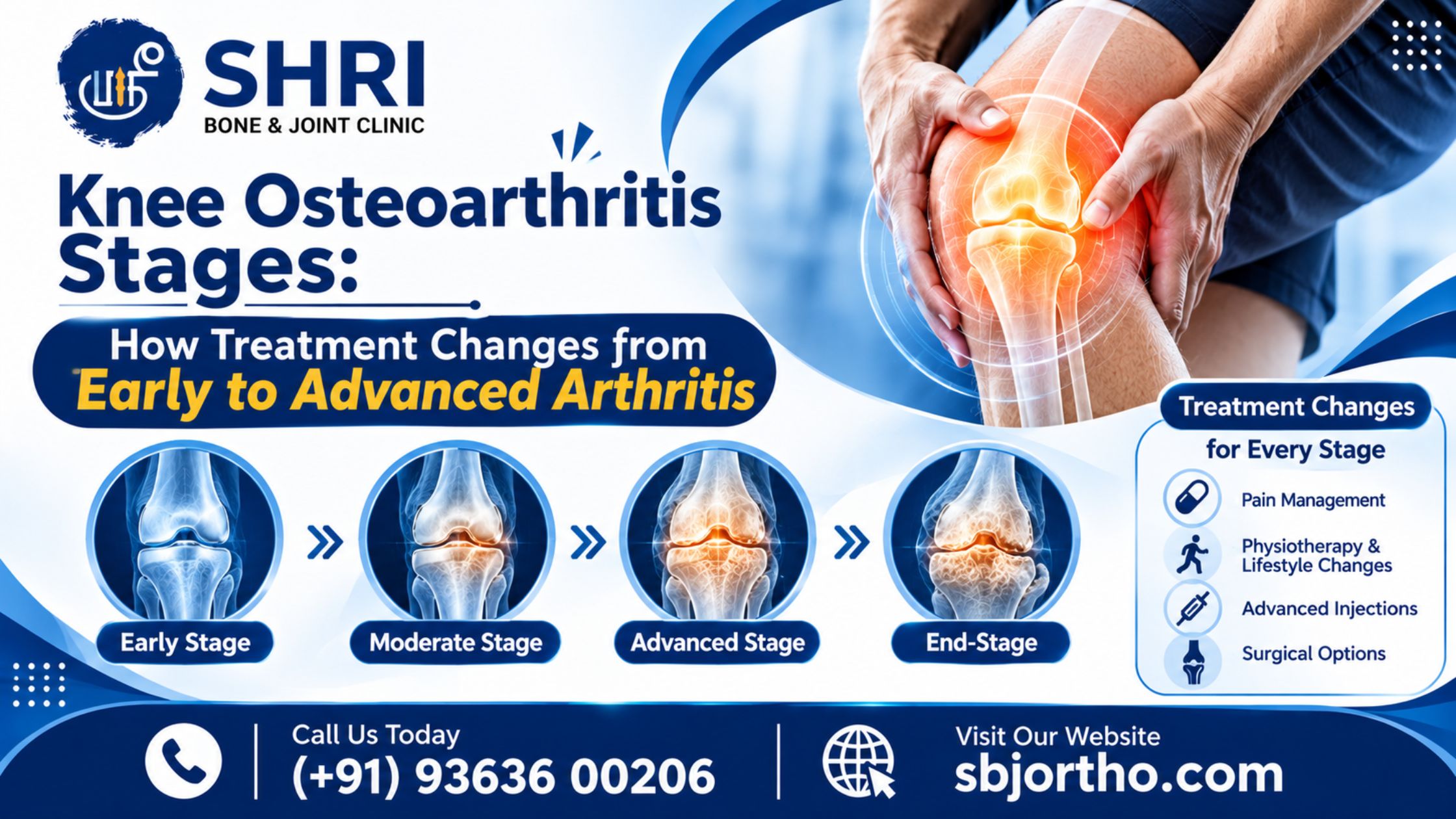
Knee osteoarthritis is a progressive joint condition that affects the cartilage, bones, and surrounding tissues of the knee. As the condition advances, patients may experience increasing pain, stiffness, swelling, and difficulty walking or performing everyday activities.
Knee osteoarthritis is commonly classified into four radiographic stages, from mild joint changes in Stage 1 to severe joint damage in Stage 4. Treatment generally begins with exercise, physiotherapy, weight management, and pain relief strategies. In advanced cases, knee replacement surgery may be considered when symptoms significantly affect daily life despite appropriate non-surgical treatment.
However, the severity of arthritis seen on an X-ray does not always match the patient’s symptoms. Some people with advanced joint changes experience manageable discomfort, while others with relatively mild changes have significant pain.
Understanding the different stages of knee osteoarthritis can help patients recognise symptoms, explore appropriate treatment options, and make informed decisions about long-term joint care.
Understanding the Four Stages of Knee Osteoarthritis
Knee osteoarthritis develops when the tissues within the joint undergo gradual structural changes.
Although cartilage deterioration is a major feature, osteoarthritis affects the entire joint, including the underlying bone, joint lining, ligaments, and surrounding muscles.
Healthy cartilage provides a smooth surface that allows the thigh bone and shin bone to move against each other with minimal friction.
As osteoarthritis progresses, cartilage may become thinner, the underlying bone may change, and bony growths called osteophytes may develop.
These changes can contribute to pain, stiffness, inflammation, and reduced joint mobility.
How Are Knee Osteoarthritis Stages Classified?
Doctors commonly use the Kellgren–Lawrence grading system to describe osteoarthritis changes visible on knee X-rays.
This system ranges from Grade 0 to Grade 4.
- Grade 0: No radiographic evidence of osteoarthritis.
- Grade 1: Doubtful or very early changes.
- Grade 2: Definite osteophytes with possible joint-space narrowing.
- Grade 3: Multiple osteophytes, definite joint-space narrowing, and possible bone changes.
- Grade 4: Severe joint-space narrowing, substantial osteophytes, and marked bone changes.
In everyday discussions, Grades 1–4 are often described as the four stages of knee osteoarthritis.
These grades describe structural findings on imaging. They do not independently determine how much pain a patient experiences or which treatment is necessary.
Stage 1 Knee Osteoarthritis: Very Early Joint Changes
Stage 1 represents doubtful or very early radiographic changes associated with knee osteoarthritis.
At this stage, an X-ray may show a small or questionable osteophyte, while the joint space generally appears preserved.
Many patients experience little or no discomfort.
Common Symptoms of Stage 1 Knee Osteoarthritis
Symptoms may include:
- Occasional knee discomfort after prolonged activity.
- Mild stiffness after sitting.
- Temporary discomfort while climbing stairs.
- Slight difficulty after strenuous exercise.
- No noticeable symptoms in some patients.
Because the changes are minimal, knee pain at this stage may also be caused by other conditions.
A clinical examination is important before attributing symptoms to osteoarthritis.
What Happens Inside the Knee During Stage 1?
Early structural changes may begin within the cartilage and surrounding joint tissues.
However, these changes may not be clearly visible on standard X-rays.
There is generally no substantial joint-space narrowing at this stage.
Is Stage 1 Knee Osteoarthritis Reversible?
Osteoarthritis-related structural changes are not reliably reversed through medication, exercise, or supplements.
However, early symptoms can often be managed effectively.
Maintaining muscle strength, healthy body weight, and regular physical activity may help reduce joint stress and improve long-term function.
Stage 1 does not necessarily progress rapidly to advanced arthritis.
Stage 2 Knee Osteoarthritis: Mild Arthritis
Stage 2 is commonly described as mild knee osteoarthritis.
X-rays typically show definite osteophytes, with possible narrowing of the joint space.
Some patients begin experiencing more noticeable symptoms during daily activities.
Common Symptoms of Stage 2 Knee Osteoarthritis
Patients may experience:
- Knee pain after prolonged walking.
- Stiffness after periods of inactivity.
- Discomfort while climbing stairs.
- Mild swelling after physical activity.
- Difficulty squatting or kneeling.
- Occasional grinding or clicking sensations.
Symptoms may fluctuate, with periods of relative comfort followed by temporary flare-ups.
What Happens Inside the Knee During Stage 2?
Structural changes become more apparent.
Osteophytes are visible on X-rays, and the joint space may begin to narrow.
Changes in the cartilage, underlying bone, and joint lining can contribute to discomfort.
However, the degree of structural change does not always predict symptom severity.
Can Stage 2 Knee Osteoarthritis Be Managed Without Surgery?
Yes. Most patients with mild knee osteoarthritis are managed without surgery.
Treatment usually focuses on improving muscle strength, reducing pain, maintaining mobility, and addressing factors that increase joint loading.
Physiotherapy and regular therapeutic exercise are important components of treatment.
Stage 3 Knee Osteoarthritis: Moderate Arthritis
Stage 3 represents more established structural changes within the knee joint.
X-rays commonly show definite joint-space narrowing, multiple osteophytes, and possible changes in the underlying bone.
Patients may experience more persistent symptoms and greater difficulty performing everyday activities.
Common Symptoms of Stage 3 Knee Osteoarthritis
Symptoms may include:
- Frequent knee pain during walking.
- Difficulty climbing or descending stairs.
- Stiffness after sitting or resting.
- Reduced knee bending or straightening.
- Recurrent swelling.
- Difficulty standing for prolonged periods.
- Reduced walking endurance.
- Increasing limitations in daily activities.
Some patients may also notice changes in walking patterns or knee alignment.
What Happens Inside the Knee During Stage 3?
Cartilage loss and changes in the underlying bone become more pronounced.
The joint space is visibly narrowed on X-rays.
Osteophytes may become larger, and the joint may show changes in alignment or shape.
Surrounding muscles may weaken because patients reduce activity to avoid discomfort.
This muscle weakness can further affect joint stability and function.
Does Stage 3 Knee Osteoarthritis Require Surgery?
Not necessarily.
Many patients with moderate knee osteoarthritis continue to benefit from non-surgical treatment.
The decision depends on pain severity, functional limitations, response to previous treatments, and patient preferences.
Surgery may be discussed when symptoms remain significant despite an appropriate treatment programme.
An X-ray grade alone is not a reason to proceed with knee replacement.
Stage 4 Knee Osteoarthritis: Severe or Advanced Arthritis
Stage 4 represents severe radiographic knee osteoarthritis.
X-rays typically show marked joint-space narrowing, substantial osteophytes, and significant changes in the underlying bone.
Patients may experience major limitations in mobility and daily activities.
Common Symptoms of Stage 4 Knee Osteoarthritis
Symptoms may include:
- Severe or persistent knee pain.
- Pain during short-distance walking.
- Significant joint stiffness.
- Difficulty standing from a chair.
- Reduced ability to climb stairs.
- Limited knee movement.
- Recurrent swelling.
- Bow-legged or knock-kneed deformity.
- Sleep disturbance due to pain.
- Reduced independence in everyday activities.
Not every patient experiences all these symptoms.
Some individuals with severe X-ray changes remain relatively functional, while others have substantial disability.
What Happens Inside the Knee During Stage 4?
The joint may show extensive cartilage loss, substantial narrowing of the space between bones, and changes in the underlying bone.
The knee may also develop deformity and restricted movement.
In advanced cases, the joint surfaces may have areas where little cartilage remains.
However, the commonly used phrase “bone-on-bone arthritis” is a simplified description rather than a complete explanation of the condition.
Is Knee Replacement Necessary for Stage 4 Osteoarthritis?
Knee replacement may be appropriate for patients with severe arthritis who experience persistent pain and significant functional limitations despite suitable non-surgical treatment.
However, Stage 4 findings do not automatically mean surgery is necessary.
The decision should consider:
- Pain severity.
- Walking ability.
- Sleep disturbance.
- Impact on daily activities.
- Response to physiotherapy and medication.
- Medical fitness.
- Patient goals and preferences.
Patients with advanced arthritis but manageable symptoms may continue with non-surgical care.
Knee Osteoarthritis Stages Comparison
| Feature | Stage 1 | Stage 2 | Stage 3 | Stage 4 |
| Severity | Very early | Mild | Moderate | Severe |
| X-ray findings | Doubtful osteophytes | Definite osteophytes | Definite joint-space narrowing | Marked joint-space narrowing and bone changes |
| Pain | Often absent or occasional | Mild or intermittent | More frequent | May be severe or persistent |
| Stiffness | Minimal | Mild | More noticeable | May be substantial |
| Walking difficulty | Usually minimal | Occasional | Increasing limitations | May significantly affect mobility |
| Physiotherapy | Useful when symptomatic | Core treatment | Core treatment | Often useful for symptom management |
| Surgery | Generally not indicated | Generally not indicated | Considered in selected cases | Considered when symptoms remain disabling |
These are general patterns. Symptoms and treatment needs vary considerably between individuals.
Can Knee Osteoarthritis Progress from Stage 1 to Stage 4?
Knee osteoarthritis can progress over time, but the rate varies significantly.
Some patients experience gradual changes over many years, while others develop more rapid structural deterioration.
Progression is influenced by several factors, including:
- Age.
- Previous knee injuries.
- Body weight.
- Joint alignment.
- Muscle weakness.
- Genetics.
- Occupational and physical demands.
- Other joint or metabolic conditions.
Not everyone with early osteoarthritis progresses to Stage 4.
Appropriate exercise, weight management, and treatment of symptoms can help maintain function and may reduce certain factors associated with progression.
How Do Doctors Diagnose the Stage of Knee Osteoarthritis?
Diagnosis begins with a clinical assessment rather than an X-ray alone.
The orthopedic specialist may evaluate:
Medical History
The doctor asks about pain, stiffness, swelling, previous injuries, and limitations in daily activities.
Physical Examination
The examination assesses joint movement, tenderness, swelling, alignment, muscle strength, and walking ability.
X-rays
Weight-bearing knee X-rays are commonly used to evaluate joint-space narrowing, osteophytes, and bone changes.
Additional Imaging
MRI is not routinely necessary for diagnosing typical knee osteoarthritis, but it may be considered when symptoms suggest another condition or the diagnosis is uncertain.
Other Investigations
Blood tests or joint-fluid analysis may be required when inflammatory arthritis, infection, or another diagnosis is suspected.
Treatment decisions should reflect the patient’s symptoms and function alongside imaging findings.
Knee Osteoarthritis Treatment by Stage: From Early Care to Knee Replacement
Treatment for knee osteoarthritis changes according to symptom severity, functional limitations, joint damage, and response to previous care.
Early treatment focuses on maintaining mobility and reducing joint stress.
As symptoms become more persistent, treatment may involve a more structured rehabilitation programme, appropriate medication, and selected supportive interventions.
For patients with advanced arthritis and substantial disability, knee replacement surgery may become an option.
Importantly, treatment is not determined by the radiographic stage alone.
Stage 1 Knee Osteoarthritis Treatment: Protecting Joint Function
At this stage, treatment generally focuses on maintaining joint health and managing any symptoms.
Regular Low-Impact Exercise
Low-impact physical activities can help maintain joint movement and muscle strength.
Suitable options may include:
- Walking within comfortable limits.
- Stationary cycling.
- Swimming.
- Water-based exercise.
- Gentle mobility exercises.
Exercise should be adjusted according to symptoms and physical ability.
Strengthening the Muscles Around the Knee
The quadriceps, hamstrings, hip muscles, and calf muscles contribute to knee stability and movement.
Strengthening these muscles can improve function and reduce the physical demands placed on the joint.
Weight Management
For patients who are overweight, gradual weight reduction may reduce knee loading and improve symptoms.
Weight management should be approached through sustainable nutrition and physical activity rather than extreme dieting.
Activity Modification
Patients may benefit from adjusting activities that repeatedly trigger pain.
This does not mean avoiding all physical activity.
The goal is to remain active while managing excessive or poorly tolerated joint loading.
Stage 2 Knee Osteoarthritis Treatment: Physiotherapy and Symptom Contro
Mild osteoarthritis is generally managed through structured non-surgical treatment.
Physiotherapy for Knee Osteoarthritis
Physiotherapy may include:
- Quadriceps strengthening.
- Hip muscle strengthening.
- Knee mobility exercises.
- Balance training.
- Walking assessment.
- Functional movement training.
- Individualised home exercises.
The programme should be adjusted according to the patient’s pain, strength, and mobility.
Pain Relief Medication
Topical non-steroidal anti-inflammatory drugs (NSAIDs) are commonly considered for knee osteoarthritis when appropriate.
Oral NSAIDs may be used for selected patients after assessing risks related to the stomach, kidneys, heart, and other medical conditions.
Medication should be taken according to medical advice.
Heat and Cold Therapy
Heat may help relieve stiffness, while cold therapy may help manage temporary swelling or discomfort.
These methods provide symptom relief but do not reverse cartilage damage.
Supportive Devices
Some patients may benefit from a walking aid or appropriately selected knee brace.
These devices should be recommended according to the patient’s symptoms and functional requirements.
Stage 3 Knee Osteoarthritis Treatment: Managing Persistent Symptom
Moderate osteoarthritis may require a more comprehensive treatment programme.
The main goals are to reduce pain, improve walking ability, maintain muscle strength, and preserve independence.
Progressive Strength Training
Strength training remains important even when arthritis becomes more advanced.
Exercises may include:
- Seated knee extensions within a comfortable range.
- Sit-to-stand exercises.
- Supported mini-squats.
- Hip strengthening.
- Step-up exercises.
- Resistance-band exercises.
- Balance and stability training.
Exercise selection should be individualised.
Patients should avoid forcing painful movements or progressing resistance too quickly.
Aquatic Physiotherapy
Water-based exercise may be useful for patients who find land-based exercise uncomfortable.
Buoyancy reduces the amount of body weight supported by the joints during movement.
Aquatic exercise can help patients practise walking, mobility, and strengthening exercises in a supported environment.
It does not repair damaged cartilage, but it may improve pain and physical function.
Medication Review
Patients with persistent symptoms may require a review of their pain management.
Medication selection should consider other medical conditions, potential side effects, and previous treatment response.
Long-term opioid treatment is generally not recommended for routine knee osteoarthritis management because of limited sustained benefit and significant risks.
Intra-Articular Injections
Corticosteroid injections may provide short-term symptom relief for selected patients.
However, injections do not reverse osteoarthritis or reliably prevent the need for surgery.
The evidence supporting hyaluronic acid injections is inconsistent, and routine use is not recommended by several major guidelines.
Platelet-rich plasma and other biological injections remain areas of research, with recommendations varying across professional guidelines.
Patients should discuss the potential benefits, limitations, and costs before choosing injection-based treatment.
Surgical Evaluation When Necessary
Patients with substantial pain and disability despite appropriate treatment may be referred for surgical evaluation.
However, many people with Stage 3 osteoarthritis continue to manage their symptoms without knee replacement.
Stage 4 Knee Osteoarthritis Treatment: When Is Knee Replacement Considered?
Advanced knee osteoarthritis can significantly affect walking, sleep, mobility, and independence.
Non-surgical treatment may still provide symptom relief, but some patients continue to experience severe limitations.
In such cases, knee replacement surgery may be considered.
When Is Total Knee Replacement Recommended?
Total knee replacement may be appropriate when:
- Knee pain remains significant despite suitable treatment.
- Walking and daily activities are substantially restricted.
- Joint stiffness or deformity affects function.
- Sleep is regularly disturbed by knee pain.
- Imaging shows advanced joint damage.
- The patient understands the benefits and risks of surgery.
- Medical assessment indicates that surgery is reasonably appropriate.
The decision should be based on symptoms, function, clinical findings, and patient preferences rather than X-ray grading alone.
What Happens During Total Knee Replacement?
Total knee replacement involves removing the damaged joint surfaces and positioning artificial components.
The procedure generally includes:
- Assessing the knee joint and its alignment.
- Preparing the damaged surfaces of the thigh bone and shin bone.
- Positioning the artificial components.
- Evaluating knee stability and movement.
- Completing the procedure and beginning postoperative care.
The objective is to reduce arthritis-related pain and improve knee function.
Can Robotic Technology Be Used for Advanced Knee Osteoarthritis?
Yes. Robotic-assisted total knee replacement may be considered for selected patients with advanced knee osteoarthritis.
Robotic systems provide additional surgical measurements and guidance during selected steps of knee replacement.
Depending on the platform, robotic assistance may support:
- Patient-specific surgical planning.
- Bone preparation.
- Implant positioning.
- Knee alignment assessment.
- Joint balance evaluation.
However, robotic technology does not independently perform surgery or guarantee better long-term outcomes than well-performed conventional knee replacement.
The surgeon determines whether robotic assistance is appropriate.
Is Partial Knee Replacement an Option?
Some patients have advanced arthritis limited to one compartment of the knee.
In selected cases, partial knee replacement may be considered instead of total knee replacement.
Suitability depends on the location of joint damage, ligament condition, deformity, and other clinical factors.
Not every patient with advanced osteoarthritis is eligible for partial knee replacement.
Knee Osteoarthritis Treatment Options by Stage
| Treatment | Stage 1 | Stage 2 | Stage 3 | Stage 4 |
| Exercise and physiotherapy | Core approach when symptomatic | Core approach | Core approach | Often beneficial |
| Weight management | When appropriate | When appropriate | When appropriate | When appropriate |
| Activity modification | As needed | As needed | As needed | As needed |
| Pain medication | Occasionally needed | May be considered | Often considered | May be considered |
| Walking aids or braces | Occasionally | Selected patients | Selected patients | Selected patients |
| Joint injections | Usually unnecessary | Selected cases | May be considered | May provide temporary relief |
| Knee replacement | Generally not indicated | Generally not indicated | Selected patients with severe symptoms | Considered when symptoms remain disabling |
The table describes general treatment patterns. Individual treatment plans may differ.
Can Physiotherapy Prevent Knee Replacement Surgery?
Physiotherapy can improve pain, muscle strength, mobility, and physical function in people with knee osteoarthritis.
For some patients, these improvements may allow symptoms to be managed without surgery for a prolonged period.
However, physiotherapy does not regenerate lost cartilage or guarantee that knee replacement will never be required.
Its benefits depend on the patient’s condition, exercise programme, and consistency.
Even when surgery becomes necessary, maintaining muscle strength and physical fitness beforehand may support postoperative rehabilitation.
Which Exercises Are Best for Knee Osteoarthritis?
There is no single exercise that works best for every patient.
A balanced programme usually includes strengthening, aerobic activity, mobility, and functional training.
Quadriceps Strengthening
The quadriceps help support the knee during walking, standing, and stair climbing.
Exercises may include seated knee extensions and sit-to-stand movements.
Hip Strengthening
Strong hip muscles support lower-limb movement and balance.
Exercises may include supported side-leg raises and resistance-band movements.
Low-Impact Aerobic Exercise
Walking, cycling, and aquatic exercise can improve cardiovascular fitness and functional endurance.
Knee Mobility Exercises
Gentle bending and straightening exercises help maintain available joint movement.
Balance Training
Balance exercises may improve stability and confidence during everyday activities.
Patients with significant pain, instability, or other medical conditions should receive an individualised exercise programme.
Which Activities Should Patients With Knee Osteoarthritis Avoid?
Patients do not necessarily need to avoid all high-impact activities permanently.
However, activities that repeatedly trigger substantial pain or swelling may require modification.
Examples include:
- Repeated deep squatting when painful.
- Heavy lifting with poor technique.
- Sudden increases in running or jumping.
- Prolonged kneeling when uncomfortable.
- High-intensity exercise beyond current capacity.
Complete inactivity is generally not recommended.
The goal is to identify tolerable activities and gradually build strength and endurance.
Can Knee Osteoarthritis Be Cured Without Surgery?
There is currently no established non-surgical treatment that reliably restores damaged cartilage to its original condition or cures knee osteoarthritis.
However, many patients can manage symptoms successfully through exercise, physiotherapy, weight management, and appropriate medical treatment.
Even in advanced arthritis, symptom severity may fluctuate.
The focus should be on improving function, reducing pain, and maintaining quality of life.
How Quickly Does Knee Osteoarthritis Progress?
Osteoarthritis progression varies significantly.
Some patients remain at a similar level of structural damage for many years.
Others experience more noticeable deterioration over time.
Factors associated with progression may include:
- Previous joint injury.
- Obesity.
- Knee malalignment.
- Muscle weakness.
- Age.
- Genetic predisposition.
- Severity of existing joint damage.
Regular medical follow-up may be useful when symptoms change or functional limitations increase.
Repeated imaging is not always necessary unless it will influence treatment decisions.
When Should You Consult an Orthopedic Specialist?
An orthopedic assessment may be appropriate when:
- Knee pain persists for several weeks.
- Walking becomes increasingly difficult.
- The knee repeatedly swells.
- Stiffness limits daily activities.
- The knee appears progressively deformed.
- Pain affects sleep.
- Symptoms do not improve with appropriate treatment.
- The knee frequently gives way.
Sudden severe pain, a hot and markedly swollen joint, fever, or inability to bear weight after an injury requires prompt medical assessment because causes other than osteoarthritis may be present.
How to Decide Between Non-Surgical Treatment and Knee Replacement
The decision should consider both the structural condition of the knee and the patient’s quality of life.
Non-surgical treatment may remain appropriate when symptoms are manageable and daily function is reasonably preserved.
Knee replacement may become an option when persistent pain and disability remain substantial despite appropriate conservative care.
Patients should discuss:
- The severity of their symptoms.
- The extent of joint damage.
- Which non-surgical treatments have been attempted.
- The expected benefits of continued physiotherapy.
- Whether knee replacement is likely to improve function.
- Surgical risks and medical fitness.
- Rehabilitation requirements.
- Personal treatment goals.
The most appropriate treatment is the one that addresses the patient’s clinical needs and functional limitations.
Conclusion: Choosing the Right Treatment for Each Stage of Knee Osteoarthritis
Knee osteoarthritis can range from minimal structural changes to advanced joint damage. Although X-rays help describe the severity of arthritis, treatment decisions should always consider pain, mobility, daily activities, and individual health.
Early and moderate osteoarthritis is generally managed through physiotherapy, strengthening exercises, weight management, and appropriate pain relief. Advanced arthritis may require surgical evaluation when symptoms remain disabling despite non-surgical care.
Patients seeking Knee Osteoarthritis Treatment in Chennai can consult Shri Bone & Joint Clinic for an assessment of their symptoms, joint condition, and available treatment options.
Dr. Shriram Krishnamoorthy evaluates knee arthritis and helps patients understand when non-surgical care may be appropriate and when joint replacement should be considered. For eligible patients with advanced arthritis, Robotic Total Knee Replacement in Chennai may be discussed as a surgical option using the VELYS Robotic-Assisted Solution, which provides CT-free robotic guidance during selected knee replacement steps.
Shri Physio & Rehab also supports knee osteoarthritis management through individualised strengthening, mobility training, and rehabilitation programmes.
The goal at every stage is to reduce pain, maintain independence, and select treatment according to the patient’s symptoms and functional needs.
FAQs
1. What are the four stages of knee osteoarthritis?
The four commonly described stages range from very early joint changes in Stage 1 to severe structural damage in Stage 4. Stage 2 generally shows definite osteophytes, while Stage 3 includes more noticeable joint-space narrowing. Stage 4 involves marked narrowing and substantial bone changes. These stages describe X-ray findings and do not always match symptom severity.
2. Can Stage 2 knee osteoarthritis be treated without surgery?
Yes. Stage 2 knee osteoarthritis is usually managed without surgery. Treatment commonly includes physiotherapy, strengthening exercises, weight management, activity modification, and appropriate pain relief medication. Many patients can maintain good mobility and manage symptoms effectively with a consistent treatment programme.
3. Does Stage 3 knee osteoarthritis always progress to Stage 4?
No. Osteoarthritis progression varies considerably between individuals. Some patients remain stable for years, while others experience further structural changes. Factors such as body weight, previous injuries, joint alignment, and existing damage may influence progression. Exercise and symptom management remain important regardless of the stage.
4. Is knee replacement compulsory for Stage 4 osteoarthritis?
No. Stage 4 osteoarthritis does not automatically require knee replacement. Surgery is generally considered when severe pain and functional limitations persist despite appropriate non-surgical treatment. Patients with advanced X-ray changes but manageable symptoms may continue conservative care after discussing their options with an orthopedic specialist.
5. Can physiotherapy reverse knee osteoarthritis?
Physiotherapy cannot reliably regenerate damaged cartilage or reverse established structural osteoarthritis. However, it can improve muscle strength, joint mobility, balance, and physical function while reducing symptoms. For many patients, regular therapeutic exercise is one of the most effective components of long-term osteoarthritis management.