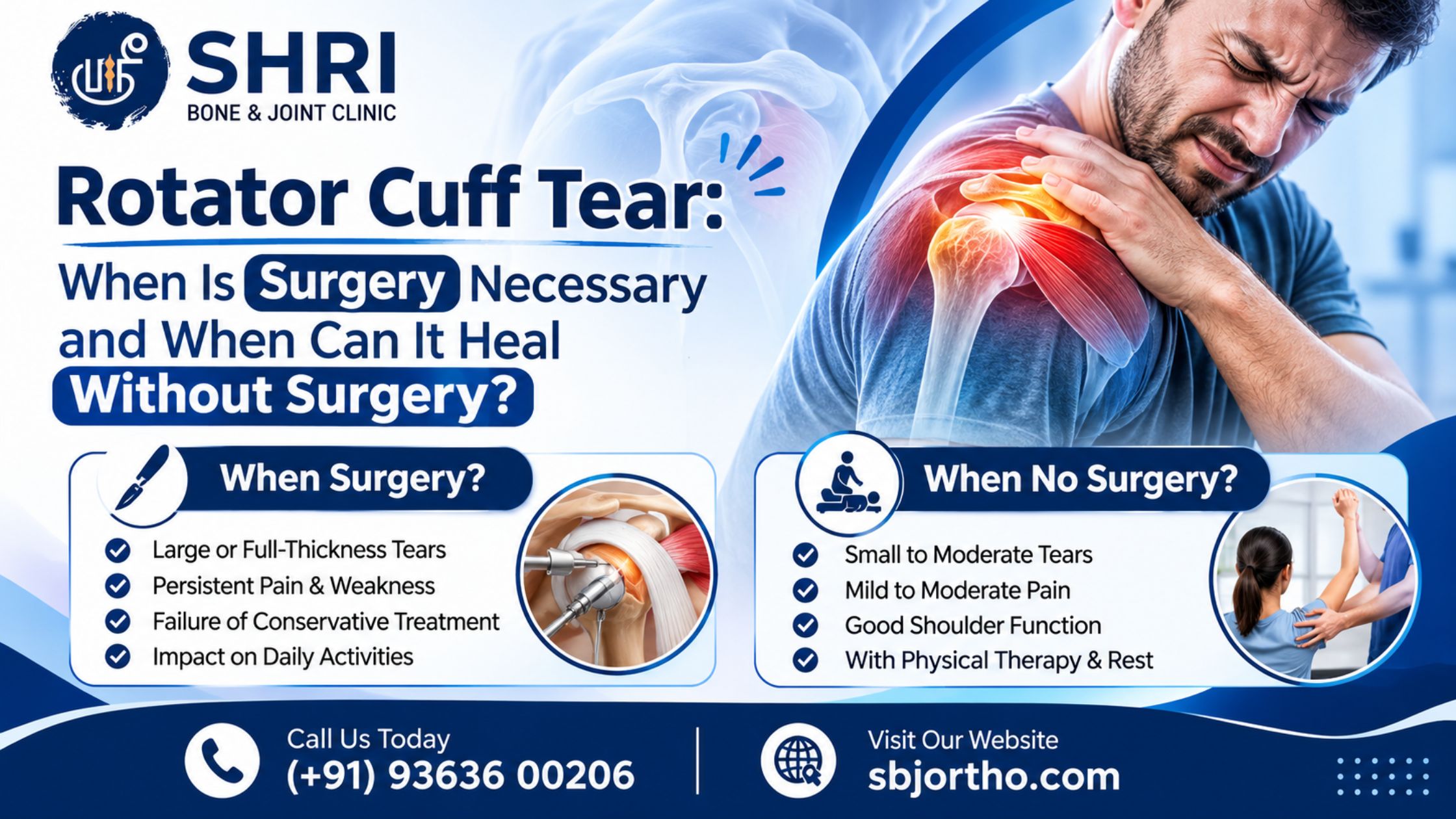
A rotator cuff tear is a common shoulder injury that can cause pain, weakness, restricted movement, and difficulty performing everyday activities. It may develop gradually due to tendon degeneration or occur suddenly following a fall, heavy lifting, or another shoulder injury.
Not every rotator cuff tear requires surgery. Many patients, particularly those with small, partial-thickness, or degenerative tears, can improve through physiotherapy, activity modification, and appropriate pain management. However, some tears may require surgical repair, especially when they occur after an injury, cause significant weakness, or continue to affect daily activities despite suitable non-surgical treatment.
An important distinction is that improvement without surgery does not always mean the torn tendon has healed anatomically. Many patients regain strength and function even when the structural tear remains.
The decision between surgery and conservative treatment depends on the tear’s size, location, severity, cause, symptoms, and the patient’s age, activity requirements, and overall health.
Understanding when a rotator cuff tear can be managed without surgery and when surgical repair may be necessary can help patients make informed treatment decisions.
Understanding Rotator Cuff Tears: Types, Symptoms and Non-Surgical Treatment
The rotator cuff is a group of four muscles and their tendons that surround the shoulder joint.
These muscles help stabilise the shoulder and control movements such as lifting, rotating, and reaching with the arm.
The four rotator cuff muscles are:
- Supraspinatus: Helps initiate arm elevation and supports shoulder stability.
- Infraspinatus: Assists with external rotation of the arm.
- Teres Minor: Supports external rotation and shoulder stability.
- Subscapularis: Helps rotate the arm inward.
A rotator cuff tear occurs when one or more of these tendons become partially or completely damaged.
The supraspinatus tendon is commonly affected.
What Causes a Rotator Cuff Tear?
Rotator cuff tears generally develop through two main mechanisms.
Degenerative Rotator Cuff Tears
Degenerative tears develop gradually as tendon tissue changes over time.
Age-related tendon changes, repetitive loading, and reduced tissue resilience may contribute to the condition.
These tears are more common in middle-aged and older adults.
Some degenerative tears develop without a specific injury.
Traumatic Rotator Cuff Tears
Traumatic tears occur following a sudden injury.
Common causes include:
- Falling onto an outstretched arm.
- Lifting a heavy object unexpectedly.
- A sudden forceful shoulder movement.
- Sports-related injuries.
- Shoulder dislocation.
- Direct trauma to the shoulder.
Acute traumatic tears, particularly those associated with sudden weakness, require timely medical assessment.
What Are the Different Types of Rotator Cuff Tears?
Rotator cuff tears are classified according to the extent of tendon damage.
Partial-Thickness Rotator Cuff Tear
A partial-thickness tear affects part of the tendon without extending through its entire thickness.
The tendon remains partially attached.
Symptoms vary depending on the tear’s location, depth, and associated inflammation.
Many partial-thickness tears can be managed without surgery.
However, persistent symptoms or high-grade tears may require further evaluation.
Full-Thickness Rotator Cuff Tea
A full-thickness tear extends through the entire thickness of the tendon.
This may create a complete defect in the tendon tissue.
Full-thickness tears vary in size, and not all cause severe symptoms.
Some patients maintain good shoulder function through compensation by surrounding muscles.
However, a full-thickness tear generally does not spontaneously reattach to its original bone attachment.
Massive Rotator Cuff Tear
A massive rotator cuff tear typically involves substantial tendon damage, often affecting multiple tendons or involving a large tear.
These injuries may cause significant weakness and reduced shoulder function.
Some massive tears are repairable, while others become difficult to repair because of tendon retraction, poor tissue quality, or muscle degeneration.
Treatment depends on the patient’s symptoms, anatomy, and functional requirements.
Partial vs Full-Thickness Rotator Cuff Tear
| Feature | Partial-Thickness Tear | Full-Thickness Tear |
| Tendon damage | Affects part of the tendon thickness | Extends through the entire tendon thickness |
| Tendon attachment | Partially preserved | May be disrupted across the full thickness |
| Pain | May be mild to severe | May be mild to severe |
| Weakness | Variable | May be more noticeable |
| Physiotherapy | Common first-line treatment | Often appropriate for selected patients |
| Natural tendon healing | Structural healing is unpredictable | Spontaneous reattachment is generally unlikely |
| Surgery | Considered for selected persistent or high-grade tears | Considered based on symptoms, injury type, size, and function |
The size of the tear does not always correspond directly to the amount of pain.
What Are the Symptoms of a Rotator Cuff Tear?
Rotator cuff tears can produce a range of symptoms.
Common symptoms include:
- Shoulder pain during arm elevation.
- Difficulty reaching overhead.
- Weakness while lifting objects.
- Pain when lying on the affected shoulder.
- Difficulty reaching behind the back.
- Reduced shoulder movement.
- Discomfort during dressing or bathing.
- Pain during sports or occupational activities.
- Difficulty performing repetitive shoulder movements.
Some patients experience significant weakness without severe pain.
Others may have a rotator cuff tear visible on imaging but experience few or no symptoms.
How Is a Rotator Cuff Tear Diagnosed?
Diagnosis involves clinical assessment and, when appropriate, imaging.
Medical History
The doctor evaluates:
- When the pain started.
- Whether an injury occurred.
- The presence of weakness.
- Activities that aggravate symptoms.
- Night pain.
- Previous shoulder problems.
- Occupational and sporting demands.
Physical Examination
The examination may assess:
- Active and passive shoulder movement.
- Rotator cuff strength.
- Pain during resisted movements.
- Shoulder stability.
- Functional limitations.
- Possible neck-related symptoms.
Ultrasound
Ultrasound can help identify rotator cuff tendon abnormalities and certain tears.
Its accuracy depends partly on the examiner’s experience and the characteristics of the tear.
MRI Scan
MRI provides detailed information about the rotator cuff tendons and surrounding shoulder structures.
It may help assess:
- Tear size.
- Tear location.
- Tendon retraction.
- Muscle quality.
- Associated injuries.
- Surgical repairability.
MRI is particularly useful when a substantial tear is suspected or surgery is being considered.
X-rays
X-rays do not directly show most rotator cuff tears.
However, they can identify arthritis, fractures, bone changes, and other conditions that may contribute to shoulder symptoms.
Can a Rotator Cuff Tear Heal Without Surgery?
The answer depends on what is meant by healing.
There is an important difference between structural tendon healing and functional recovery.
Structural healing means that the damaged tendon tissue repairs or reattaches.
Functional recovery means that pain decreases and the patient regains movement, strength, and the ability to perform daily activities.
Many patients experience functional recovery without surgery.
However, full-thickness rotator cuff tears generally do not reattach to the bone naturally.
Partial-thickness tears may remain stable, improve symptomatically, or progress over time.
Non-surgical treatment aims to improve shoulder function and manage symptoms, even when the tear remains visible on imaging.
Which Rotator Cuff Tears Can Be Treated Without Surgery?
Non-surgical treatment may be appropriate for:
Small Partial-Thickness Tears
Patients with limited tendon damage and manageable symptoms may respond well to physiotherapy.
Degenerative Tears
Some age-related tears can be managed through strengthening and activity modification.
Tears Without Significant Weakness
Patients who retain good shoulder movement and strength may not require immediate surgery.
Patients With Manageable Symptoms
When pain does not substantially interfere with daily activities, conservative treatment may be appropriate.
Patients With Higher Surgical Risks
Some patients may benefit more from symptom management when medical conditions increase the risks of surgery.
Patients Who Prefer Non-Surgical Care
Patient preferences are important when non-surgical treatment is medically reasonable.
The decision should be based on the full clinical assessment rather than tear size alone.
What Is the Best Non-Surgical Treatment for a Rotator Cuff Tear?
Non-surgical treatment usually combines exercise-based rehabilitation, symptom management, and adjustments to activities that aggravate the shoulder.
1. Physiotherapy
Physiotherapy is a central component of conservative treatment.
The programme may focus on:
- Improving comfortable shoulder movement.
- Strengthening the remaining functional rotator cuff.
- Strengthening shoulder blade muscles.
- Improving shoulder stability.
- Restoring functional reaching and lifting.
- Gradually increasing activity tolerance.
Exercises should be selected according to the tear characteristics and symptoms.
2. Activity Modification
Patients may need to temporarily reduce activities that aggravate symptoms.
Examples include:
- Repetitive heavy overhead lifting.
- Sudden forceful pulling.
- Lifting heavy objects away from the body.
- Painful gym exercises.
- Repetitive movements that trigger prolonged discomfort.
Complete inactivity is generally not recommended.
The goal is to maintain comfortable movement while avoiding excessive loading.
3. Pain Management
Appropriate pain relief may help patients participate in rehabilitation.
Depending on the patient’s medical condition, treatment may include:
- Topical anti-inflammatory medication.
- Oral pain medication when appropriate.
- Cold therapy during painful flare-ups.
- Temporary adjustments to activity.
Medication should be used according to medical advice.
4. Corticosteroid Injections
A corticosteroid injection may provide short-term pain relief for selected patients.
However, injections do not repair a torn tendon.
Repeated injections may have adverse effects on tendon tissue and may complicate future surgical planning.
Their use should be carefully considered, particularly when tendon repair may be necessary.
5. Progressive Strengthening
Strengthening exercises help improve the shoulder’s ability to tolerate daily activities.
The programme may include:
- Isometric shoulder exercises.
- Resistance-band external rotation.
- Resistance-band internal rotation.
- Scapular strengthening.
- Supported shoulder elevation.
- Functional lifting exercises.
Resistance should increase gradually according to symptoms and physical capacity.
Which Exercises Help a Rotator Cuff Tear?
Exercises depend on the severity of the tear and the patient’s functional limitations.
Commonly used rehabilitation exercises include:
Pendulum Exercises
Gentle pendulum movements can help maintain shoulder mobility when active movement is uncomfortable.
Isometric Rotator Cuff Exercises
Isometric exercises activate the shoulder muscles without substantial joint movement.
They may be useful during early rehabilitation.
Resistance-Band External Rotation
This exercise strengthens muscles that help control outward rotation of the arm.
It should be introduced only when the movement and resistance are appropriate for the injury.
Scapular Retraction
Gentle shoulder blade exercises can improve muscular control around the upper back.
Supported Shoulder Flexion
Assisted arm elevation may help maintain movement without placing excessive demands on the injured tendon.
Important: Patients with an acute traumatic tear, sudden loss of strength, or substantial tendon damage should not begin an unsupervised strengthening programme before appropriate assessment.
How Long Does a Rotator Cuff Tear Take to Improve Without Surgery?
The time required for improvement varies according to the tear, symptoms, physical demands, and rehabilitation programme.
Some patients notice reduced pain within several weeks.
Meaningful improvements in strength and function may require several months.
| Rehabilitation Period | General Treatment Focus |
| Weeks 1–2 | Symptom management, gentle mobility, activity modification |
| Weeks 3–6 | Controlled movement, initial strengthening |
| Weeks 6–12 | Progressive rotator cuff and scapular strengthening |
| Months 3–6 | Functional strengthening and gradual return to demanding activities |
| Beyond 6 months | Continued exercise and long-term symptom management when necessary |
These are general rehabilitation stages rather than guaranteed recovery timelines.
A reduction in symptoms does not necessarily indicate that the tendon has structurally healed.
Can a Rotator Cuff Tear Get Worse Without Surgery?
Yes. Some rotator cuff tears enlarge over time.
Progression is more likely in certain full-thickness and degenerative tears, although not every tear worsens.
Potential changes include:
- Increasing tear size.
- Tendon retraction.
- Muscle weakness.
- Fatty degeneration of the rotator cuff muscles.
- Reduced shoulder function.
- Greater difficulty with surgical repair in some cases.
However, tear progression does not occur at the same rate in every patient.
Regular clinical review may be appropriate when symptoms worsen or a significant tear is being managed without surgery.
When Is Rotator Cuff Surgery Necessary? Benefits, Recovery and Treatment Decisions
Surgery may be considered when a rotator cuff tear causes substantial functional limitations, when appropriate non-surgical treatment has not provided sufficient improvement, or when the nature of the injury makes early repair advisable.
The decision is individualised.
Not every full-thickness tear requires surgery, and not every partial-thickness tear can be managed successfully without it.
When Do Doctors Recommend Rotator Cuff Repair Surgery?
Several clinical situations may support surgical evaluation.
1. Acute Traumatic Rotator Cuff Tear
A sudden tear following a fall or other injury may require timely assessment.
This is particularly important when the patient experiences immediate weakness or difficulty lifting the arm.
Early surgical evaluation may be beneficial for selected traumatic full-thickness tears because prolonged delay can allow tendon retraction and muscle changes.
Not every traumatic tear requires surgery, but significant injuries should not be ignored.
2. Persistent Pain Despite Physiotherapy
Surgery may be considered when shoulder pain remains substantial despite an appropriate period of structured non-surgical treatment.
The surgeon evaluates whether the symptoms are likely to improve with tendon repair.
3. Significant Shoulder Weakness
Patients with marked weakness may struggle to lift the arm, carry objects, or perform essential daily activities.
A repairable tear associated with significant functional weakness may warrant surgical consideration.
4. Large or Full-Thickness Tears
Larger tears may be more likely to cause weakness or progress over time.
However, tear size alone does not determine whether surgery is necessary.
The patient’s symptoms, activity level, tendon quality, and repairability must also be considered.
5. Progressive Tear Enlargement
Some patients experience increasing tear size or worsening function during conservative treatment.
Surgical repair may be discussed when progression threatens long-term shoulder function.
6. High Functional Demands
Younger or physically active patients who require substantial shoulder strength for work or sports may benefit from surgical evaluation.
The decision depends on the injury and the expected benefits of repair.
7. Failure of Appropriate Conservative Treatment
Patients who continue to experience substantial pain, weakness, or disability after a suitable rehabilitation programme may be considered for surgery.
The duration of conservative treatment varies according to the tear and clinical circumstances.
When Is Rotator Cuff Surgery Usually Not Necessary?
Surgery may not be required when:
- The tear is small and symptoms are manageable.
- Shoulder strength and movement remain satisfactory.
- The patient responds well to physiotherapy.
- The tear is degenerative and does not substantially affect function.
- Surgical risks outweigh the expected benefits.
- The patient prefers continued non-surgical management after understanding the options.
Some patients with full-thickness tears maintain good shoulder function without surgery.
Treatment should focus on the patient’s symptoms and goals rather than imaging findings alone.
Rotator Cuff Surgery vs Non-Surgical Treatment
| Comparison Factor | Non-Surgical Treatment | Rotator Cuff Repair Surgery |
| Primary goal | Reduce pain and improve function | Reattach repairable torn tendon tissue |
| Common approach | Physiotherapy, activity modification, medication | Surgical tendon repair followed by rehabilitation |
| Structural tendon repair | Not reliably achieved | Intended to restore tendon attachment |
| Best suited for | Selected partial, degenerative, or manageable tears | Selected traumatic, symptomatic, or functionally significant tears |
| Recovery | Gradual strengthening over weeks to months | Tendon protection followed by several months of rehabilitation |
| Risks | Persistent symptoms or tear progression | Infection, stiffness, retear, anaesthesia-related risks |
| Rehabilitation | Usually required | Essential after surgery |
| Long-term outcomes | Many patients achieve meaningful improvement | Many patients improve, but healing and outcomes vary |
Neither approach is universally better.
The decision depends on tear characteristics, symptoms, medical fitness, and patient priorities.
How Is Rotator Cuff Repair Surgery Performed?
Rotator cuff repair is commonly performed using an arthroscopic technique, although some cases require mini-open or open surgery.
The exact procedure depends on the tear size, tendon quality, and associated shoulder conditions.
Step 1: Anaesthesia
The patient receives appropriate anaesthesia.
Regional nerve blocks may also be used for postoperative pain management.
Step 2: Shoulder Assessment
The surgeon examines the damaged tendon and surrounding shoulder structures.
Additional injuries may be identified during the procedure.
Step 3: Tendon Preparation
The surgeon prepares the torn tendon and its attachment site.
The goal is to position repairable tendon tissue appropriately against the bone.
Step 4: Tendon Reattachment
Sutures and specialised fixation devices, commonly called suture anchors, may be used to secure the tendon to the bone.
The repair technique depends on the tear pattern and tissue quality.
Step 5: Surgical Closure
The surgical incisions are closed.
The arm is commonly supported in a sling after surgery.
Step 6: Postoperative Rehabilitation
Rehabilitation follows a structured programme designed to protect the repair while gradually restoring movement and strength.
Patients should not begin unrestricted shoulder exercises immediately after tendon repair.
Is Arthroscopic Rotator Cuff Surgery Better Than Open Surgery?
Arthroscopic surgery uses a camera and specialised instruments inserted through small incisions.
It allows the surgeon to examine and repair selected tendon injuries without a large open incision.
Potential advantages include smaller incisions and reduced disruption of some superficial tissues.
However, the most suitable approach depends on:
- Tear size and complexity.
- Tendon quality.
- Associated injuries.
- Previous surgery.
- Surgeon expertise.
Both arthroscopic and open techniques can be effective in appropriately selected cases.
What Are the Benefits of Rotator Cuff Repair Surgery?
The main objective of surgery is to restore the attachment of repairable torn tendon tissue.
Potential benefits include:
Improved Shoulder Strength
Successful repair and rehabilitation may improve the shoulder’s ability to lift and rotate the arm.
Reduced Pain
Many patients experience meaningful pain reduction following recovery.
Improved Functional Movement
Surgery may help patients regain the ability to perform daily activities that were limited by the tear.
Restoration of Tendon Continuity
Unlike symptom-focused conservative treatment, repair surgery attempts to restore the tendon attachment.
Potential Reduction in Further Structural Deterioration
Successful repair may help preserve tendon function in selected patients.
However, surgery does not guarantee complete healing, normal strength, or freedom from future tendon problems.
What Are the Risks of Rotator Cuff Repair Surgery?
Potential complications include:
- Infection.
- Bleeding.
- Shoulder stiffness.
- Persistent pain.
- Nerve or blood vessel injury.
- Anaesthesia-related complications.
- Failure of tendon healing.
- Retear of the repaired tendon.
- Continued weakness.
- Need for additional surgery.
The risk of retear may be higher with larger tears, poor tendon quality, advanced muscle degeneration, and certain patient-related factors.
The surgeon should explain the expected benefits and individual risks before surgery.
How Long Does Recovery Take After Rotator Cuff Surgery?
Recovery after rotator cuff repair generally takes several months.
The repaired tendon requires time to heal to the bone, and rehabilitation must progress carefully.
The timeline depends on the tear size, repair technique, tissue quality, and surgeon’s instructions.
| Recovery Period | General Rehabilitation Focus |
| Weeks 0–6 | Protection of the repair, sling use as prescribed, controlled movement according to protocol |
| Weeks 6–12 | Gradual progression of shoulder movement when cleared |
| Months 3–4 | Progressive strengthening when appropriate |
| Months 4–6 | Functional strengthening and gradual return to selected activities |
| Months 6–12 | Continued recovery of strength, endurance, and higher-demand function |
These are broad estimates rather than fixed milestones.
Some large or complex repairs require longer protection and rehabilitation.
Patients should follow the treating surgeon’s specific postoperative protocol.
Why Is Physiotherapy Important After Rotator Cuff Surgery?
Physiotherapy supports recovery after tendon repair.
However, the early rehabilitation programme differs substantially from exercises used for non-surgical rotator cuff treatment.
Following surgery, the repaired tendon must be protected while healing.
Rehabilitation may progress through several phases.
Protection Phase
The arm may be supported in a sling.
Only permitted movements are performed.
Mobility Phase
Controlled passive or assisted movements may be introduced according to the surgeon’s instructions.
Strengthening Phase
Gradual strengthening begins when the repair has healed sufficiently and the surgeon permits increased loading.
Functional Recovery Phase
Patients progressively return to daily activities, occupational tasks, and recreational movements.
Premature heavy lifting or aggressive stretching may place unnecessary stress on the repair.
What Happens if a Full-Thickness Rotator Cuff Tear Is Left Untreated?
Some full-thickness tears remain relatively stable and can be managed successfully without surgery.
Others may enlarge over time.
Potential consequences of progression include:
- Increasing shoulder weakness.
- Reduced overhead function.
- Tendon retraction.
- Muscle atrophy.
- Fatty degeneration.
- Reduced repairability.
- Development of rotator cuff tear arthropathy in some longstanding massive tears.
However, these changes do not occur in every patient.
The decision to continue non-surgical treatment should involve discussion of symptoms, functional requirements, tear characteristics, and the potential risk of progression.
Can a Complete Rotator Cuff Tear Heal on Its Own?
A complete full-thickness tear generally does not spontaneously reattach to its original bone attachment.
However, this does not mean that every complete tear requires surgery.
Some patients regain satisfactory shoulder function through strengthening of the remaining muscles and appropriate rehabilitation.
The distinction between structural healing and functional improvement is important.
Patients should discuss both the expected symptom improvement and the risk of tear progression with their orthopedic specialist.
Is Surgery Necessary for a Small Rotator Cuff Tear?
Small tears are often initially managed without surgery, particularly when they develop gradually and do not cause substantial weakness.
Physiotherapy and activity modification may provide meaningful symptom relief.
However, even a relatively small tear may require surgical evaluation if it follows an acute injury, causes significant weakness, or remains highly symptomatic despite appropriate treatment.
The decision should be individualised.
Does Age Affect the Decision to Undergo Rotator Cuff Surgery?
Age is one factor considered during treatment planning, but it does not independently determine whether surgery is appropriate.
Younger, active patients with traumatic tears may be more likely to benefit from early surgical evaluation.
Older adults may also benefit from repair when the tendon is suitable and symptoms significantly affect function.
However, age-related tendon degeneration, muscle changes, medical conditions, and rehabilitation capacity can influence outcomes.
The surgeon evaluates the overall clinical picture rather than relying on age alone.
Can Rotator Cuff Tears Return After Surgery?
Yes. A repaired rotator cuff tendon can fail to heal completely or tear again.
Retear risk depends on several factors, including:
- Initial tear size.
- Tendon quality.
- Muscle degeneration.
- Bone quality.
- Smoking.
- Diabetes and other medical conditions.
- Surgical factors.
- Rehabilitation progression.
- Subsequent injury.
Some patients with a structural retear still experience improved pain and function.
However, persistent weakness or recurrent symptoms may require further evaluation.
When Should You See an Orthopedic Specialist for a Rotator Cuff Tear?
Medical evaluation is recommended when shoulder pain or weakness affects everyday activities.
Important reasons to seek assessment include:
- Sudden shoulder weakness following an injury.
- Difficulty lifting the arm.
- Persistent pain despite activity modification.
- Significant night pain.
- Progressive loss of shoulder movement.
- Difficulty performing occupational tasks.
- Recurrent shoulder instability.
- Worsening weakness over time.
Prompt assessment is particularly important after an acute injury associated with substantial weakness or inability to raise the arm.
Early evaluation can help identify tears that may benefit from timely surgical treatment.
How to Decide Between Rotator Cuff Surgery and Physiotherapy
The most appropriate treatment depends on the characteristics of the tear and the patient’s needs.
Before deciding, patients should discuss:
- Is the tear partial-thickness or full-thickness?
- Was the tear caused by an injury or gradual degeneration?
- How large is the tear?
- Is there tendon retraction or muscle degeneration?
- Is the tear likely to progress?
- Can physiotherapy improve my current symptoms?
- Would delaying surgery affect repairability?
- What benefits can I realistically expect from surgery?
- What are the risks of the procedure?
- How long will rehabilitation take?
These questions help patients understand both the structural condition of the tendon and the expected functional outcomes.
Conclusion: When Should You Choose Rotator Cuff Surgery?
A rotator cuff tear does not automatically require surgery. Many patients with partial-thickness or degenerative tears can achieve meaningful pain relief and functional improvement through physiotherapy, strengthening exercises, and activity modification.
However, acute traumatic tears, significant weakness, persistent functional limitations, and certain large or progressive tears may require surgical evaluation. Although non-surgical treatment can improve shoulder function, complete tendon tears generally do not reattach to the bone naturally.
Patients considering Rotator Cuff Repair Surgery in Chennai can consult Shri Bone & Joint Clinic for an orthopedic assessment, imaging review, and discussion of suitable treatment options.
Dr. Shriram Krishnamoorthy evaluates shoulder injuries and related orthopedic conditions to help determine whether conservative management or specialist surgical assessment is appropriate. Patients seeking Rotator Cuff Rupture Treatment can discuss the severity of tendon damage, expected recovery, and whether further surgical evaluation is necessary.
Shri Physio & Rehab supports non-surgical shoulder rehabilitation through individualised mobility, rotator cuff strengthening, and functional exercise programmes. Rehabilitation following surgical repair must follow the operating surgeon’s specific instructions.
The most appropriate treatment is the one that addresses the patient’s symptoms, tendon condition, functional requirements, and long-term shoulder health.
FAQs
1. Can a rotator cuff tear heal completely without surgery?
Some patients experience substantial improvement in pain, strength, and shoulder movement without surgery. However, this functional improvement does not necessarily mean the tendon has structurally healed. Full-thickness rotator cuff tears generally do not spontaneously reattach to the bone, although many can still be managed successfully without an operation.
2. When is surgery necessary for a rotator cuff tear?
Surgery may be considered for selected acute traumatic tears, significant shoulder weakness, persistent pain despite appropriate physiotherapy, or large and progressive tears. The decision depends on tendon repairability, tear size, symptoms, patient activity requirements, and overall health. Not every full-thickness tear requires surgery.
3. What happens if a rotator cuff tear is not repaired?
Some tears remain stable and cause manageable symptoms for years. Others may enlarge, retract, or lead to muscle degeneration and increasing weakness. The risk of progression varies according to the tear and patient factors. Regular assessment may be appropriate when a significant tear is managed without surgery.
4. How long does it take to recover from rotator cuff repair surgery?
Recovery commonly takes several months. Early rehabilitation focuses on protecting the repaired tendon, followed by gradual mobility and strengthening exercises. Many patients continue improving for 6–12 months, depending on the tear size, repair technique, tissue healing, and rehabilitation progress. The surgeon’s postoperative protocol should guide recovery.
5. Is physiotherapy effective for a full-thickness rotator cuff tear?
Yes. Physiotherapy can improve pain, strength, movement, and daily function in selected patients with full-thickness tears. However, it does not reliably restore the torn tendon’s anatomical attachment. Patients with acute traumatic tears, substantial weakness, or progressive symptoms should undergo specialist evaluation to determine whether surgical repair may be beneficial.