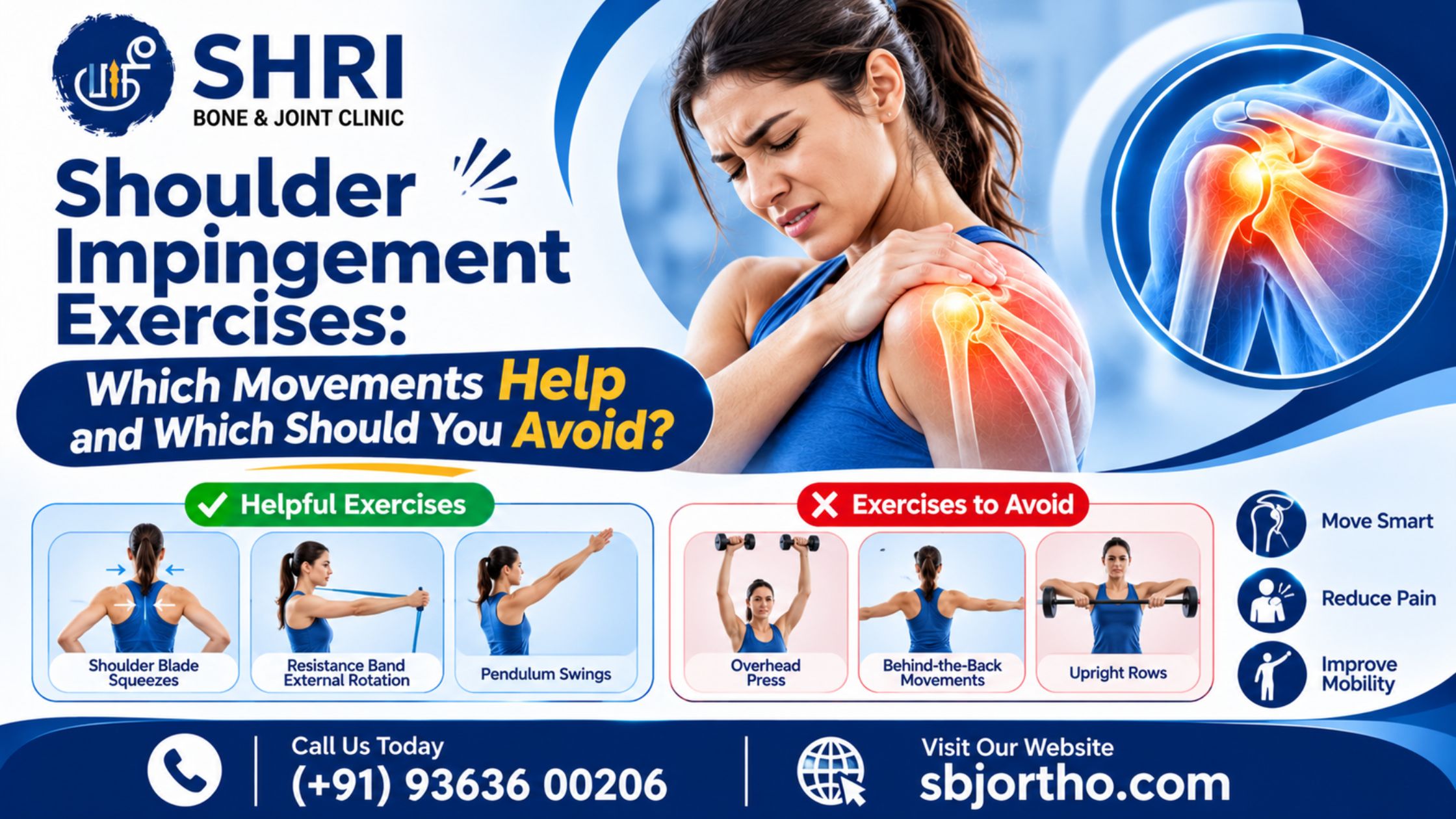
Shoulder impingement can make everyday movements such as reaching overhead, lifting objects, getting dressed, or sleeping on one side uncomfortable. The condition commonly causes pain when raising the arm, particularly during movements that place additional demands on the rotator cuff tendons and surrounding shoulder structures.
The most helpful shoulder impingement exercises generally focus on improving shoulder mobility, strengthening the rotator cuff, and developing better shoulder blade control. Exercises such as pendulum movements, gentle wall slides, resistance-band external rotations, and scapular strengthening may help reduce symptoms and improve function when performed appropriately.
However, not every exercise is suitable during every stage of recovery. Heavy overhead presses, painful lateral raises, deep dips, and repetitive movements that aggravate symptoms may need to be temporarily modified.
Shoulder impingement is often discussed under the broader term subacromial pain syndrome, which describes pain associated with structures around the rotator cuff and subacromial region. The condition is not always caused by a tendon being mechanically trapped between bones.
Understanding which exercises help, which movements may worsen symptoms, and how to progress safely can support recovery without unnecessary strain on the shoulder.
Best Shoulder Impingement Exercises to Reduce Pain and Improve Mobility
Exercise-based rehabilitation is commonly recommended as an initial treatment for shoulder impingement-related pain.
The aim is to restore comfortable movement, improve muscle strength, and increase the shoulder’s ability to tolerate everyday activities.
An effective programme generally includes three components:
- Mobility exercises to maintain or improve comfortable shoulder movement.
- Rotator cuff strengthening to improve control of the shoulder joint.
- Scapular strengthening to support coordinated movement of the shoulder blade and arm.
The most appropriate exercises depend on pain severity, movement restrictions, strength, and the underlying diagnosis.
1. Pendulum Exercise for Shoulder Pain
The pendulum exercise is a gentle movement commonly used when the shoulder is painful or stiff.
It allows the arm to move with relatively little muscular effort.
How to Perform the Pendulum Exercise
- Stand beside a stable table or chair.
- Support your body with the unaffected arm.
- Lean forward slightly and allow the painful arm to hang comfortably.
- Gently shift your body weight to create small arm movements.
- Allow the arm to swing forward and backward.
- Repeat with small side-to-side or circular movements if comfortable.
Suggested starting point: Perform gentle movements for 30–60 seconds, once or twice, according to comfort.
Benefits of Pendulum Exercise
- Encourages gentle shoulder movement.
- May help reduce guarding and stiffness.
- Allows movement without heavy loading.
- Can be useful during the early stages of rehabilitation.
Avoid forcing large circles or actively swinging the arm if this increases pain.
2. Wall Slides for Shoulder Mobility
Wall slides help improve controlled arm elevation while encouraging coordinated movement between the shoulder joint and shoulder blade.
They may be useful for patients who experience discomfort while raising their arms.
How to Perform Wall Slides
- Stand facing a wall.
- Place your hands or forearms against the wall at a comfortable height.
- Slowly slide your arms upward.
- Stop before the movement becomes significantly painful.
- Hold briefly if comfortable.
- Return to the starting position in a controlled manner.
Suggested starting point: 8–10 repetitions, depending on symptoms.
Benefits of Wall Slides
- Encourages controlled shoulder elevation.
- Supports shoulder blade movement.
- Helps maintain functional reaching ability.
- Can be progressed gradually as movement improves.
If the exercise causes sharp pain or increasing symptoms, reduce the movement range or stop.
3. Resistance-Band External Rotation
External rotation exercises strengthen muscles of the rotator cuff, particularly the infraspinatus and teres minor.
These muscles help control the position and movement of the upper arm bone.
How to Perform External Rotation
- Secure a light resistance band at approximately waist height.
- Stand sideways to the anchor point.
- Hold the band with the hand farther from the anchor.
- Keep your elbow bent to approximately 90 degrees.
- Position your elbow comfortably beside your body.
- Slowly rotate your forearm outward.
- Return to the starting position with control.
A small rolled towel between the elbow and body may help maintain a comfortable position.
Suggested starting point: 8–12 repetitions using light resistance.
Benefits of External Rotation Exercise
- Strengthens important rotator cuff muscles.
- Improves shoulder control.
- Supports functional arm movement.
- Helps build tolerance to daily activities.
Avoid using resistance that causes compensatory trunk rotation or sharp shoulder pain.
4. Resistance-Band Internal Rotation
Internal rotation exercises strengthen muscles involved in rotating the arm toward the body.
They may be included as part of a balanced rotator cuff strengthening programme.
How to Perform Internal Rotation
- Secure a resistance band at waist height.
- Stand sideways to the anchor.
- Hold the band with the arm closest to the anchor.
- Keep the elbow bent and close to your body.
- Slowly pull the hand inward across the abdomen.
- Return to the starting position.
Suggested starting point: 8–12 controlled repetitions.
Benefits of Internal Rotation Exercises
- Supports rotator cuff strength.
- Improves muscular control.
- Helps restore tolerance to functional movements.
- Complements external rotation strengthening.
The exercise should be performed with light resistance initially.
5. Scapular Retraction Exercise
The shoulder blade, also called the scapula, plays an important role in shoulder movement.
Scapular retraction exercises help patients develop awareness and control of the muscles around the shoulder blades.
How to Perform Scapular Retraction
- Sit or stand comfortably.
- Relax your shoulders.
- Gently draw your shoulder blades toward each other.
- Avoid excessively arching your lower back.
- Hold for approximately 3–5 seconds.
- Relax and repeat.
Suggested starting point: 10 repetitions.
Benefits of Scapular Retraction
- Encourages shoulder blade control.
- Activates muscles around the upper back.
- May improve tolerance to reaching activities.
- Supports a broader strengthening programme.
The aim is gentle muscular activation rather than forcefully pulling the shoulders backward.
6. Resistance-Band Rows
Resistance-band rows strengthen muscles of the upper back and shoulder blade region.
These muscles contribute to coordinated shoulder movement and upper-limb stability.
How to Perform Resistance-Band Rows
- Secure a resistance band at approximately chest height.
- Hold the band with both hands.
- Stand upright with your shoulders relaxed.
- Pull your elbows backward in a controlled movement.
- Allow the shoulder blades to move naturally.
- Slowly return to the starting position.
Suggested starting point: 8–12 repetitions with light resistance.
Benefits of Resistance-Band Rows
- Strengthens upper-back muscles.
- Supports scapular control.
- Improves tolerance to pulling activities.
- Helps develop functional shoulder strength.
Avoid shrugging the shoulders or using excessive resistance.
7. Isometric Shoulder External Rotation
Isometric exercises activate muscles without requiring substantial joint movement.
They may be useful when movement is uncomfortable but gentle muscular loading is tolerated.
How to Perform Isometric External Rotation
- Stand sideways beside a wall.
- Bend the affected elbow to approximately 90 degrees.
- Keep the elbow close to your body.
- Place the back of your hand against the wall.
- Gently press outward without moving your arm.
- Hold for approximately 5 seconds.
- Relax.
Suggested starting point: 5–8 gentle contractions.
Benefits of Isometric Exercises
- Activates the rotator cuff.
- Allows strengthening with minimal movement.
- May be useful during painful phases.
- Helps prepare the shoulder for progressive resistance exercises.
Use gentle pressure rather than maximum effort.
8. Serratus Anterior Wall Push-Up Plus
The serratus anterior helps control movement of the shoulder blade against the rib cage.
Strengthening this muscle may improve scapular function during reaching and lifting.
How to Perform the Wall Push-Up Plus
- Stand facing a wall.
- Place both hands against the wall at shoulder height.
- Keep your elbows straight.
- Gently push your upper body away from the wall by moving your shoulder blades forward.
- Avoid rounding your entire back excessively.
- Return to the starting position.
Suggested starting point: 8–10 repetitions.
Benefits of the Wall Push-Up Plus
- Strengthens the serratus anterior.
- Supports shoulder blade control.
- Encourages coordinated upper-limb movement.
- Can be progressed to more demanding exercises as strength improves.
If placing the hands at shoulder height is uncomfortable, adjust the position or seek physiotherapy guidance.
9. Gentle Cross-Body Shoulder Stretch
The cross-body stretch targets tissues around the back of the shoulder.
It may be useful when posterior shoulder tightness contributes to restricted movement.
However, it is not appropriate for every shoulder condition.
How to Perform the Cross-Body Stretch
- Sit or stand comfortably.
- Bring the affected arm gently across your chest.
- Support the arm with your opposite hand.
- Apply only a light stretch.
- Hold for approximately 15–20 seconds.
- Release slowly.
Suggested starting point: 2–3 gentle repetitions.
Benefits of Cross-Body Stretching
- May improve comfortable shoulder mobility.
- Helps address selected movement restrictions.
- Can support functional reaching activities.
Avoid this stretch if it causes pinching, instability, or significant pain.
10. Assisted Shoulder Flexion
Assisted shoulder flexion allows the unaffected arm or a suitable support to help move the painful shoulder.
This can be useful when active lifting is uncomfortable.
How to Perform Assisted Shoulder Flexion
- Lie comfortably on your back.
- Hold your hands together or use a light exercise stick.
- Allow the unaffected arm to assist the painful arm.
- Slowly raise both arms toward the head.
- Move only within a comfortable range.
- Return gradually.
Suggested starting point: 8–10 repetitions.
Benefits of Assisted Shoulder Flexion
- Helps maintain shoulder mobility.
- Reduces the effort required from the painful arm.
- Encourages gradual return to overhead movement.
- Can be adapted according to symptoms.
Avoid forcing the arm beyond its comfortable range.
Shoulder Impingement Exercise Summary
| Exercise | Primary Purpose | General Starting Approach |
| Pendulum exercise | Gentle mobility | 30–60 seconds |
| Wall slides | Controlled arm elevation | 8–10 repetitions |
| Band external rotation | Rotator cuff strengthening | 8–12 repetitions |
| Band internal rotation | Rotator cuff strengthening | 8–12 repetitions |
| Scapular retraction | Shoulder blade control | 10 repetitions |
| Resistance-band rows | Upper-back strengthening | 8–12 repetitions |
| Isometric external rotation | Gentle muscle activation | 5–8 contractions |
| Wall push-up plus | Serratus anterior strengthening | 8–10 repetitions |
| Cross-body stretch | Selected mobility restrictions | 15–20-second holds |
| Assisted shoulder flexion | Supported shoulder movement | 8–10 repetitions |
These are illustrative starting suggestions, not a universal prescription. Exercise selection, resistance, frequency, and progression should be individualised.
Shoulder Impingement Exercises to Avoid, Recovery Tips and When to Seek Treatment
Not all shoulder movements are harmful when someone has shoulder impingement-related pain.
However, certain exercises can aggravate symptoms, particularly when performed with excessive resistance, poor control, or beyond the shoulder’s current capacity.
The goal is not to permanently avoid shoulder movement. Instead, patients should temporarily modify activities that provoke substantial discomfort and gradually rebuild strength.
Which Exercises Should You Avoid With Shoulder Impingement?
1. Heavy Overhead Shoulder Presses
Overhead pressing requires coordinated shoulder movement and sufficient rotator cuff strength.
Heavy overhead presses may aggravate symptoms when the shoulder is already painful.
Why they may cause discomfort:
- Increased loading during arm elevation.
- Greater muscular demands on the rotator cuff.
- Difficulty maintaining control when fatigued.
- Repeated movement through a painful range.
What to do instead:
Begin with controlled wall slides, gentle shoulder elevation, and appropriate rotator cuff strengthening.
Overhead pressing may be reintroduced gradually when strength and symptoms allow.
2. Painful Lateral Raises
Lateral raises involve lifting the arms sideways against resistance.
Some patients with subacromial pain experience discomfort during this movement, particularly through the middle portion of arm elevation.
Why they may cause discomfort:
- Increased loading of the shoulder muscles.
- Repeated movement through a painful range.
- Excessive resistance or poor control.
What to do instead:
Use lighter resistance, reduce the movement range, or perform supported exercises.
Lateral raises are not permanently prohibited and may be included later in rehabilitation.
3. Behind-the-Neck Shoulder Presses
Behind-the-neck pressing places the shoulder in a combination of elevation and external rotation.
This position may be uncomfortable for people with limited mobility or painful shoulders.
Why they may cause discomfort:
- Requires substantial shoulder mobility.
- May aggravate symptoms in certain patients.
- Can be difficult to control with heavy loads.
What to do instead:
Use more comfortable pressing variations when appropriate, or focus on shoulder strengthening below shoulder height initially.
4. Deep Bench Dips
Bench dips place the shoulder into substantial extension behind the body.
This movement may be uncomfortable for patients with anterior shoulder pain or reduced shoulder tolerance.
Why they may cause discomfort:
- High loading in a deeply extended shoulder position.
- Increased demands on surrounding tissues.
- Difficulty controlling movement at the bottom of the exercise.
What to do instead:
Consider modified pushing exercises within a comfortable range, such as wall push-ups, when appropriate.
5. Heavy Upright Rows
Upright rows involve lifting resistance close to the body while raising the elbows.
Some patients experience shoulder pain during this movement, especially with heavy loads or high elbow positions.
Why they may cause discomfort:
- High muscular demands.
- Repeated movement through potentially painful positions.
- Difficulty maintaining comfortable shoulder mechanics.
What to do instead:
Choose exercises that allow a comfortable arm position and controlled resistance, such as rows or appropriately modified shoulder raises.
6. Repetitive Overhead Lifting During Painful Flare-Ups
Repeatedly lifting objects overhead may aggravate symptoms when the shoulder is highly irritable.
This can occur during household work, occupational activities, or exercise.
What to do instead:
Temporarily reduce the frequency, weight, or height of overhead tasks.
Gradually reintroduce these activities as pain and strength improve.
Shoulder Impingement Exercises: Helpful vs Potentially Aggravating Movements
| Generally Helpful When Tolerated | May Need Temporary Modification |
| Gentle pendulum movements | Heavy overhead presses |
| Controlled wall slides | Painful lateral raises |
| Light resistance-band rotations | Behind-the-neck pressing |
| Scapular strengthening | Deep bench dips |
| Supported shoulder mobility | Heavy upright rows |
| Isometric rotator cuff exercises | Repetitive heavy overhead lifting |
| Progressive strengthening | Exercises that consistently worsen symptoms |
No exercise is universally harmful or universally beneficial.
The appropriate choice depends on the patient’s diagnosis, pain response, movement capacity, and rehabilitation stage.
Should You Exercise Through Shoulder Impingement Pain?
Some mild discomfort during rehabilitation may be acceptable, but exercises should not produce sharp, severe, or progressively worsening pain.
A practical approach is to monitor how the shoulder responds during and after exercise.
Generally acceptable responses may include:
- Mild discomfort that remains manageable.
- Temporary muscular fatigue.
- Symptoms that settle after exercise.
- No meaningful increase in pain or stiffness the following day.
Warning signs that the exercise is too demanding include:
- Sharp or catching pain.
- Increasing pain with each repetition.
- Significant loss of movement.
- Persistent worsening of symptoms after exercise.
- New weakness or instability.
If symptoms increase, reduce resistance, range of motion, or exercise volume.
If pain remains significant, stop the activity and seek professional assessment.
How Often Should You Perform Shoulder Impingement Exercises?
Exercise frequency depends on the type of movement and the patient’s symptoms.
Gentle mobility exercises may be performed more frequently when comfortable.
Strengthening exercises often require recovery time between more demanding sessions.
A general rehabilitation programme may include:
- Gentle mobility exercises on most days.
- Rotator cuff strengthening several times per week.
- Scapular strengthening as tolerated.
- Gradual progression of resistance.
- Rest or reduced loading during symptom flare-ups.
There is no single exercise schedule that is appropriate for everyone.
A physiotherapist can help determine the suitable frequency, repetitions, and progression.
How Long Does Shoulder Impingement Take to Improve With Exercises?
Recovery varies depending on the underlying condition, symptom duration, physical demands, and consistency of rehabilitation.
Some patients notice improvement within a few weeks.
Others require several months of progressive strengthening and activity modification.
A general rehabilitation timeline is outlined below.
| Recovery Period | Common Rehabilitation Focus |
| Weeks 1–2 | Symptom management, gentle mobility, identifying aggravating activities |
| Weeks 3–4 | Improving comfortable movement and introducing controlled strengthening |
| Weeks 5–8 | Progressive rotator cuff and scapular strengthening |
| Weeks 9–12 | Increasing functional strength and tolerance to daily activities |
| Beyond 12 weeks | Continued strengthening and gradual return to demanding activities when necessary |
These are illustrative stages rather than guaranteed recovery milestones.
Long-standing shoulder pain, associated tendon injuries, or other conditions may require a different treatment approach.
Can Shoulder Impingement Heal Without Surgery?
Many patients with subacromial pain syndrome improve through non-surgical treatment.
Exercise-based rehabilitation, activity modification, and appropriate pain management are commonly recommended as initial treatment.
Surgery is not routinely necessary for uncomplicated shoulder impingement-related pain.
Research has not demonstrated a meaningful additional benefit from routine subacromial decompression surgery compared with placebo surgery for typical subacromial pain syndrome without a separate surgical indication.
However, treatment decisions may differ when patients have associated conditions such as substantial rotator cuff tears or other structural injuries.
Is Physiotherapy Better Than Rest for Shoulder Impingement?
Complete rest is generally not recommended for prolonged shoulder impingement-related pain.
Avoiding all movement may contribute to stiffness, weakness, and reduced confidence in using the arm.
Physiotherapy aims to restore comfortable movement and gradually improve the shoulder’s ability to tolerate loading.
A suitable programme may include:
- Mobility exercises.
- Rotator cuff strengthening.
- Scapular strengthening.
- Activity modification.
- Progressive functional training.
- Education about managing symptoms.
Temporary reduction of painful activities may be helpful during flare-ups, but gradual return to movement is usually important.
Can Poor Posture Cause Shoulder Impingement
Shoulder position and movement patterns may influence symptoms in some individuals, but poor posture should not automatically be considered the main cause of shoulder impingement.
Research has not established that one particular posture causes subacromial pain in every patient.
Factors such as tendon sensitivity, muscle strength, training load, sleep, and previous injuries may also contribute.
Rather than trying to maintain a rigid posture throughout the day, patients may benefit from regular movement, comfortable working positions, and progressive strengthening.
Can You Go to the Gym With Shoulder Impingement?
Many patients can continue exercising with suitable modifications.
The aim is to maintain general fitness while avoiding loads and movements that significantly aggravate the shoulder.
Practical adjustments may include:
- Reducing overhead lifting loads.
- Choosing comfortable movement ranges.
- Using lighter resistance.
- Avoiding repeated painful movements.
- Continuing lower-body exercises when appropriate.
- Gradually rebuilding shoulder strength.
- Allowing adequate recovery between demanding sessions.
Patients should avoid assuming that all upper-body exercise must stop.
A physiotherapist can help modify gym activities according to symptoms and training goals.
Can You Do Push-Ups With Shoulder Impingement?
Push-ups are not automatically prohibited.
However, standard floor push-ups may be uncomfortable during a painful phase.
Patients may begin with modified versions such as:
- Wall push-ups.
- Incline push-ups.
- Reduced-range push-ups.
The exercise can be progressed gradually as strength and tolerance improve.
If push-ups cause sharp pain or persistent symptom aggravation, they should be modified or temporarily avoided.
Are Swimming and Yoga Good for Shoulder Impingement?
Swimming and yoga can provide mobility and strengthening benefits, but certain positions may aggravate shoulder pain.
Swimming
Repeated overhead strokes may be uncomfortable during a symptomatic period.
Patients may need to reduce swimming intensity, modify their stroke, or temporarily choose alternative exercise.
Yoga
Some yoga positions place substantial body weight through the shoulders or require prolonged overhead movement.
Patients may need to modify poses such as downward-facing dog, plank variations, or deep shoulder stretches.
The suitability of these activities depends on the individual’s symptoms and movement capacity.
How Should You Sleep With Shoulder Impingement?
Shoulder pain can become more noticeable at night, particularly when lying directly on the affected side.
Helpful adjustments may include:
Sleep on the Unaffected Side
Place a pillow in front of the body to support the painful arm.
Sleep on Your Back
A small pillow under the affected arm may improve comfort.
Avoid Direct Pressure
Try not to remain in positions that consistently increase shoulder pain.
Support the Arm
Use pillows to prevent the shoulder from hanging into an uncomfortable position.
Persistent night pain should be evaluated, particularly when associated with weakness or restricted movement.
When Should You Stop Exercises and Consult a Doctor?
Shoulder pain may have several causes, including rotator cuff disorders, frozen shoulder, arthritis, instability, and nerve-related conditions.
Medical assessment is important when symptoms do not improve or when warning signs are present.
Seek evaluation if you experience:
- Persistent shoulder pain despite appropriate exercise modification.
- Significant weakness when lifting the arm.
- Increasing restriction of movement.
- Recurrent shoulder instability.
- Pain following a fall or injury.
- Persistent night pain.
- Numbness or tingling.
- Symptoms that interfere with work or daily activities.
Seek urgent medical attention if there is obvious deformity after an injury, sudden inability to move the arm, severe pain following trauma, or changes in hand circulation or sensation.
These symptoms may indicate a fracture, dislocation, or another condition requiring prompt assessment.
Shoulder Impingement vs Rotator Cuff Tear: Why Diagnosis Matters
Shoulder impingement-related pain and rotator cuff tears can produce overlapping symptoms.
Both may cause pain during arm elevation, weakness, and difficulty sleeping.
However, treatment recommendations can differ.
| Feature | Subacromial Pain Syndrome | Rotator Cuff Tear |
| Common symptoms | Pain during reaching and lifting | Pain and sometimes noticeable weakness |
| Onset | Often gradual | May be gradual or follow injury |
| Shoulder movement | Painful but often preserved | May be painful or limited by weakness |
| Physiotherapy | Common first-line treatment | Often appropriate, depending on tear characteristics |
| Surgery | Not routinely recommended for uncomplicated cases | Considered for selected tears |
| Imaging | Not always required initially | May be needed when a significant tear is suspected |
A sudden loss of strength following an injury requires timely medical assessment because an acute rotator cuff tear may need a different treatment approach.
What Happens During Physiotherapy for Shoulder Impingement?
A physiotherapist generally begins by assessing shoulder movement, strength, symptoms, and functional limitations.
The assessment may include:
- Reviewing the patient’s medical history.
- Identifying painful activities.
- Evaluating shoulder range of motion.
- Assessing rotator cuff strength.
- Examining shoulder blade movement.
- Screening for neck-related or neurological symptoms.
- Developing an individualised exercise programme.
Treatment usually progresses from symptom management and comfortable movement toward strengthening and functional activities.
Manual therapy may sometimes be used as an additional measure, but exercise and progressive loading remain central components of rehabilitation.
How to Prevent Shoulder Impingement Symptoms From Returning
Shoulder symptoms can recur, particularly when activity levels increase faster than the tissues can tolerate.
Long-term management may include:
Maintain Rotator Cuff Strength
Continue appropriate strengthening exercises even after symptoms improve.
Improve Shoulder Blade Control
Include exercises targeting the muscles around the scapula.
Progress Exercise Gradually
Avoid sudden increases in lifting weight, repetitions, or overhead activity.
Take Breaks From Repetitive Tasks
Alternate demanding activities with periods of relative recovery.
Maintain General Physical Fitness
Regular exercise supports overall muscle strength and physical function.
Respond Early to Symptoms
Temporary adjustments to training or work activities may help prevent prolonged flare-ups.
The objective is to build a shoulder that can tolerate everyday demands rather than permanently avoiding particular movements.
Conclusion: Choosing the Right Shoulder Impingement Exercises
Shoulder impingement exercises can help improve mobility, rotator cuff strength, shoulder blade control, and tolerance to daily activities. Gentle movements such as pendulum exercises and wall slides may be useful initially, while resistance-band rotations and progressive strengthening can support longer-term recovery.
Heavy overhead lifting, deep dips, and other painful movements may need temporary modification. However, these exercises are not necessarily harmful for everyone and can sometimes be reintroduced as symptoms improve.
Patients seeking Shoulder Impingement Syndrome Treatment in Chennai can consult Shri Bone & Joint Clinic for an orthopedic assessment and an individualised treatment plan.
Dr. Shriram Krishnamoorthy evaluates shoulder pain and related orthopedic conditions, helping patients understand whether physiotherapy, activity modification, or further investigation is appropriate. Shri Physio & Rehab supports recovery through mobility exercises, rotator cuff strengthening, and functional rehabilitation.
Shoulder pain following trauma, especially when accompanied by deformity or instability, may require a different approach. Patients seeking Shoulder Dislocation Treatment in Chennai should undergo appropriate medical evaluation before beginning shoulder exercises, as rehabilitation following a dislocation depends on the injury and joint stability.
The most effective exercise programme is one that matches the diagnosis, current symptoms, and functional goals while allowing gradual, controlled progression.
FAQs
1. What is the best exercise for shoulder impingement?
There is no single best exercise for every patient. Gentle wall slides, resistance-band external rotations, scapular strengthening, and controlled mobility exercises are commonly used. The most appropriate exercise depends on pain severity, shoulder strength, movement restrictions, and the underlying diagnosis.
2. Which exercises should I avoid with shoulder impingement?
Heavy overhead presses, painful lateral raises, deep bench dips, and repetitive overhead lifting may need temporary modification if they aggravate symptoms. These exercises are not permanently prohibited. They can sometimes be reintroduced gradually when shoulder strength and movement tolerance improve.
3. Can shoulder impingement improve with exercises alone?
Many patients with subacromial pain syndrome improve through exercise-based rehabilitation, activity modification, and appropriate symptom management. However, recovery varies, and some patients may require further evaluation to identify associated rotator cuff injuries or other shoulder conditions.
4. How long should I do shoulder impingement exercises?
Some patients notice improvement within several weeks, while others require a structured rehabilitation programme lasting several months. Exercise duration depends on symptom severity, strength, activity demands, and progress. Continuing appropriate strengthening after pain improves may help maintain shoulder function.
5. Is it safe to exercise if shoulder impingement causes pain?
Gentle exercise may be appropriate when discomfort is mild and settles without lasting symptom aggravation. Sharp pain, increasing weakness, instability, or persistent worsening after exercise suggests the programme should be modified. Patients with severe symptoms or pain following an injury should seek medical assessment before continuing.