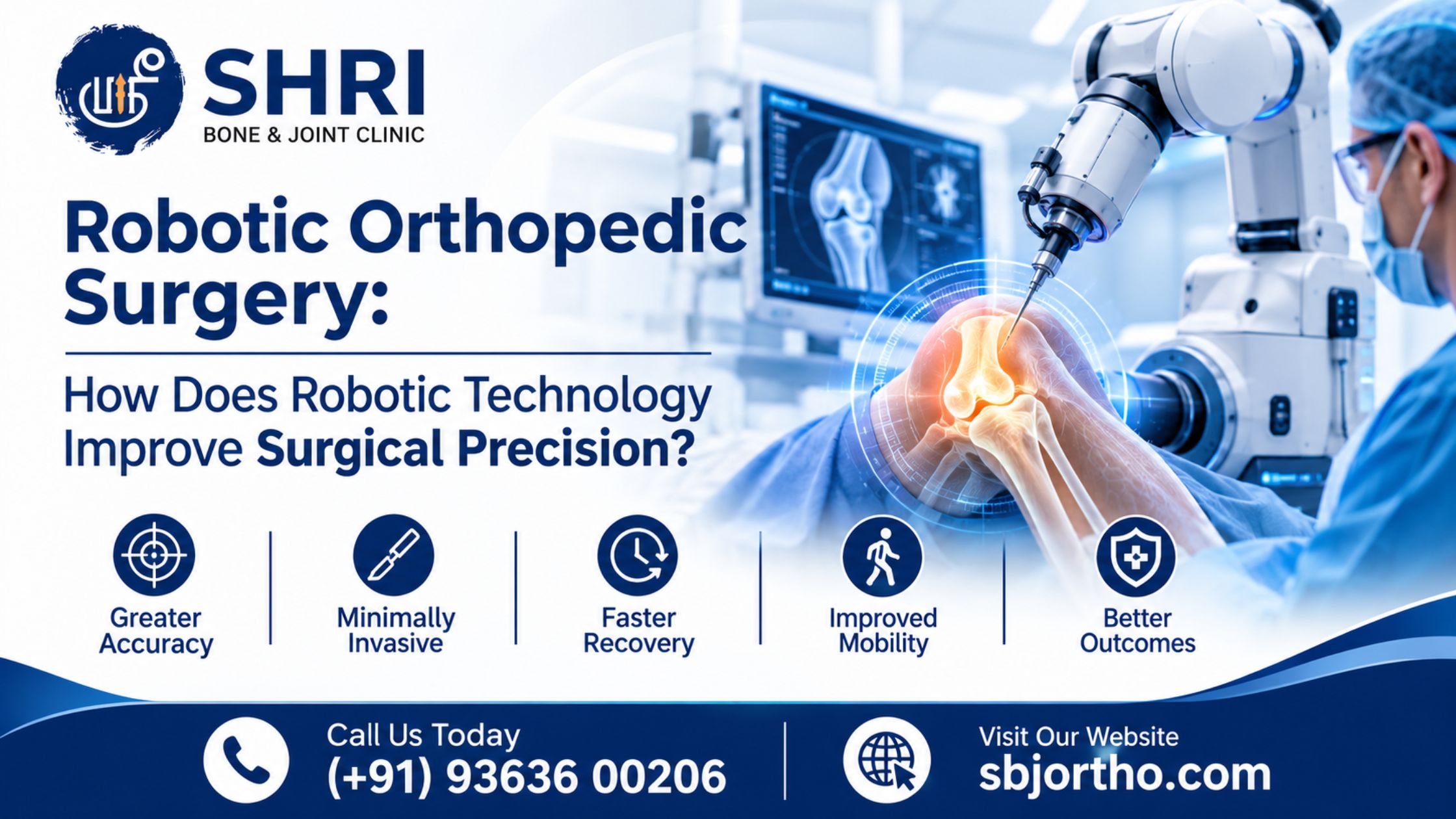
Robotic orthopedic surgery is changing how surgeons plan and perform certain bone and joint procedures. By combining computer-assisted measurements, real-time surgical guidance, and specialised instruments, robotic technology helps surgeons execute surgical plans with greater precision and consistency.
One of the biggest advantages of robotic-assisted orthopedic surgery is its ability to provide detailed information about joint anatomy, alignment, and implant positioning during an operation. This additional guidance can help surgeons make informed adjustments based on each patient’s anatomy.
However, robotic orthopedic surgery does not mean that a robot independently performs the operation. The orthopedic surgeon remains responsible for every clinical decision and controls the surgical procedure.
Understanding how robotic technology works, where it improves precision, and what limitations remain can help patients make informed decisions about advanced orthopedic treatments.
How Does Robotic Technology Improve Precision in Orthopedic Surgery?
Surgical precision is especially important in orthopedic procedures because small differences in bone preparation, joint alignment, and implant positioning can affect how an artificial joint moves and functions.
Traditional orthopedic surgery relies on anatomical landmarks, preoperative imaging, conventional instruments, and the surgeon’s clinical expertise.
Robotic-assisted systems add another layer of technological guidance by providing measurements and helping the surgeon carry out selected surgical steps according to a planned position or alignment.
The exact capabilities depend on the robotic platform and the procedure being performed.
What Is Robotic Orthopedic Surgery?
Robotic orthopedic surgery refers to procedures in which a surgeon uses robotic-assisted technology to support surgical planning, navigation, bone preparation, or implant placement.
These systems may combine:
- Computer-assisted surgical planning
- Digital anatomical measurements
- Optical tracking systems
- Robotic guidance or instrument control
- Real-time information during surgery
- Software-assisted alignment assessment
- Patient-specific surgical adjustments
Robotic technology is used in selected orthopedic procedures, particularly knee and hip replacement.
Some specialised systems also support certain spine procedures, although the technology and clinical applications differ considerably between platforms.
Not every orthopedic operation can be performed using robotic assistance, and not every robotic system supports the same procedures.
1. Patient-Specific Surgical Planning
One of the most important contributions of robotic technology is its ability to support planning based on the patient’s individual anatomy.
No two joints are exactly alike.
Patients may have differences in bone shape, joint alignment, deformity, ligament tension, and the extent of joint damage.
Robotic-assisted systems help surgeons assess these characteristics and plan selected surgical steps accordingly.
Depending on the platform, planning may involve preoperative imaging or measurements collected during surgery.
For example, some robotic knee replacement systems use CT-based planning, while others use intraoperative measurements.
This allows the surgeon to develop a plan that reflects the patient’s anatomy rather than relying entirely on standardised measurements.
2. Precise Bone Preparation
Bone preparation is an important stage of joint replacement surgery.
During knee replacement, the surgeon prepares the damaged surfaces of the thigh bone and shin bone to accommodate artificial components.
The accuracy of these preparations influences how closely the implant position matches the surgical plan.
Traditional techniques use mechanical guides and cutting blocks to assist bone preparation.
Robotic-assisted systems may provide additional guidance that helps the surgeon perform bone cuts within planned boundaries.
Depending on the system, this may involve robotic instrument guidance, controlled cutting tools, or software-based feedback.
Potential advantages include:
- Greater consistency in executing planned bone cuts
- Improved control of selected bone preparation steps
- Reduced deviation from planned measurements
- Additional feedback during surgical adjustments
- More detailed assessment of implant positioning
These technical benefits do not automatically translate into better long-term outcomes for every patient.
3. Real-Time Surgical Feedback
One of the differences between robotic-assisted and conventional surgery is the availability of additional intraoperative measurements.
During selected robotic procedures, the system can provide information about joint position, alignment, and movement.
This information helps the surgeon assess whether the procedure is progressing according to the surgical plan.
If adjustments are necessary, the surgeon may use the measurements to refine the approach.
For example, during robotic-assisted knee replacement, intraoperative information may help assess the relationship between implant positioning and knee balance.
The surgeon remains responsible for interpreting the information and making the final decision.
4. Improved Implant Positioning Accuracy
Artificial joint components must be positioned appropriately to support movement, stability, and load distribution.
Robotic technology can help surgeons plan and execute implant positioning with greater consistency in selected procedures.
The system may assist with:
- Evaluating the planned implant orientation
- Assessing joint alignment
- Guiding bone preparation
- Measuring the relationship between joint surfaces
- Checking the planned position against intraoperative findings
Research involving certain robotic-assisted joint replacement systems has demonstrated improvements in selected implant alignment and positioning measurements compared with conventional techniques.
However, precise implant placement is only one factor influencing patient outcomes.
Implant design, soft-tissue balance, bone quality, rehabilitation, and patient-related factors also play important roles.
5. Assessment of Joint Alignment
Joint alignment refers to the relationship between bones and how forces are distributed across a joint.
In knee replacement, the surgeon evaluates the alignment of the thigh bone, shin bone, and artificial components.
Patients with advanced arthritis may have bow-legged or knock-kneed deformities.
Robotic-assisted systems can provide measurements that help the surgeon assess alignment during surgery.
This may support a more individualised surgical plan.
However, the ideal alignment strategy can vary depending on the patient and surgical philosophy. Robotic technology does not establish one universally correct alignment for every knee.
6. Soft-Tissue Balance Assessment
Ligaments and other soft tissues play an important role in joint stability.
During knee replacement, the surgeon must consider how the joint behaves during bending and straightening.
Some robotic-assisted systems provide information that helps assess joint gaps, movement, and ligament balance.
This may assist the surgeon in adjusting implant positioning or other aspects of the surgical plan.
Appropriate soft-tissue balance is important because excessive tightness or looseness can affect knee movement and stability.
Nevertheless, robotic measurements complement rather than replace the surgeon’s clinical judgement.
7. Controlled Surgical Boundaries
Certain robotic systems use software-defined boundaries to guide the movement of surgical instruments.
These boundaries are designed to help the surgeon perform selected steps within the planned area.
Depending on the platform, the system may provide feedback or restrict particular instrument movements.
This can help improve control during bone preparation.
However, the presence and function of these boundaries vary between robotic systems.
It would be inaccurate to assume that every robotic orthopedic platform uses the same instrument-control technology.
8. Intraoperative Adjustments Based on Patient Anatomy
Preoperative planning provides important information, but the surgeon may identify additional findings during the operation.
Robotic-assisted technology can support adjustments based on intraoperative measurements.
For example, the surgeon may reassess alignment or joint balance and modify selected aspects of the surgical plan.
This flexibility can be valuable when treating patients with variations in joint anatomy or deformity.
The goal is to combine technological guidance with surgical expertise.
Does Robotic Orthopedic Surgery Require a CT Scan?
Not all robotic orthopedic procedures require a CT scan.
The imaging requirements depend on the surgical platform.
Some systems use preoperative CT scans to create a three-dimensional model of the patient’s anatomy.
Other systems collect measurements during surgery and do not require a CT scan specifically for robotic planning.
For example, the VELYS Robotic-Assisted Solution supports a CT-free workflow for knee replacement.
This distinction is important because patients sometimes assume that all robotic orthopedic systems operate in the same way.
Additional imaging may still be necessary for diagnosis or other clinical reasons.
How Does Robotic Surgery Compare With Conventional Orthopedic Surgery?
| Surgical Factor | Conventional Orthopedic Surgery | Robotic-Assisted Orthopedic Surgery |
| Surgical planning | Clinical assessment, imaging, conventional measurements | Computer-assisted planning and additional measurements |
| Bone preparation | Conventional instruments and surgical guides | Technology-assisted guidance during selected steps |
| Alignment assessment | Anatomical landmarks and conventional methods | Additional digital or intraoperative measurements |
| Implant positioning | Guided by surgeon expertise and conventional instruments | Robotic assistance may improve execution of planned positioning |
| Soft-tissue assessment | Surgeon evaluation using established techniques | May include technology-assisted measurements |
| Intraoperative adjustments | Based on surgical findings and conventional assessment | May incorporate real-time system feedback |
| Surgeon control | Surgeon performs the operation | Surgeon performs and controls the operation |
| Equipment requirements | Standard surgical instruments | Specialised robotic equipment |
| Long-term outcomes | Extensive evidence for established procedures | Evidence varies by procedure and robotic platform |
Both approaches depend on appropriate patient selection and surgical expertise.
Robotic assistance adds technological capabilities, but conventional orthopedic surgery remains effective for many patients.
Benefits, Limitations and Clinical Applications of Robotic Orthopedic Surgery
Robotic-assisted orthopedic surgery offers potential advantages in surgical planning and precision.
However, it is important to distinguish technical improvements from clinical outcomes such as pain relief, recovery time, complication rates, and implant longevity.
What Are the Main Benefits of Robotic Orthopedic Surgery?
Greater Precision in Selected Surgical Steps
Robotic guidance may help surgeons execute planned bone preparation and implant positioning more accurately.
More Detailed Surgical Measurements
The technology can provide additional information about anatomy, alignment, and joint balance.
Individualised Surgical Planning
Surgeons can use patient-specific measurements to guide surgical decisions.
Improved Consistency
Some robotic platforms have demonstrated greater consistency in selected surgical measurements compared with conventional techniques.
Additional Intraoperative Feedback
Real-time information may help surgeons assess and refine the surgical plan.
These advantages relate primarily to surgical execution. The extent to which they improve patient outcomes depends on the procedure, technology, and clinical circumstances.
Robotic Knee Replacement Surgery
Robotic-assisted knee replacement is one of the most established applications of robotic technology in orthopedic surgery.
It may be used during selected total knee replacement procedures to support:
- Knee anatomy assessment
- Surgical planning
- Bone preparation
- Implant positioning
- Joint alignment evaluation
- Soft-tissue balance assessment
The surgeon controls the procedure while the robotic system provides guidance during selected stages.
Robotic knee replacement is generally considered for patients who require joint replacement because of advanced arthritis or other appropriate indications.
It is not a treatment for every type of knee pain.
Robotic Hip Replacement Surgery
Certain robotic systems are designed to assist hip replacement surgery.
Depending on the platform, robotic assistance may help with planning and positioning the artificial hip components.
Potential applications include:
- Assessment of hip anatomy
- Acetabular component positioning
- Implant orientation
- Leg-length and offset assessment
- Surgical planning adjustments
The specific capabilities depend on the system.
A robotic platform designed for knee replacement cannot automatically be assumed to support hip replacement.
For example, the VELYS Robotic-Assisted Solution used for knee replacement is not a robotic hip replacement system.
Robotic Spine Surgery
Some specialised robotic platforms support selected spine procedures, particularly aspects of spinal instrumentation.
Depending on the technology, robotic guidance may assist with planning and placement of surgical hardware.
These systems are different from those used for knee or hip replacement.
Robotic spine surgery is not suitable for every spinal condition, and its availability depends on the surgical centre and equipment.
Does Robotic Orthopedic Surgery Reduce Human Error?
Robotic technology can help reduce certain deviations from a planned surgical measurement or instrument position.
However, it does not eliminate the possibility of human error.
Surgical outcomes still depend on:
- Accurate diagnosis
- Appropriate patient selection
- Correct surgical planning
- Surgeon training
- Equipment setup
- Interpretation of system measurements
- Intraoperative decision-making
- Postoperative care
Robotic systems can also experience technical problems or measurement inaccuracies.
The surgeon must understand the technology’s limitations and be prepared to use appropriate alternative techniques when necessary.
Is Robotic Orthopedic Surgery Safer Than Traditional Surgery?
Robotic-assisted surgery may offer technical advantages in selected procedures, but it should not automatically be described as safer than conventional surgery.
The available evidence varies by operation and robotic platform.
General orthopedic surgical risks may include:
- Infection
- Bleeding
- Blood clots
- Nerve or blood vessel injury
- Anaesthesia-related complications
- Persistent pain
- Implant-related problems
- Need for additional surgery
Some robotic systems may introduce technology-specific considerations, including tracking-pin complications, equipment-related problems, or additional procedural steps.
Robotic assistance does not eliminate these risks.
Does Greater Surgical Precision Mean Faster Recovery?
Not necessarily.
Greater accuracy in selected surgical measurements may be beneficial, but recovery depends on many factors beyond technical precision.
These include:
- Patient age and overall health
- Severity of the underlying condition
- Surgical procedure
- Preoperative muscle strength
- Pain management
- Tissue healing
- Postoperative complications
- Rehabilitation participation
Some studies have reported improvements in selected early recovery measures following robotic-assisted joint replacement.
However, these findings are not consistent across all systems and procedures.
Patients should not assume that robotic surgery guarantees faster recovery.
Can Robotic Surgery Improve Implant Longevity?
Implant positioning is one factor that may influence the long-term performance of an artificial joint.
Robotic technology can improve the accuracy of selected positioning measurements, but long-term implant survival depends on multiple factors.
These include implant materials, bone quality, surgical technique, joint stability, patient activity, infection risk, and other medical conditions.
Current evidence does not conclusively establish that robotic-assisted joint replacements consistently last longer than well-performed conventional replacements.
Long-term clinical studies remain important for understanding whether technical precision translates into improved implant survival.
What Are the Limitations of Robotic Orthopedic Surgery?
Despite its advantages, robotic-assisted surgery has several limitations.
Higher Equipment and Procedure Costs
Robotic systems require specialised equipment, maintenance, and trained personnel. This may increase treatment expenses.
Technology-Specific Training
Surgeons must receive appropriate training and develop experience with the selected robotic platform.
Not Suitable for Every Procedure
Different systems support different operations. A platform designed for knee replacement may not be suitable for hip or spine surgery.
Technical Complications
Equipment malfunction, tracking problems, or other technical issues may require adjustments or conversion to conventional techniques.
Limited Evidence for Universal Clinical Superiority
Improved technical accuracy does not establish better outcomes for every patient or procedure.
Dependence on Surgical Expertise
Robotic technology cannot replace appropriate surgical judgement, anatomical knowledge, or complication management.
Is Robotic Orthopedic Surgery Suitable for Everyone?
Robotic-assisted surgery may be appropriate for selected patients who require an orthopedic operation supported by an available robotic platform.
However, suitability depends on:
- The underlying orthopedic condition
- Severity of joint damage
- Bone anatomy and deformity
- Previous surgical procedures
- Overall medical fitness
- Implant requirements
- Surgeon assessment
- Availability of appropriate robotic technology
Patients with mild joint symptoms may benefit from non-surgical treatment rather than surgery.
The decision to operate should be made independently of whether robotic technology is available.
How Important Is the Orthopedic Surgeon’s Experience?
The surgeon’s expertise remains one of the most important considerations in robotic orthopedic surgery.
A robotic system can provide measurements and guidance, but it cannot independently determine the best treatment for a patient.
The surgeon must evaluate the diagnosis, select the procedure, interpret the system’s information, and respond to unexpected findings.
Experience with the specific robotic platform is also important.
Patients should discuss the surgeon’s training, the proposed procedure, expected benefits, risks, and rehabilitation requirements before surgery.
What Is the Future of Robotic Orthopedic Surgery?
Robotic orthopedic technology continues to evolve.
Future developments may include improved surgical planning, more sophisticated intraoperative measurements, enhanced instrument guidance, and better integration of clinical data.
Researchers are also studying whether improvements in surgical precision lead to meaningful long-term benefits such as better function, fewer complications, and improved implant survival.
As the technology develops, its value should continue to be assessed through high-quality clinical research rather than technical performance alone.
Conclusion: How Robotic Technology Supports More Precise Orthopedic Surgery
Robotic orthopedic surgery improves surgical precision by providing additional measurements, patient-specific planning tools, and guidance during selected operative steps. These capabilities can help surgeons assess anatomy, prepare bone, evaluate alignment, and position implants according to the surgical plan.
However, the technology does not independently perform surgery or guarantee better outcomes. Successful treatment still depends on accurate diagnosis, appropriate patient selection, surgeon expertise, and postoperative rehabilitation.
Patients exploring Robotic Orthopedic Surgery in Chennai can consult Shri Bone & Joint Clinic to understand how robotic assistance is used in selected knee replacement procedures.
Dr. Shriram Krishnamoorthy uses the VELYS Robotic-Assisted Solution, which supports CT-free robotic-assisted knee replacement planning and surgical guidance. Patients considering Robotic Joint Replacement Surgery in Chennai can discuss whether robotic-assisted knee replacement is appropriate for their condition.
Shri Physio & Rehab also supports postoperative rehabilitation through exercises and functional recovery programmes designed according to individual surgical requirements.
Ultimately, robotic technology is most valuable when it complements the surgeon’s experience and supports an appropriate treatment plan.
FAQs
1. How does robotic technology improve precision in orthopedic surgery?
Robotic-assisted systems provide additional measurements and guidance during selected surgical steps. Depending on the platform, they can help surgeons assess joint anatomy, plan bone preparation, evaluate alignment, and position implants more consistently. The surgeon remains responsible for interpreting the information and performing the operation.
2. Is robotic orthopedic surgery more accurate than traditional surgery?
Certain robotic systems have demonstrated improved accuracy or consistency in selected surgical measurements, particularly during joint replacement. However, results depend on the platform, procedure, and surgical technique. Greater technical accuracy does not automatically guarantee better long-term clinical outcomes.
3. Can robotic orthopedic surgery be performed without a CT scan?
Yes, some robotic systems use intraoperative measurements instead of preoperative CT-based planning. For example, the VELYS Robotic-Assisted Solution supports a CT-free knee replacement workflow. Other robotic systems may require CT imaging, so the requirement depends on the technology used.
4. Does robotic orthopedic surgery reduce recovery time?
Some studies suggest possible improvements in selected early recovery outcomes following robotic-assisted procedures, but findings are not consistent across all systems. Recovery depends on the operation, patient health, tissue healing, pain management, and rehabilitation. Robotic surgery does not guarantee faster recovery.
5. Can robotic technology replace an orthopedic surgeon?
No. Robotic-assisted orthopedic surgery requires a trained surgeon to plan, control, and perform the procedure. The technology provides guidance and measurements but does not independently make clinical decisions. Surgical expertise remains essential for patient safety and successful treatment.