
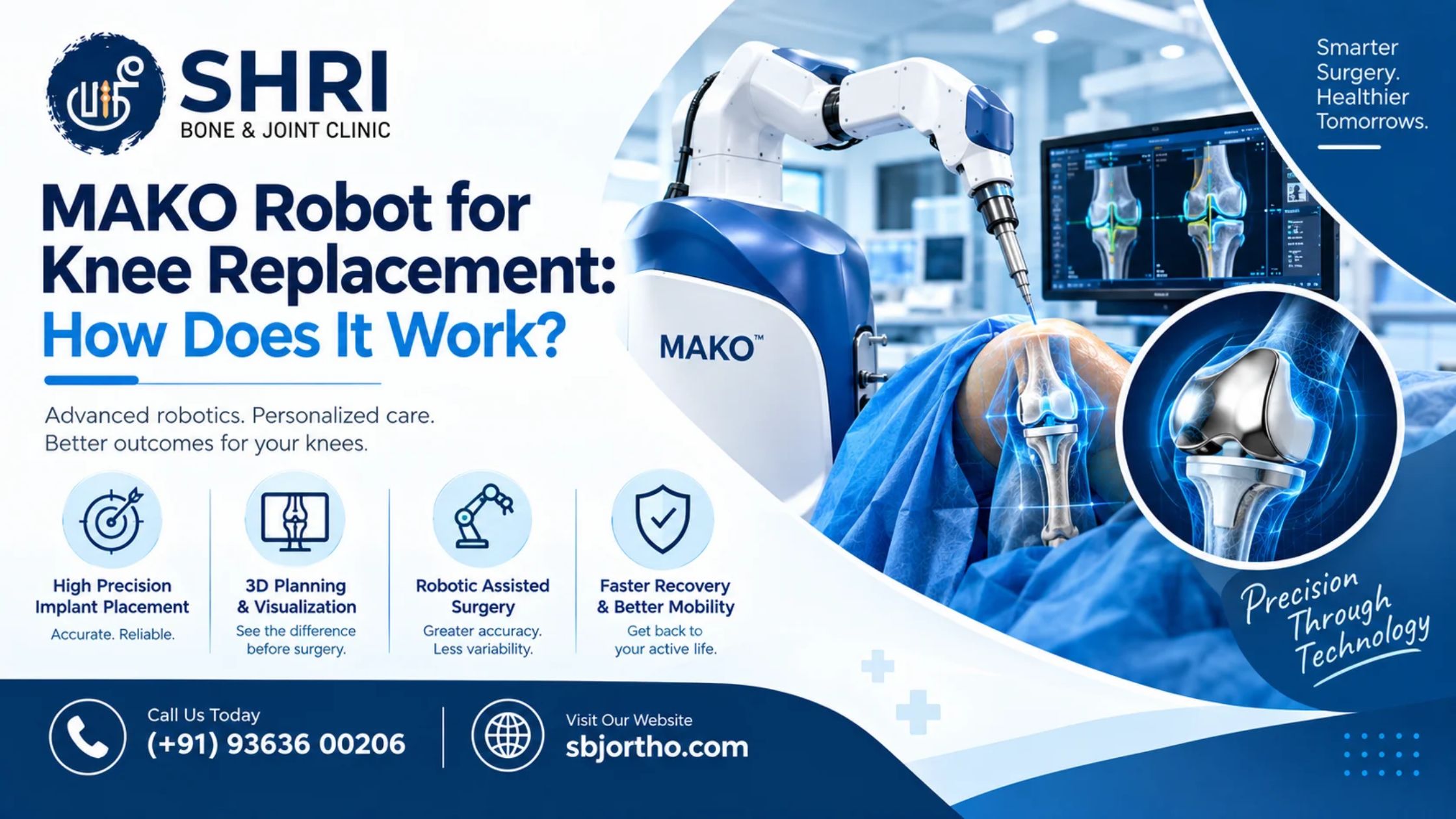
Robotic-assisted technology has introduced new ways for orthopedic surgeons to plan and perform knee replacement surgery. Among the widely known systems is the MAKO robot, a robotic-arm assisted surgical platform developed by Stryker for joint replacement procedures.
The MAKO robot does not independently perform knee replacement. Instead, it works as a surgical assistance system. The orthopedic surgeon uses patient-specific information to plan the procedure and controls the robotic arm during bone preparation.
One of the defining features of MAKO knee replacement is its CT-based planning process. A CT scan is used to create a three-dimensional model of the patient’s knee, allowing the surgeon to plan implant size, positioning and bone preparation before and during surgery.
Understanding how MAKO works—and how it differs from other robotic knee replacement systems—can help patients make sense of the technology without assuming that the robot replaces the skill or judgement of the surgeon.
Understanding the MAKO Robot and Knee Replacement Technology
MAKO combines three-dimensional imaging, computer-based surgical planning and robotic-arm assistance. Each of these elements has a different role in helping the surgeon plan and execute knee replacement.
What Is the MAKO Robot?
The MAKO robot is a robotic-arm assisted surgical system used for certain joint replacement procedures.
In knee replacement, the technology is designed to assist the orthopedic surgeon with patient-specific planning and bone preparation.
The system combines information from a preoperative CT scan with intraoperative assessment. This allows the surgeon to develop a three-dimensional plan for the individual patient’s knee.
The surgeon remains in control throughout the operation.
Is MAKO an Implant or a Robotic System?
MAKO is a robotic-assisted surgical platform, not the knee implant itself.
This distinction can sometimes be confusing because Stryker develops both orthopedic implants and MAKO robotic technology.
The implant consists of the artificial components placed inside the knee to replace damaged joint surfaces.
The MAKO robot is technology used during surgery to assist the surgeon with planning and bone preparation.
Both may be involved in a robotic knee replacement, but they perform completely different functions.
Does the MAKO Robot Perform Surgery by Itself?
No. MAKO is not an autonomous surgical robot.
The orthopedic surgeon plans the procedure and controls the robotic arm. The system provides information and boundaries that assist the surgeon while preparing the bone.
The surgeon remains responsible for:
- Deciding whether knee replacement is required
- Choosing the appropriate procedure
- Reviewing the CT-based plan
- Evaluating knee anatomy
- Assessing joint balance
- Determining implant positioning
- Controlling bone preparation
- Evaluating the reconstructed knee
- Managing postoperative treatment
Robotic technology therefore supports surgical decision-making rather than replacing it.
Why Does MAKO Use a CT Scan?
MAKO uses a preoperative CT scan as part of its planning workflow.
The scan provides detailed anatomical information that can be converted into a three-dimensional virtual model of the patient’s knee.
This model helps the surgeon understand the patient’s individual anatomy and develop the surgical plan before bone preparation begins.
The plan can include:
- Implant size
- Implant position
- Bone preparation
- Individual anatomy
- Alignment considerations
This CT-based approach is one of the characteristics that differentiates MAKO from some other robotic knee replacement systems.
How Is a 3D Model Used in MAKO Knee Replacement?
The CT images are processed to create a virtual three-dimensional representation of the patient’s knee.
The surgeon uses this model to plan where the knee replacement components may be positioned.
Rather than using the same predetermined plan for every patient, the technology allows the procedure to be planned around the anatomy of the individual knee.
The surgeon reviews the plan and can modify it according to clinical requirements.
The computer-generated model is therefore a planning tool, not a replacement for the surgeon’s judgement.
Can MAKO Be Used for Partial and Total Knee Replacement?
MAKO technology can be used for robotic-assisted knee replacement procedures, including appropriate total and partial knee replacement applications.
The type of replacement a patient requires depends primarily on the pattern of joint damage rather than the availability of robotic technology.
A patient with arthritis confined to a suitable part of the knee may be considered for partial replacement, whereas widespread joint damage may require total knee replacement.
Clinical examination and imaging are necessary before making this decision.
How the MAKO Robot Works During Knee Replacement Surgery
The MAKO process begins before the day of surgery with imaging and surgical planning. The plan is then linked to the patient’s actual knee during the operation so that robotic-arm assistance can be used during bone preparation.
Step 1: Evaluating Whether Knee Replacement Is Necessary
Before discussing robotic technology, the surgeon must first determine whether knee replacement is actually appropriate.
Patients with advanced knee arthritis may experience:
- Persistent knee pain
- Significant stiffness
- Reduced movement
- Difficulty walking
- Difficulty climbing stairs
- Progressive knee deformity
- Pain affecting sleep
- Reduced ability to perform everyday activities
However, many patients with knee pain do not require replacement.
Symptoms, examination findings, imaging, previous treatment and overall health should be considered before surgery is recommended.
Step 2: Taking a CT Scan of the Knee
When MAKO robotic-assisted surgery is planned, CT imaging is used to capture detailed information about the patient’s anatomy.
The scan forms the basis of the three-dimensional model used for planning.
This happens before surgery and allows the surgeon to study the individual knee before performing bone preparation.
Step 3: Creating a Patient-Specific Surgical Plan
Using the three-dimensional model, the surgeon develops a surgical plan for the patient’s knee.
The plan can help determine the intended size and position of the knee replacement components and how the bone will be prepared.
Because patients differ in anatomy and joint damage, patient-specific planning allows these differences to be considered before the final surgical steps are performed.
The surgeon reviews and controls this process rather than relying automatically on a computer-generated recommendation.
Step 4: Matching the Plan With the Patient’s Knee
During surgery, the system needs to relate the virtual model to the patient’s actual anatomy.
This allows the planned procedure to correspond with the physical position of the knee in the operating room.
The surgeon can then assess the knee and use the available information while refining the surgical approach.
Step 5: Assessing Knee Movement and Balance
Knee replacement involves more than removing damaged bone.
Ligaments and surrounding soft tissues influence how the knee moves and how stable it feels.
During surgery, the orthopedic surgeon evaluates the knee and considers balance alongside the planned implant position.
This information may lead to adjustments before final bone preparation.
Step 6: Using the Robotic Arm for Bone Preparation
Once the surgeon is satisfied with the plan, the robotic arm assists during bone preparation.
The system is designed to help the surgeon work within the planned boundaries.
However, the robotic arm does not independently begin cutting or make surgical decisions.
The orthopedic surgeon controls the robotic arm and performs the procedure.
Step 7: Evaluating Trial Components
Trial components may be placed before the final knee replacement components are secured.
This allows the surgeon to assess how the reconstructed knee behaves.
Factors evaluated can include:
- Range of movement
- Stability
- Alignment
- Flexion and extension
- Soft-tissue balance
If necessary, the surgeon can make appropriate adjustments before completing the replacement.
Step 8: Positioning the Final Knee Components
After the surgeon is satisfied with the bone preparation and trial assessment, the final components are positioned.
The knee is assessed again for movement and stability before surgery is completed.
The robotic system has therefore assisted with planning and execution, while the surgeon remains responsible for the overall procedure.
What Are the Potential Benefits of MAKO Robotic Technology?
MAKO is designed to provide the surgeon with additional information and assistance during joint replacement.
Potential advantages include:
- CT-based patient-specific planning
- Three-dimensional modelling
- Planning of implant position
- Robotic-arm assisted bone preparation
- Defined boundaries during bone preparation
- Ability to assess and refine the surgical plan
These technological features should not be interpreted as a guarantee of a particular clinical outcome.
Knee replacement results can also depend on patient health, severity of arthritis, surgeon experience, implant selection, rehabilitation and individual healing.
What Is the Difference Between MAKO and VELYS?
MAKO and VELYS are both robotic-assisted technologies used in knee replacement, but they use different workflows.
One of the clearest differences involves surgical planning.
MAKO uses CT-based planning. A preoperative CT scan is used to create a three-dimensional model of the patient’s knee.
VELYS uses a CT-free workflow. Information about the knee can be collected during surgery without requiring a preoperative CT scan specifically for robotic planning.
The systems also differ in their hardware and how robotic assistance is integrated into the surgical workflow.
These differences do not mean that one technology should automatically be considered better for every patient. The surgeon’s experience with the selected platform and the suitability of the treatment for the individual patient remain important.
Is MAKO Better Than Conventional Knee Replacement?
Robotic assistance provides additional planning and execution tools, but it should not be viewed as a guarantee of a better outcome for every patient.
Conventional knee replacement has established surgical principles, while robotic-assisted procedures add technology that can support patient-specific planning and bone preparation.
The most appropriate approach depends on the individual patient, the surgeon’s experience and the available technology.
Patients should discuss the potential advantages, limitations and alternatives with their orthopedic surgeon rather than selecting surgery based solely on the presence of a robot.
Does MAKO Robotic Surgery Mean Faster Recovery?
The use of robotic technology does not create one standard recovery timeline.
Recovery after knee replacement can be influenced by:
- Age
- General health
- Severity of arthritis
- Muscle strength
- Preoperative mobility
- Type of knee replacement
- Surgical factors
- Physiotherapy
- Individual healing
Patients generally begin mobilisation according to their medical condition after surgery. Physiotherapy then focuses on restoring knee movement, strengthening the surrounding muscles and progressively improving walking and functional activities.
Robotic technology does not remove the need for rehabilitation.
What Should Patients Consider When Comparing Robotic Systems?
Patients may encounter several names while researching robotic knee replacement, including MAKO and VELYS.
Instead of choosing treatment solely according to the robot’s brand name, it can be more useful to ask:
- Why do I need knee replacement?
- Do I need partial or total replacement?
- Which robotic platform will be used?
- How does that system work?
- Does it require additional imaging?
- Which implant will be used?
- How experienced is the surgeon with the system?
- What are the risks and limitations?
- What rehabilitation will I need?
Robotic technology is one component of the overall treatment pathway. Surgeon experience, appropriate patient selection and postoperative rehabilitation remain equally important considerations.
Conclusion: Choosing Robotic Knee Replacement Care in Chennai
The MAKO robot is a robotic-arm assisted surgical system that uses CT-based three-dimensional planning to help an orthopedic surgeon plan and execute knee replacement. The surgeon remains in control throughout the procedure, while the technology provides patient-specific information and assistance during bone preparation.
Patients considering knee replacement in Chennai do not need to choose treatment based only on whether a particular robotic brand is available. Consulting an experienced Orthopedic Specialist in Chennai can help determine whether replacement is required, which procedure is appropriate and which robotic technology suits the treatment pathway.
Patients comparing surgical expertise can learn more about the Best Robotic Knee Replacement Surgeon in Chennai, while those considering robotic surgery can understand the available technologies before making a decision.
At Shri Bone & Joint Clinic, Dr. Shriram Krishnamoorthy uses the VELYS robotic-assisted system. Patients interested in the technology he uses can explore VELYS Robotic Knee Replacement in Chennai, including its CT-free workflow and role in patient-specific planning.
Patients preparing financially for surgery can also understand the factors influencing Robotic Knee Replacement Cost in Chennai, including the type of replacement, implant, robotic technology, hospital requirements and rehabilitation.
FAQs
1. What is the MAKO robot used for?
MAKO is a robotic-arm assisted surgical system used for certain joint replacement procedures, including knee replacement.
It provides patient-specific planning based on CT imaging and robotic assistance during parts of the surgical procedure while the orthopedic surgeon remains in control.
2. Does the MAKO robot perform knee replacement automatically?
No. MAKO is not an autonomous surgical system.
The orthopedic surgeon develops the plan, controls the robotic arm and performs the procedure. The technology assists the surgeon rather than replacing surgical judgement.
3. Does MAKO knee replacement require a CT scan?
MAKO uses a CT-based planning workflow. A preoperative CT scan is used to create a three-dimensional model of the patient’s anatomy.
The surgeon uses this model to develop a patient-specific surgical plan before and during knee replacement.
4. What is the main difference between MAKO and VELYS?
A major difference is the planning process. MAKO uses a preoperative CT scan to create a three-dimensional model for planning.
VELYS uses a CT-free workflow in which anatomical information can be collected during surgery for robotic-assisted planning.
5. Is the MAKO robot suitable for every knee replacement patient?
No. The first consideration is whether the patient actually requires knee replacement and what type of replacement is appropriate.
The decision to use a particular robotic system should be made according to the patient’s knee condition, surgical requirements, available technology and the surgeon’s experience.