
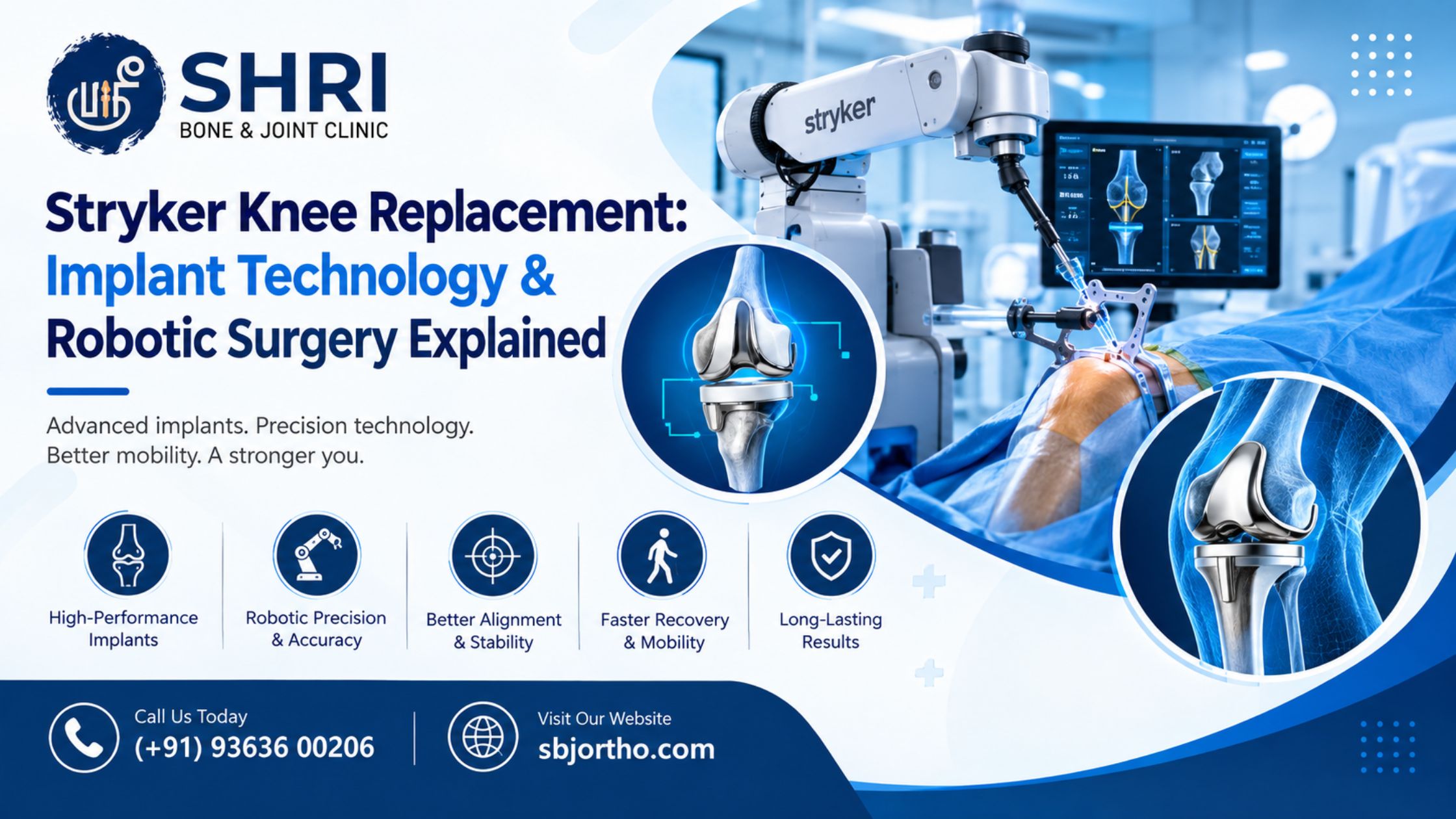
Knee replacement has evolved considerably over the years, not only in surgical techniques but also in implant design and robotic-assisted technology. One of the well-known names associated with orthopedic implants and robotic surgery is Stryker, a medical technology company that develops knee replacement systems and the MAKO robotic platform.
The term Stryker knee replacement can refer to knee replacement performed using Stryker implant systems, while searches for the term may also relate to MAKO robotic-assisted surgery. These are connected technologies, but they are not the same thing: the implant is the artificial joint component placed in the knee, while the robotic platform is a technology used to assist the surgeon during the operation.
Understanding this difference is useful for patients comparing knee replacement technologies. More importantly, the implant brand or robotic system alone does not determine whether a knee replacement will be appropriate or successful. Patient selection, surgical planning, surgeon experience and rehabilitation remain essential parts of treatment.
Understanding Stryker Knee Replacement Technology
Stryker develops orthopedic implants used in joint replacement procedures. Within knee replacement, different implant components and configurations may be selected depending on the patient’s anatomy, joint damage and surgical requirements.
What Is a Stryker Knee Replacement?
A Stryker knee replacement generally refers to knee replacement surgery in which a knee implant system manufactured by Stryker is used.
During total knee replacement, damaged joint surfaces at the ends of the thigh bone and shin bone are prepared and resurfaced using artificial components. Depending on the procedure, the surface of the kneecap may also be addressed.
The replacement commonly includes metal components and a medical-grade polyethylene insert that creates a smooth bearing surface between them.
The purpose is to replace severely damaged joint surfaces and create a stable joint that supports functional movement.
What Is the Stryker Triathlon Knee System?
The Triathlon Total Knee System is one of Stryker’s knee replacement implant platforms.
It is designed for total knee arthroplasty and includes components that allow the surgeon to reconstruct damaged knee surfaces.
Patients may encounter terms such as:
- Stryker Triathlon knee replacement
- Triathlon knee system
- Stryker total knee replacement
- Stryker knee implant
These generally relate to the implant family rather than the robotic system itself.
This distinction becomes important when comparing Stryker implants with MAKO robotic-assisted technology.
Is a Stryker Knee Implant the Same as the MAKO Robot?
No. They serve different purposes.
A knee implant is the artificial joint component that remains inside the patient’s knee after replacement.
MAKO is Stryker’s robotic-arm assisted surgical technology. It assists the surgeon with planning and executing aspects of joint replacement surgery.
A patient may therefore hear both names during discussions about robotic knee replacement, but they should not be treated as interchangeable terms.
One describes the replacement components, while the other describes technology used to assist the surgeon during surgery.
How Are Knee Implants Selected?
There is no single knee implant that is automatically appropriate for every patient.
The orthopedic surgeon considers several factors when selecting the implant and surgical approach, including:
- Patient anatomy
- Extent of arthritis
- Bone quality
- Knee stability
- Ligament condition
- Type of replacement required
- Deformity and alignment
- Surgical requirements
- Implant compatibility with the chosen technique
Patients may naturally want to compare implant brands, but selecting an implant based solely on brand recognition is not ideal.
The surgeon should determine which implant system and configuration are appropriate for the individual knee.
How Long Can a Knee Replacement Implant Last?
Modern knee replacements are designed for long-term use, but no implant can be guaranteed to last for a specific number of years in every patient.
Implant longevity can be influenced by factors such as age at surgery, body weight, activity level, implant positioning, bone quality and individual biological factors.
Long-term follow-up remains important after knee replacement, even when the patient is functioning well.
Patients should also follow their surgeon’s recommendations regarding activities and maintaining overall joint health after recovery.
Does a More Advanced Implant Automatically Mean a Better Result?
Not necessarily.
Implant design is important, but knee replacement outcomes depend on considerably more than the implant itself.
The overall treatment involves appropriate patient selection, surgical technique, component positioning, knee balance, management of medical conditions and rehabilitation.
An advanced implant cannot compensate for an inappropriate indication for surgery or inadequate rehabilitation.
For this reason, patients should discuss the complete treatment plan with their orthopedic surgeon rather than focusing only on the implant brand.
Stryker MAKO Robotic Knee Surgery and How It Works
Stryker is also associated with MAKO robotic-arm assisted technology. This adds another dimension to knee replacement by providing the surgeon with technology for patient-specific planning and assistance during the operation.
What Is MAKO Robotic Knee Replacement?
MAKO is a robotic-arm assisted surgical platform used for certain joint replacement procedures, including knee replacement.
The system does not independently perform surgery.
Instead, the orthopedic surgeon uses the technology to help develop a surgical plan based on the patient’s anatomy and to assist with execution during the operation.
The surgeon remains responsible for clinical decisions and controls the robotic arm during the procedure.
How Does MAKO Plan Knee Replacement?
MAKO knee replacement uses a CT-based planning process.
A CT scan is used to create a three-dimensional model of the patient’s knee anatomy. The surgeon uses this information to develop a patient-specific preoperative plan.
The plan can include factors such as:
- Implant size
- Implant position
- Bone preparation
- Alignment
- Individual knee anatomy
The surgeon reviews and controls the plan rather than simply accepting an automatically generated surgical approach.
What Happens During MAKO Robotic Surgery?
During surgery, the system allows the preoperative plan to be related to the patient’s actual knee anatomy.
The surgeon assesses the joint and can make appropriate adjustments based on the surgical findings.
The robotic arm then assists the surgeon while preparing the bone according to the planned boundaries.
This does not mean the robotic arm operates independently. The surgeon guides and controls the procedure.
Once preparation is complete, the implant components can be positioned and the reconstructed knee assessed for movement, alignment and stability.
What Is the Difference Between MAKO and VELYS?
MAKO and VELYS are different robotic-assisted technologies used in knee replacement.
One notable difference is their planning workflow.
MAKO uses CT-based planning, where a preoperative CT scan is used to develop a three-dimensional model for surgical planning.
VELYS uses a CT-free workflow. Information about the patient’s knee can be collected during surgery and used to support patient-specific planning.
The systems also differ in their hardware, surgical workflow and how robotic assistance is delivered.
It would be misleading to say that one platform is universally superior for every patient. The surgeon’s experience with the chosen technology and ability to apply it appropriately are important considerations.
Is Stryker Knee Replacement Better Than Other Knee Replacement Systems?
There is no single implant or robotic platform that can objectively be considered the best option for every patient.
Different implant systems have their own designs and surgical considerations. Similarly, robotic platforms use different methods of planning and assisting the surgeon.
The appropriate choice depends on factors such as:
- Patient anatomy
- Pattern of arthritis
- Type of replacement
- Bone quality
- Surgeon experience
- Implant requirements
- Available robotic technology
Patients should therefore avoid making a treatment decision solely because one system has greater brand recognition or is described as newer technology.
Is Robotic Knee Replacement More Accurate?
One of the primary objectives of robotic-assisted technology is to help the surgeon execute a planned procedure with a high degree of precision.
The technology can assist with planning bone preparation and implant positioning according to patient-specific information.
However, technical precision is only one part of knee replacement.
The final outcome is also influenced by patient selection, surgical judgement, knee balance, implant selection, rehabilitation and individual healing.
Robotic technology should therefore be viewed as an advanced surgical tool rather than a guarantee of a particular result.
Does Robotic Surgery Change Knee Replacement Recovery?
Regardless of the robotic system used, rehabilitation remains an essential part of knee replacement.
When medically appropriate, patients generally begin mobilisation relatively early following surgery.
Rehabilitation can include:
- Knee bending and straightening exercises
- Thigh muscle activation
- Assisted standing and walking
- Progressive strengthening
- Balance training
- Gait improvement
- Gradual return to everyday activities
Recovery varies significantly between patients.
Age, overall health, muscle strength, preoperative mobility, severity of arthritis and participation in physiotherapy can all influence progress.
What Should Patients Compare: Robot, Implant or Surgeon?
All three can be relevant, but they should not be given equal importance without context.
The implant needs to be suitable for the patient’s knee. Robotic technology can provide additional information and assistance during surgery. The surgeon must bring these elements together and determine how they should be used for the individual patient.
Before undergoing knee replacement, patients can ask:
- Why is replacement necessary?
- Do I require partial or total knee replacement?
- Which implant is being recommended?
- Why is that implant suitable for me?
- Will robotic assistance be used?
- Which robotic system will be used?
- Does the system require preoperative imaging?
- How experienced is the surgeon with the system?
- What rehabilitation will be required?
Understanding these factors is more useful than selecting surgery based only on the name of an implant or robot.
Conclusion: Understanding Your Robotic Knee Replacement Options in Chennai
Stryker knee replacement technology includes established knee implant systems, while Stryker’s MAKO platform provides robotic-arm assistance for joint replacement surgery. They are related technologies but perform different roles: the implant replaces damaged joint surfaces, while robotic technology assists the surgeon with planning and surgical execution.
For patients in Chennai, the robotic system actually used by the treating surgeon is an important consideration. At Shri Bone & Joint Clinic, Dr. Shriram Krishnamoorthy uses the VELYS Robotic-Assisted Solution rather than presenting MAKO as the technology used in his practice.
Patients can consult an Orthopedic Specialist in Chennai to understand whether knee replacement is required and which approach is appropriate for their individual knee.
Those considering surgery can learn more about Robotic Assisted Knee Replacement in Chennai and the role of robotic technology during the procedure. Patients comparing surgical experience can also explore the Best Robotic Knee Replacement Surgeon in Chennai.
For patients specifically interested in the technology used by Dr. Shriram, VELYS Robotic Knee Replacement in Chennai explains how the CT-free VELYS system assists with patient-specific surgical planning while keeping the orthopedic surgeon in control of the procedure.
FAQs
1. What is a Stryker knee replacement?
A Stryker knee replacement generally refers to knee replacement performed using an implant system manufactured by Stryker, such as its Triathlon knee platform.
The implant and robotic technology are separate components of treatment. The implant remains in the knee, while robotic technology may assist the surgeon during surgery.
2. Is Stryker the same as MAKO robotic knee replacement?
Stryker is the medical technology company associated with both orthopedic implant systems and the MAKO robotic platform.
MAKO is a robotic-arm assisted surgical system, whereas a Stryker knee implant is the artificial joint component used to replace damaged knee surfaces.
3. Does MAKO robotic knee replacement require a CT scan?
MAKO uses CT-based planning. A preoperative CT scan is used to create a three-dimensional model of the patient’s anatomy for surgical planning.
Other robotic platforms may use different workflows, including systems that do not require a preoperative CT scan specifically for robotic planning.
4. What is the difference between MAKO and VELYS knee replacement?
Both are technologies designed to assist orthopedic surgeons during knee replacement, but their workflows and robotic systems differ.
A major distinction is that MAKO uses CT-based preoperative planning, while VELYS uses a CT-free workflow that can collect anatomical information during surgery.
5. Should I choose knee replacement based on the implant brand?
Implant brand is only one consideration in knee replacement.
The surgeon should consider your anatomy, arthritis, bone quality, type of replacement and surgical requirements when selecting an implant. Surgeon experience, appropriate planning and postoperative rehabilitation are also important parts of the treatment.