
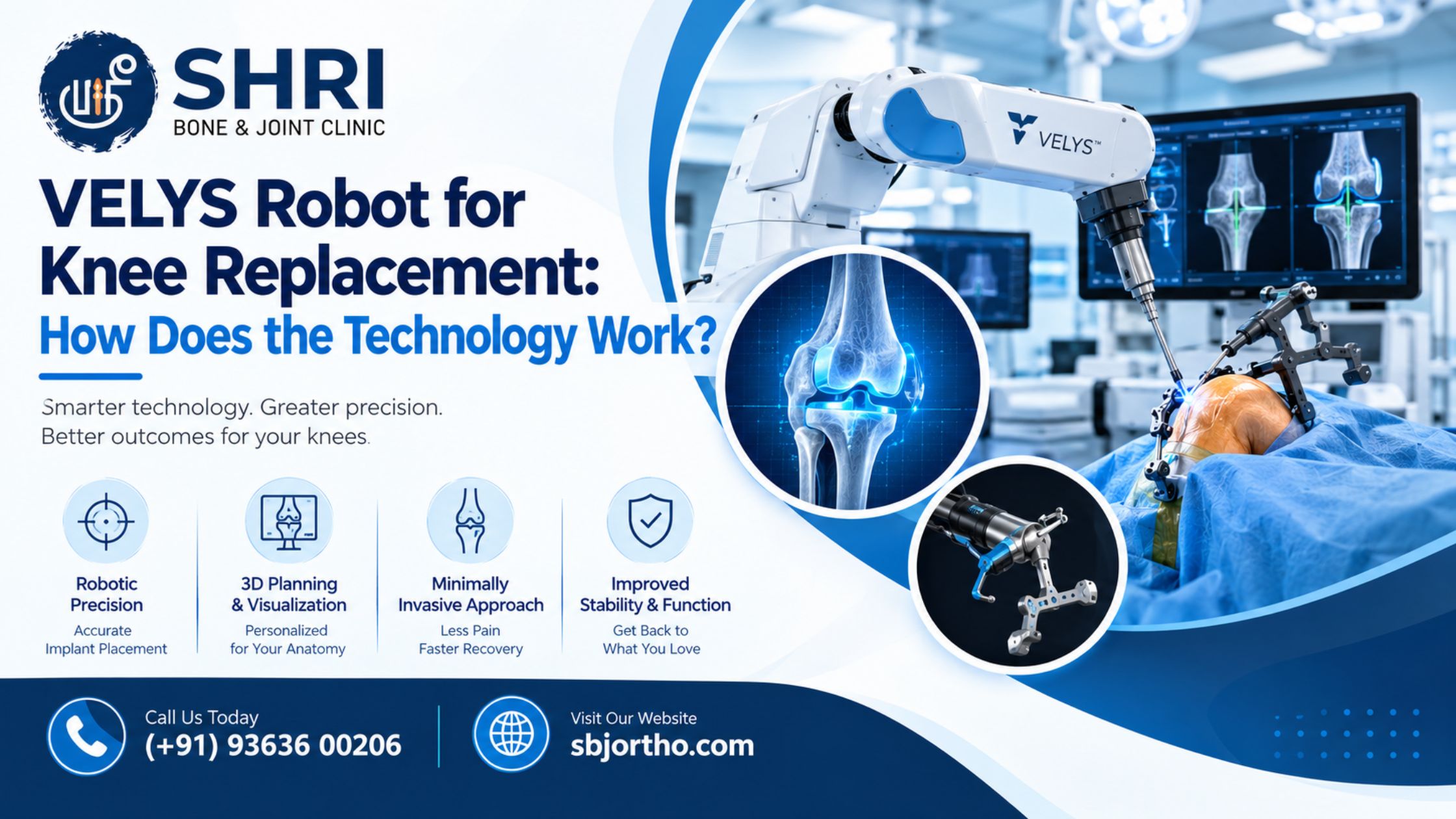
Robotic technology is changing how orthopedic surgeons plan and perform knee replacement surgery. Rather than replacing the surgeon, these systems provide additional information and assistance that can help the surgeon understand an individual patient’s knee and execute a personalised surgical plan.
The VELYS robot is a robotic-assisted technology designed for knee replacement surgery. It provides real-time information about the patient’s knee during the procedure and helps the surgeon assess anatomy, alignment, implant positioning and soft-tissue balance.
One of the notable features of the VELYS Robotic-Assisted Solution is its CT-free workflow. Unlike some robotic systems that use a preoperative CT scan specifically for surgical planning, VELYS can collect the required anatomical information during surgery.
But what exactly happens once the patient enters the operating room? And how does VELYS help the surgeon without taking control of the procedure? Understanding the technology step by step makes the role of robotic assistance much clearer.
Understanding the VELYS Robot and Its Role in Knee Replacement
VELYS should be understood as a surgical assistance system rather than an autonomous robot. The orthopedic surgeon remains responsible for assessing the patient, deciding whether knee replacement is necessary, planning the operation and controlling the procedure.
What Is the VELYS Robot?
The VELYS Robotic-Assisted Solution is a technology used to assist orthopedic surgeons during knee replacement.
It is designed to provide patient-specific information during surgery and help the surgeon plan and execute important parts of the knee replacement procedure.
The technology can assist with evaluating:
- Individual knee anatomy
- Leg alignment
- Joint movement
- Soft-tissue balance
- Implant positioning
- Bone preparation
- Knee stability
The surgeon interprets this information and uses it together with surgical experience and clinical judgement.
The technology therefore supports the surgeon rather than replacing the surgeon.
Does the VELYS Robot Perform Knee Replacement by Itself?
No. The VELYS robot does not independently perform knee replacement surgery.
This distinction is important because the term “robotic surgery” can make patients imagine a machine performing an operation without direct surgeon involvement.
In reality, the surgeon remains in control.
The surgeon determines the surgical plan, evaluates the information generated during the procedure and controls the surgical instruments. VELYS provides technological assistance that helps the surgeon execute the planned procedure.
What Does CT-Free Robotic Knee Replacement Mean?
Some robotic knee replacement systems use a CT scan performed before surgery to create a three-dimensional model of the patient’s knee.
VELYS uses a different workflow.
It can gather anatomical information during the operation, which means a preoperative CT scan specifically for robotic planning is not required.
This is commonly described as a CT-free workflow.
However, CT-free does not mean that patients will never require imaging. X-rays and other investigations may still be required as part of the diagnosis, assessment and preparation for knee replacement.
It simply means that a dedicated preoperative CT scan is not required for the VELYS robotic planning workflow.
Why Is Patient-Specific Information Important?
No two knees are exactly identical.
Patients can have differences in:
- Bone anatomy
- Leg alignment
- Severity of arthritis
- Knee deformity
- Ligament condition
- Joint movement
- Soft-tissue balance
For this reason, knee replacement planning needs to account for the characteristics of the individual joint.
The VELYS system provides information about the patient’s knee during surgery. The surgeon can use this information when deciding how the knee replacement should be planned and executed.
This does not mean the technology automatically determines the ideal plan. The orthopedic surgeon still interprets the information and decides what is appropriate for the patient.
How Does VELYS Assess Knee Alignment?
Alignment is an important consideration during knee replacement.
Advanced arthritis can sometimes change the normal alignment of the leg, contributing to bow-legged or knock-kneed deformity.
During VELYS-assisted surgery, information about the patient’s knee can help the surgeon understand existing alignment and assess how the planned reconstruction may affect it.
The surgeon uses this information alongside clinical judgement when developing the surgical plan.
How Does VELYS Help Assess Soft-Tissue Balance?
Knee replacement is not only about replacing damaged bone surfaces.
Ligaments and other soft tissues influence the stability and movement of the knee. Their behaviour therefore needs to be considered when reconstructing the joint.
VELYS provides information that can help the surgeon assess knee balance during the operation.
The knee can be evaluated through movement, allowing the surgeon to consider how the joint behaves before finalising the replacement.
How the VELYS Robot Works During Knee Replacement Surgery
VELYS technology is integrated into different stages of the knee replacement procedure. From collecting anatomical information to assisting with bone preparation, the system provides data and technological support while the surgeon remains responsible for the operation.
Step 1: Evaluating the Patient Before Surgery
The robotic procedure begins with a decision that has nothing to do with the robot itself: determining whether the patient actually needs knee replacement.
The orthopedic surgeon evaluates symptoms, knee movement, stability, deformity, walking ability and imaging findings.
Knee replacement may be considered when advanced joint damage causes persistent pain and functional limitations despite appropriate non-surgical treatment.
Only after the patient is considered suitable for replacement does robotic-assisted surgical planning become relevant.
Step 2: Collecting Information About the Knee
During surgery, the VELYS system gathers information about the patient’s individual knee.
Tracking technology and anatomical reference information allow the system to understand the position and movement of the joint.
This information creates the foundation for patient-specific surgical planning without requiring a dedicated preoperative CT scan for the robotic workflow.
Step 3: Creating the Surgical Plan
The surgeon uses the information gathered during surgery to develop the knee replacement plan.
The plan can take into consideration factors such as:
- Patient anatomy
- Knee alignment
- Implant position
- Joint movement
- Soft-tissue balance
The surgeon can assess the proposed reconstruction before completing the bone preparation.
Importantly, the surgeon is not required to blindly follow a computer-generated plan. Clinical judgement remains central to deciding how the knee should be reconstructed.
Step 4: Evaluating Knee Movement and Balance
The knee can be moved through different positions while the surgeon assesses its behaviour.
This provides information about alignment and soft-tissue balance.
The surgeon can then consider whether adjustments to the plan are appropriate before proceeding with final bone preparation.
This ability to evaluate the knee during surgery is an important part of patient-specific planning.
Step 5: Planning Implant Position
Knee replacement components must be positioned according to the surgical plan.
Using information from the individual knee, the surgeon can evaluate the planned position of the components before completing the preparation.
Component positioning is only one aspect of knee replacement, but it is an important consideration alongside balance, stability and overall joint function.
Step 6: Robotic-Assisted Bone Preparation
After the surgical plan has been established, the damaged bone surfaces need to be prepared for the replacement components.
VELYS provides robotic assistance during this stage.
The surgeon controls the procedure and uses the system to help execute the planned bone preparation.
The robotic technology therefore helps translate the surgical plan into the actual procedure rather than independently deciding where and how the bone should be prepared.
Step 7: Checking the Reconstructed Knee
After preparation, the surgeon assesses how the reconstructed knee behaves.
Trial components may be used before the final components are secured.
The surgeon evaluates factors such as:
- Knee movement
- Stability
- Alignment
- Flexion and extension
- Soft-tissue balance
If clinically appropriate, adjustments can be considered before completing the replacement.
Step 8: Positioning the Final Components
Once the surgeon is satisfied with the preparation and assessment, the final knee replacement components are positioned.
The knee is then evaluated again to ensure that the reconstruction corresponds appropriately with the surgical plan.
The operation is completed only after the surgeon is satisfied with the final assessment.
What Are the Potential Benefits of VELYS Technology?
VELYS is designed to provide additional information and technological assistance during knee replacement.
Potential advantages of the approach include:
- Patient-specific surgical planning
- Real-time information during surgery
- CT-free robotic planning
- Assistance with bone preparation
- Assessment of knee alignment
- Assessment of soft-tissue balance
- Planning of component positioning
- Ability to evaluate the knee during the procedure
These are potential technological and surgical advantages rather than guarantees of a particular clinical outcome.
Patient health, severity of arthritis, surgeon experience, rehabilitation and individual healing continue to influence recovery.
Is VELYS Better Than Other Knee Replacement Robots?
There are multiple robotic-assisted technologies used in knee replacement, and their workflows differ.
For example, some systems use CT-based preoperative planning, whereas VELYS uses a CT-free workflow that collects anatomical information during surgery.
Different systems can also vary in their hardware, planning process and method of assisting with bone preparation.
It is therefore more useful to understand how a particular system works than to assume that one robot is automatically superior for every patient.
The surgeon’s experience with the chosen system and ability to use the technology appropriately are important considerations.
Does VELYS Reduce the Need for an Experienced Surgeon?
No. Robotic assistance makes the surgeon’s role different in some aspects, but it does not make surgical expertise unnecessary.
The surgeon still needs to:
- Determine whether replacement is required
- Select the appropriate procedure
- Interpret knee anatomy
- Assess joint damage
- Evaluate alignment
- Understand ligament balance
- Develop the surgical plan
- Control the operation
- Respond to unexpected findings
- Manage postoperative care
The technology provides additional information, but the surgeon must decide how that information should be applied to the individual patient.
What Happens After VELYS-Assisted Knee Replacement?
Once surgery is completed, recovery and rehabilitation begin.
Robotic technology does not eliminate the need for physiotherapy.
When medically appropriate, patients generally begin mobilisation relatively early. Rehabilitation then progresses according to the patient’s condition and recovery.
Physiotherapy may focus on:
- Restoring knee bending
- Improving knee straightening
- Activating thigh muscles
- Standing safely
- Walking with appropriate support
- Improving balance
- Increasing strength
- Returning progressively to everyday activities
Recovery varies between individuals. Age, overall health, preoperative strength, joint condition and participation in rehabilitation can all influence progress.
Conclusion: VELYS Robotic Knee Replacement Care in Chennai
The VELYS robot is best understood as an advanced surgical assistance system that works alongside the orthopedic surgeon. Its CT-free workflow allows information about the patient’s knee to be collected during surgery and used to support patient-specific planning, alignment assessment, component positioning, knee balance and bone preparation.
For patients considering robotic knee replacement in Chennai, Dr. Shriram Krishnamoorthy at Shri Bone & Joint Clinic uses VELYS technology as part of his knee replacement approach. Patients can consult an Orthopedic Specialist in Chennai to determine whether knee replacement is necessary and whether robotic-assisted surgery is appropriate for their condition.
Those comparing surgical expertise can learn more about the Best Robotic Knee Replacement Surgeon in Chennai, while patients specifically interested in the technology and treatment pathway can explore VELYS Robotic Knee Replacement in Chennai.
Treatment planning also includes understanding the financial aspects of surgery. The Robotic Knee Replacement Cost in Chennai can vary according to the implant, hospital requirements, type of procedure, robotic technology and rehabilitation, so an individual estimate should be obtained after orthopedic evaluation.
FAQs
1. What is the VELYS robot used for?
The VELYS Robotic-Assisted Solution is used to assist orthopedic surgeons during knee replacement surgery.
It provides patient-specific information and technological assistance that can support surgical planning, assessment of alignment and balance, implant positioning and bone preparation.
2. Does the VELYS robot perform knee replacement automatically?
No. The orthopedic surgeon remains in control throughout the procedure.
VELYS provides information and robotic assistance, but the surgeon develops the surgical plan, controls the operation and makes the clinical decisions.
3. Does VELYS knee replacement require a CT scan?
VELYS uses a CT-free robotic workflow, so a dedicated preoperative CT scan specifically for robotic surgical planning is not required.
Patients may still require X-rays or other investigations for diagnosis, preoperative assessment or other clinical reasons.
4. What is the difference between VELYS and other robotic knee systems?
One important difference is the planning workflow. VELYS can collect anatomical information during surgery without requiring a dedicated preoperative CT scan for robotic planning.
Other robotic platforms may use CT-based planning or different methods of surgical assistance. The technologies can also differ in their hardware and operative workflow.
5. Is VELYS robotic knee replacement suitable for everyone?
No. Robotic technology does not change the fundamental requirement that a patient must first be an appropriate candidate for knee replacement.
An orthopedic surgeon needs to evaluate the severity of arthritis, symptoms, mobility, imaging findings, previous treatment and overall health before recommending surgery.