Introduction
Back pain, neck pain, sciatica, disc problems, and nerve compression are among the most common reasons people seek medical care. While surgery is necessary in certain situations, many individuals look for treatment options that can help improve their symptoms without undergoing an operation.
Over the last few years, advancements in rehabilitation technology have introduced new approaches to spine care. One such development is RoboSpine Therapy, a technology-assisted rehabilitation method designed to support patients with various spine-related conditions.
Many patients hear the term “RoboSpine Therapy” and immediately wonder whether it involves surgery, robots performing treatment, or highly complex procedures. In reality, RoboSpine Therapy is a non-surgical rehabilitation approach that combines spinal decompression technology with structured rehabilitation principles.
Understanding how it works can help patients make informed decisions when exploring treatment options for chronic spine problems.
Understanding How the Spine Works
The human spine is made up of vertebrae, spinal discs, joints, ligaments, muscles, and nerves that work together to support movement and stability.
The spinal discs act as cushions between the vertebrae. These discs help absorb shock, distribute pressure, and allow the spine to move comfortably.
Over time, factors such as ageing, poor posture, repetitive strain, injury, prolonged sitting, and lifestyle habits can place excessive stress on the spine.
This may contribute to conditions such as:
- Disc bulges
- Herniated discs
- Degenerative disc disease
- Sciatica
- Nerve compression
- Chronic back pain
- Neck pain
- Spinal stiffness
When these conditions affect normal movement and quality of life, rehabilitation becomes an important part of recovery.
What Is RoboSpine Therapy?
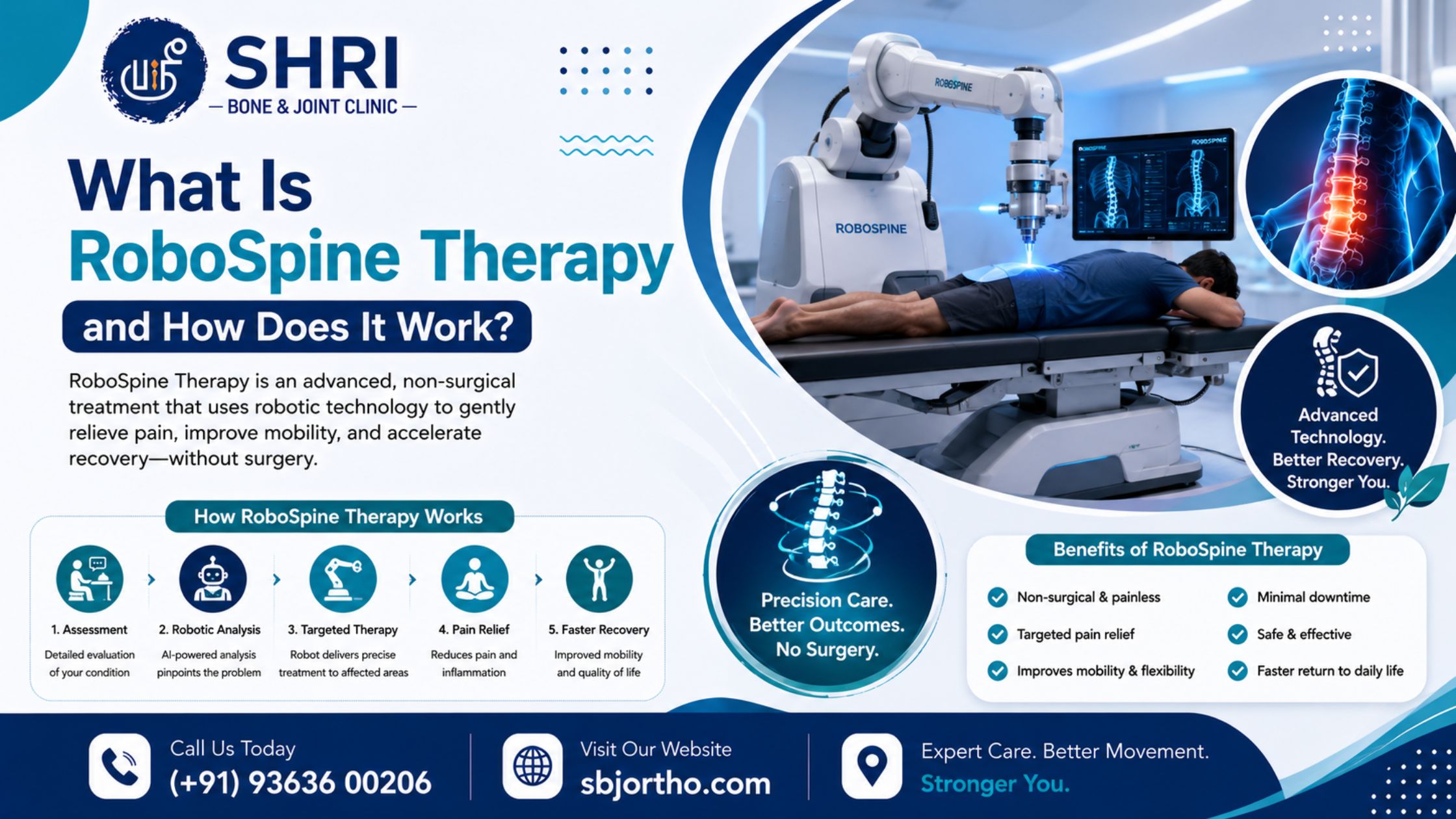
RoboSpine Therapy is an advanced, technology-assisted spinal rehabilitation method that uses a computer-controlled robotic decompression system to deliver precise treatment to specific areas of the spine.
Unlike traditional traction systems that apply general pulling forces, robotic systems are designed to provide highly controlled and targeted decompression based on the patient’s condition.
The technology continuously monitors the treatment process and adjusts force, angle, and movement patterns according to programmed treatment parameters.
The objective is to create an environment that helps reduce pressure on spinal discs and nerves while supporting rehabilitation and recovery.
Rather than replacing physiotherapy, RoboSpine Therapy is typically used as part of a broader rehabilitation program.
How Does RoboSpine Therapy Work?
To understand how RoboSpine Therapy works, it is helpful to first understand what happens when spinal structures become compressed.
In many spine-related conditions, the discs or surrounding tissues may place pressure on nearby nerves.
This pressure can contribute to:
- Back pain
- Neck pain
- Sciatica
- Tingling sensations
- Numbness
- Reduced mobility
RoboSpine Therapy uses controlled decompression to gently create space within targeted spinal segments.
The treatment is delivered through a robotic system that:
- Identifies the target area
- Applies controlled decompression forces
- Monitors resistance during treatment
- Adjusts settings automatically when needed
- Delivers consistent and repeatable therapy sessions
Because the system is computer-controlled, treatment can often be more precise than conventional manual traction methods.
What Happens During a RoboSpine Therapy Session?
A typical session usually begins with an assessment.
Healthcare professionals evaluate:
- Symptoms
- Pain patterns
- Movement restrictions
- Medical history
- Imaging findings when available
Based on this assessment, treatment settings are customised.
During the session:
Step 1: Positioning
The patient lies comfortably on the treatment system.
Step 2: Targeting
The specific spinal region requiring treatment is selected.
This may involve:
- Cervical spine (neck)
- Thoracic spine (mid-back)
- Lumbar spine (lower back)
Step 3: Controlled Decompression
The robotic system delivers gentle and precise decompression cycles.
The forces are carefully controlled and adjusted according to the treatment plan.
Step 4: Monitoring
Throughout the session, the system continuously monitors the treatment response.
This helps maintain consistency and precision.
Step 5: Rehabilitation Integration
Many treatment plans also include:
- Physiotherapy
- Strengthening exercises
- Mobility training
- Posture correction
- Functional rehabilitation
This comprehensive approach helps support long-term outcomes.
Conditions Commonly Treated with RoboSpine Therapy
RoboSpine Therapy may be considered for a variety of spine-related conditions.
Disc Bulges
Disc bulges can place pressure on nearby nerves and contribute to pain or mobility restrictions.
Herniated Discs
Some patients with disc-related symptoms may benefit from decompression-focused rehabilitation.
Degenerative Disc Disease
Age-related disc changes may contribute to chronic pain and reduced mobility.
Sciatica
Nerve irritation affecting the legs may be associated with disc or spinal problems.
Chronic Back Pain
Persistent back pain often involves multiple factors that affect spinal function.
Chronic Neck Pain
Cervical spine conditions may contribute to neck discomfort and restricted movement.
Spinal Stenosis
Narrowing of spaces around spinal nerves can affect movement and quality of life.
What Makes RoboSpine Therapy Different?
One of the biggest differences between RoboSpine Therapy and traditional traction is precision.
Computer-Controlled Adjustments
The robotic system can make treatment adjustments during the session.
Consistency
Each treatment session follows programmed parameters, reducing variability.
Individualisation
Treatment settings can be customised according to the patient’s condition.
Data-Based Monitoring
The system continuously tracks treatment performance and response.
Integration with Rehabilitation
RoboSpine Therapy is typically combined with broader rehabilitation strategies rather than being used as a standalone solution.
Is RoboSpine Therapy Painful?
Most patients find RoboSpine Therapy comfortable.
The treatment is designed to be gradual and controlled.
Unlike sudden manipulations or forceful adjustments, robotic decompression typically uses gentle and progressive movements.
Patients often report feeling:
- Relaxed during treatment
- Reduced spinal tension
- Improved movement comfort
However, individual experiences vary depending on the condition being treated.
How Many Sessions Are Usually Needed?
There is no single answer because treatment plans are customised.
The number of sessions depends on factors such as:
- Severity of symptoms
- Duration of the condition
- Type of spinal problem
- Rehabilitation goals
- Overall health
Some individuals may notice changes relatively early, while others require a longer rehabilitation program.
Consistency is often one of the most important factors influencing outcomes.
Who Is a Good Candidate for RoboSpine Therapy?
RoboSpine Therapy may be suitable for individuals who:
- Have chronic back pain
- Experience neck pain
- Have disc-related conditions
- Are looking for non-surgical options
- Want a structured rehabilitation approach
- Have movement limitations related to spinal problems
A proper clinical assessment is necessary to determine whether the treatment is appropriate for a particular individual.
Is RoboSpine Therapy a Replacement for Physiotherapy?
No.
This is a common misconception.
RoboSpine Therapy is best viewed as a tool within a broader rehabilitation program.
Physiotherapy remains important for:
- Strengthening muscles
- Improving mobility
- Correcting movement patterns
- Enhancing function
- Preventing recurrence
The combination of technology-assisted treatment and active rehabilitation often produces the most comprehensive recovery approach.
The Future of Spine Rehabilitation
Technology continues to transform rehabilitation.
Modern spine care is increasingly moving toward personalised, data-driven, and non-surgical treatment approaches that focus on improving function rather than simply treating symptoms.
RoboSpine Therapy represents one example of how technology can support rehabilitation by providing precision, consistency, and individualised treatment delivery.
As rehabilitation methods continue to evolve, advanced systems are likely to play an increasingly important role in helping patients recover from spine-related conditions.
Conclusion
RoboSpine Therapy is an advanced, non-surgical rehabilitation approach that uses robotic spinal decompression technology to support patients with a variety of spine-related conditions. By delivering precise and controlled treatment, it aims to reduce pressure on spinal structures, improve movement, and support recovery.
While it is not a replacement for physiotherapy or comprehensive rehabilitation, it can be a valuable component of a structured treatment plan for selected patients.
If you are experiencing ongoing spine-related symptoms, consulting an experienced Orthopedic Specialist in Chennai can help determine whether technology-assisted rehabilitation is appropriate for your condition. Patients interested in advanced non-surgical spine care may also benefit from learning more about RoboSpine Therapy in Chennai and how it fits into a broader rehabilitation strategy.
FAQs
Is RoboSpine Therapy a surgical procedure?
No. RoboSpine Therapy is a non-surgical rehabilitation treatment that uses robotic decompression technology to support spine-related recovery.
Can RoboSpine Therapy help with disc problems?
It may be considered as part of a rehabilitation program for certain disc-related conditions, depending on the individual’s symptoms and diagnosis.
How long does a RoboSpine Therapy session take?
The duration can vary depending on the treatment plan and condition being managed. The treating rehabilitation team will determine the appropriate session length.
Is RoboSpine Therapy safe?
When performed under professional supervision and after proper assessment, RoboSpine Therapy is generally designed to be a controlled and structured rehabilitation approach.
Can RoboSpine Therapy replace physiotherapy?
No. It is typically used alongside physiotherapy, strengthening exercises, and rehabilitation programs rather than replacing them.