
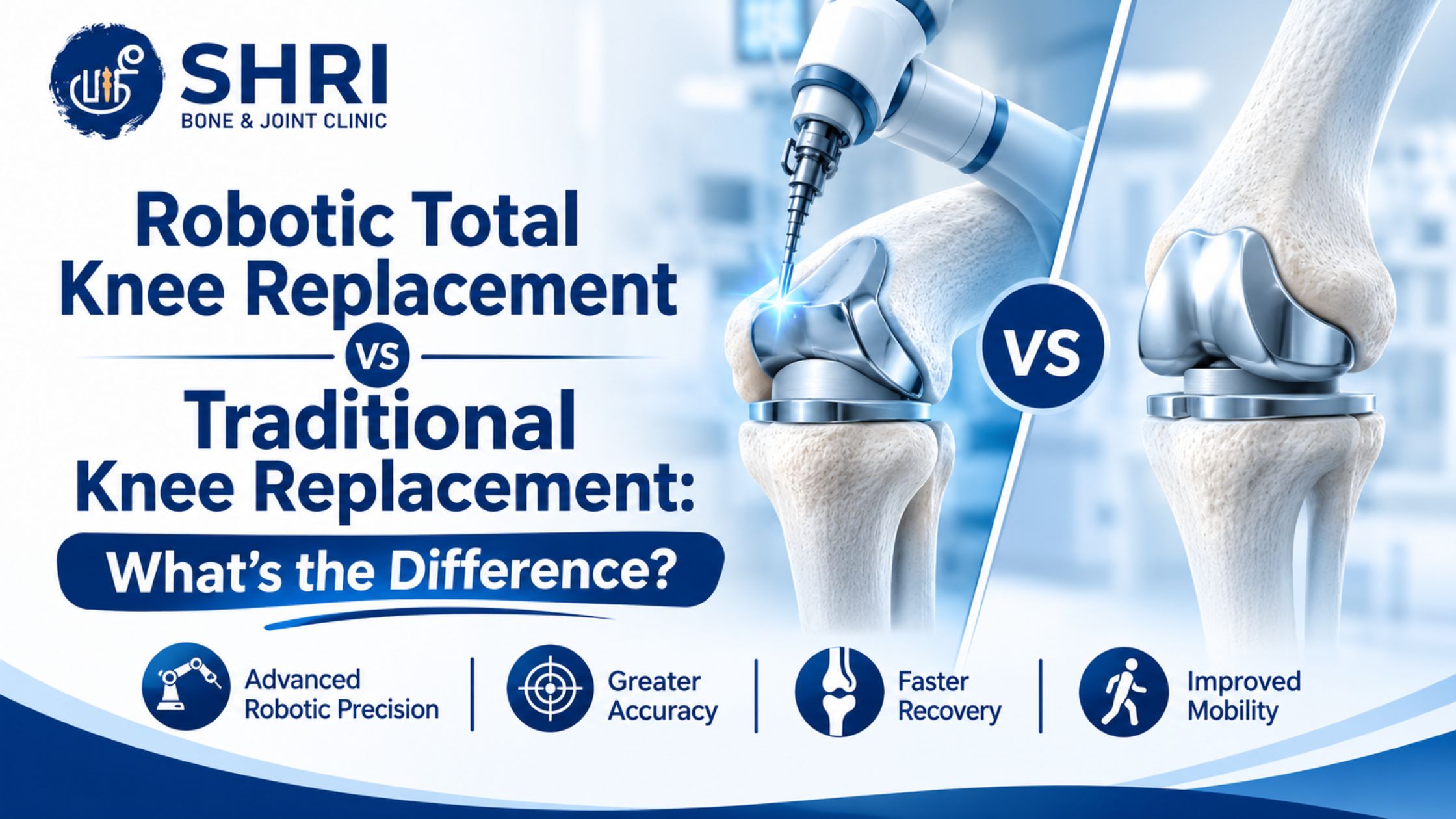
Knee replacement surgery has helped millions of people manage severe knee arthritis, reduce persistent pain, and regain mobility. However, with the introduction of robotic-assisted technology, patients now have another surgical approach to consider. This often raises an important question: Is robotic total knee replacement better than traditional knee replacement?
Both procedures aim to replace damaged knee joint surfaces with artificial implants, improve joint function, and reduce arthritis-related pain. The primary difference lies in how the surgeon plans the procedure, prepares the bone, and positions the implants.
Traditional knee replacement relies on established surgical instruments and the surgeon’s expertise, while robotic-assisted knee replacement uses advanced technology to provide additional measurements and guidance during surgery.
Understanding the differences in surgical precision, recovery, implant positioning, benefits, limitations, and costs can help patients make an informed decision.
What Is the Difference Between Robotic and Traditional Total Knee Replacement?
Total knee replacement, also called total knee arthroplasty, is a surgical procedure performed when advanced joint damage causes significant pain, stiffness, and difficulty performing everyday activities.
During surgery, the damaged surfaces of the thigh bone (femur) and shin bone (tibia) are prepared and replaced with artificial components. The surgeon also evaluates joint alignment, ligament balance, and knee movement.
Both robotic and traditional techniques follow these fundamental principles. However, the methods used to guide surgical planning and implant positioning differ.
What Is Traditional Total Knee Replacement?
Traditional total knee replacement is a well-established surgical procedure that uses conventional surgical instruments to remove damaged joint surfaces and position artificial implants.
The orthopedic surgeon evaluates the patient’s knee anatomy, deformity, ligament condition, and preoperative imaging before surgery.
During the procedure, the surgeon typically uses mechanical alignment guides, cutting blocks, and other instruments to prepare the bones.
The surgeon then positions the artificial components and checks knee stability, alignment, and range of movement.
Traditional knee replacement has been performed successfully for decades and remains an effective treatment for appropriately selected patients with advanced knee arthritis.
Key characteristics of traditional knee replacement:
- Uses conventional surgical instruments and alignment guides.
- Relies on the surgeon’s assessment and experience.
- Does not require robotic-assisted equipment.
- Allows the surgeon to assess and adjust implant positioning.
- Has extensive long-term clinical evidence supporting its effectiveness.
Traditional surgery should not be considered an outdated or ineffective treatment simply because robotic technology is available.
What Is Robotic Total Knee Replacement?
Robotic total knee replacement uses a robotic-assisted system to support the surgeon during selected stages of knee replacement surgery.
Depending on the technology, the system may help assess the patient’s knee anatomy, plan bone preparation, evaluate alignment, and guide implant positioning.
Robotic systems do not independently perform knee replacement surgery. The orthopedic surgeon remains responsible for the procedure and controls the surgical instruments.
One example is the VELYS Robotic-Assisted Solution, which uses intraoperative measurements to support knee replacement without requiring a preoperative CT scan specifically for robotic planning.
Other robotic platforms may use different imaging and planning methods.
Key characteristics of robotic total knee replacement:
- Uses technology-assisted surgical planning and guidance.
- Provides additional measurements during surgery.
- Supports precise execution of planned bone preparation.
- Helps assess implant alignment and knee balance.
- Allows the surgeon to make intraoperative adjustments.
- Requires specialised equipment and appropriate surgical training.
The objective is to support accurate, patient-specific surgical execution while maintaining the surgeon’s control over the operation.
Robotic vs Traditional Knee Replacement: Key Differences
| Comparison Factor | Traditional Knee Replacement | Robotic Total Knee Replacement |
| Surgical planning | Based on clinical assessment, imaging, and conventional instruments | Uses robotic-assisted measurements and planning tools |
| Bone preparation | Guided by conventional cutting blocks and instruments | Robotic guidance assists selected bone preparation steps |
| Implant positioning | Surgeon uses conventional alignment techniques | Technology provides additional guidance for planned positioning |
| Knee alignment | Assessed using conventional surgical methods | Intraoperative measurements can support alignment assessment |
| Soft-tissue balance | Evaluated by the surgeon using established techniques | May include technology-assisted assessment of joint balance |
| CT scan requirement | Usually not required for standard planning | Depends on the robotic platform; VELYS uses a CT-free workflow |
| Surgeon involvement | Surgeon performs and controls the procedure | Surgeon performs and controls the procedure |
| Surgical equipment | Standard knee replacement instruments | Specialised robotic-assisted equipment |
| Recovery | Depends on patient health, surgery, and rehabilitation | Depends on patient health, surgery, and rehabilitation |
| Long-term outcomes | Extensive long-term clinical evidence | Promising precision data; long-term superiority is not conclusively established |
| Cost | Generally lower equipment-related costs | May involve additional technology-related charges |
Both approaches can provide meaningful pain relief and functional improvement when performed appropriately.
How Does Surgical Precision Differ?
Surgical precision is one of the main areas in which robotic-assisted knee replacement differs from conventional surgery.
During traditional knee replacement, the surgeon uses mechanical instruments and anatomical landmarks to guide bone preparation and implant placement.
These methods are established and can produce accurate results.
Robotic-assisted technology provides additional information that may help the surgeon execute the planned bone cuts and implant positioning with greater consistency.
For example, the system may support:
- Measurement of knee anatomy.
- Assessment of joint alignment.
- Planning of bone resection.
- Guidance during bone preparation.
- Evaluation of ligament balance.
- Verification of implant positioning.
Research has shown that certain robotic-assisted systems can improve the accuracy or consistency of selected alignment measurements.
However, greater technical precision does not automatically guarantee better pain relief, faster recovery, or longer implant survival.
Patient outcomes depend on several factors beyond implant positioning.
Does Robotic Surgery Use Artificial Intelligence?
Robotic knee replacement systems use computer-assisted technology, sensors, and specialised software to support surgical planning and guidance.
Some systems may incorporate advanced computational methods, but robotic assistance should not automatically be described as artificial intelligence.
The surgeon makes the clinical decisions and performs the operation.
The robotic system provides measurements and guidance according to the technology’s capabilities.
Is Robotic Knee Replacement Completely Automated?
No. Robotic total knee replacement is not an autonomous procedure.
The orthopedic surgeon controls the surgery, including the assessment of knee anatomy, surgical planning, bone preparation, and implant placement.
The technology assists the surgeon rather than replacing surgical expertise.
This distinction is important because patients sometimes assume that a robotic machine performs the entire operation independently.
Robotic vs Traditional Knee Replacement: Benefits, Recovery, Risks and Which Is Better
Choosing between robotic and traditional knee replacement involves more than comparing the technology used during surgery.
Patients should consider the expected benefits, surgical risks, recovery requirements, implant performance, cost, and the surgeon’s experience with the selected technique.
Benefits of Robotic Total Knee Replacement
Robotic-assisted knee replacement offers several potential technical advantages.
- Patient-Specific Surgical Planning
Robotic systems can provide detailed information about the knee during surgery.
This allows the surgeon to assess the joint and adjust the surgical plan according to the patient’s anatomy.
- Precise Bone Preparation
Robotic guidance can help the surgeon perform selected bone cuts according to the planned measurements.
This may improve the consistency of surgical execution.
- Intraoperative Alignment Assessment
Robotic systems can provide information about knee alignment during the procedure.
The surgeon can use these measurements when evaluating implant positioning.
- Joint Balance Evaluation
Certain systems help assess the relationship between joint alignment, movement, and soft-tissue tension.
This information may assist the surgeon in achieving an appropriate balance between stability and mobility.
- Technology-Assisted Surgical Adjustments
The surgeon may modify the surgical plan based on intraoperative findings.
This can be useful because knee anatomy and deformity vary between patients.
These benefits relate primarily to surgical planning and execution. Their effect on long-term patient outcomes remains an area of ongoing research.
Benefits of Traditional Total Knee Replacement
Traditional knee replacement continues to offer important advantages.
- Established Surgical Technique
Conventional total knee replacement has been used for many decades and has a substantial body of clinical evidence.
- Proven Long-Term Effectiveness
Many patients experience meaningful improvements in pain and mobility following traditional knee replacement.
Long-term implant survival has also been extensively studied.
- Broad Surgical Availability
Traditional knee replacement is available across a wide range of orthopedic centres.
- Lower Technology-Related Expenses
Because the procedure does not require specialised robotic equipment, it may involve fewer technology-related charges.
- Surgeon-Controlled Planning
Experienced orthopedic surgeons can use established alignment and balancing techniques to achieve appropriate implant positioning and joint stability.
The success of traditional knee replacement depends on sound surgical planning, appropriate implant selection, patient factors, and postoperative rehabilitation.
Is Robotic Knee Replacement Less Painful Than Traditional Surgery?
Some studies have reported improvements in selected early postoperative outcomes with robotic-assisted knee replacement.
However, the evidence is not consistent enough to conclude that robotic surgery always causes less pain.
Postoperative discomfort depends on:
- Preoperative knee condition.
- Surgical technique.
- Tissue handling.
- Pain management.
- Swelling and inflammation.
- Individual pain sensitivity.
- Rehabilitation progress.
Both robotic and traditional knee replacement require appropriate postoperative pain management.
Patients should not choose robotic surgery solely on the expectation that it will be painless.
Which Knee Replacement Has a Faster Recovery?
Recovery after both procedures follows broadly similar principles.
Patients are usually encouraged to begin assisted movement and walking when medically appropriate.
Rehabilitation focuses on restoring knee bending, straightening, strength, balance, and walking ability.
Some research suggests that certain robotic-assisted approaches may offer advantages in selected early recovery measures. However, faster recovery has not been consistently demonstrated across all robotic systems and patient groups.
A general recovery timeline for both approaches is shown below.
| Recovery Period | Typical Rehabilitation Goals |
| First 1–3 days | Pain management, assisted walking, gentle knee movement |
| Weeks 1–2 | Wound healing, swelling management, quadriceps activation |
| Weeks 3–6 | Improved walking, knee movement, progressive strengthening |
| Weeks 6–12 | Better balance, endurance, stair climbing, daily activities |
| Months 3–6 | Continued improvements in strength and functional independence |
| Months 6–12 | Further recovery in comfort, movement, and overall function |
These are general recovery expectations rather than guaranteed milestones.
The type of surgery is only one factor influencing recovery. Preoperative muscle strength, age, other medical conditions, and rehabilitation participation are also important.
Does Robotic Knee Replacement Last Longer?
One of the most common questions patients ask is whether robotic knee replacement implants last longer than implants positioned using traditional methods.
Robotic technology can improve the precision of certain surgical measurements, but there is not yet sufficient long-term evidence to establish that robotic-assisted knee replacements consistently last longer than well-performed traditional knee replacements.
Implant longevity depends on several factors, including:
- Implant design and materials.
- Surgical positioning.
- Joint stability.
- Patient weight and activity.
- Bone quality.
- Infection risk.
- Implant wear.
- Individual health conditions.
Many modern knee replacements remain functional for 15–20 years or longer, but individual outcomes vary.
Robotic assistance does not guarantee a particular implant lifespan.
Are the Risks Different Between Robotic and Traditional Knee Replacement?
Both procedures share the general risks associated with total knee replacement surgery.
Potential complications include:
- Infection.
- Blood clots.
- Bleeding.
- Nerve or blood vessel injury.
- Persistent pain.
- Knee stiffness.
- Implant loosening or wear.
- Instability.
- Anaesthesia-related complications.
- Need for revision surgery.
Robotic-assisted procedures may also involve technology-specific considerations, such as equipment-related problems, additional operative steps, or complications associated with tracking pins when a system uses them.
The exact risks vary according to the robotic platform and surgical technique.
There is currently insufficient evidence to claim that robotic-assisted surgery eliminates the major complications associated with knee replacement.
Is Robotic Knee Replacement Suitable for Every Patient?
Robotic-assisted total knee replacement may be considered for patients who require knee replacement because of advanced joint damage.
However, suitability depends on individual clinical findings and the capabilities of the robotic system.
Factors considered include:
- Severity and pattern of arthritis.
- Knee deformity.
- Bone quality.
- Previous knee surgery.
- Existing implants or hardware.
- Medical fitness.
- Surgical complexity.
- Availability of suitable implants and equipment.
Patients with complex deformities or previous surgical procedures may require additional planning.
The orthopedic surgeon determines whether robotic assistance is appropriate.
Which Procedure Is Better for Severe Knee Osteoarthritis?
Both robotic and traditional total knee replacement can be effective for patients with severe knee osteoarthritis.
The decision should consider the patient’s symptoms, joint damage, medical fitness, surgical requirements, and the surgeon’s experience.
Robotic-assisted surgery may be considered when the surgeon believes additional intraoperative measurements and guidance will be useful.
Traditional knee replacement remains a reliable option supported by extensive clinical experience.
Neither approach should be considered universally superior for every patient.
Is Robotic Knee Replacement More Expensive?
Robotic-assisted knee replacement may cost more than conventional surgery because of specialised equipment, technology-related charges, and other operational expenses.
However, the total cost varies according to the hospital, implant selection, surgical complexity, length of stay, and rehabilitation requirements.
| Cost Factor | Traditional Knee Replacement | Robotic Knee Replacement |
| Surgical equipment | Conventional instruments | Specialised robotic-assisted equipment |
| Technology-related charges | Generally lower | May be higher |
| Implant costs | Depends on implant selection | Depends on implant selection |
| Hospital expenses | Depends on hospital and admission | Depends on hospital and admission |
| Rehabilitation | Usually required | Usually required |
| Insurance coverage | Depends on policy | Depends on policy and robotic-related exclusions |
Patients should request an itemised estimate and confirm insurance coverage before making a decision.
A higher procedure cost does not automatically indicate better clinical results.
How Important Is the Surgeon’s Experience?
Surgeon experience is important in both robotic and traditional knee replacement.
Robotic technology can provide useful measurements and guidance, but it does not replace the surgeon’s knowledge of knee anatomy, implant positioning, ligament balance, or complication management.
An experienced surgeon must be able to:
- Evaluate the patient’s condition.
- Select the appropriate surgical approach.
- Plan implant positioning.
- Assess knee stability.
- Manage unexpected surgical findings.
- Recognise and address complications.
- Coordinate postoperative rehabilitation.
For robotic procedures, appropriate training and experience with the specific platform are also important.
Patients should discuss the surgeon’s experience with the proposed technique rather than choosing a procedure based only on the availability of robotic equipment.
How to Choose Between Robotic and Traditional Knee Replacement
Patients considering total knee replacement should discuss the following questions with their orthopedic surgeon:
- Is knee replacement necessary for my current condition?
- Am I suitable for robotic-assisted surgery?
- Which surgical technique do you recommend for my knee anatomy?
- What are the expected benefits and limitations?
- What risks apply to my medical condition?
- How much experience do you have with the proposed technique?
- What rehabilitation programme will I need?
- What are the total costs and insurance considerations?
The most appropriate decision is one that considers the patient’s medical needs, treatment goals, and the surgeon’s clinical assessment.
Conclusion: Which Knee Replacement Should You Choose?
Robotic and traditional total knee replacement share the same fundamental objective: replacing damaged joint surfaces to reduce pain and improve knee function.
The main advantage of robotic-assisted surgery is the additional technology used to support surgical planning, bone preparation, implant positioning, and alignment assessment. Traditional knee replacement remains a well-established procedure with extensive evidence supporting its long-term effectiveness.
For patients considering Total Knee Replacement in Chennai, the decision should be based on arthritis severity, medical fitness, surgical requirements, and the orthopedic surgeon’s recommendation.
At Shri Bone & Joint Clinic, Dr. Shriram Krishnamoorthy uses the VELYS Robotic-Assisted Solution for knee replacement planning and surgical guidance. Patients interested in Robotic Total Knee Replacement in Chennai can consult the clinic to understand the technology, its potential benefits, limitations, and suitability for their condition.
Postoperative rehabilitation also plays an important role in recovery. Shri Physio & Rehab provides rehabilitation support focused on restoring knee movement, strength, balance, and functional mobility.
Ultimately, the best approach is not determined by technology alone, but by appropriate patient selection, surgical expertise, and a carefully planned recovery programme.
FAQs
1. Is robotic total knee replacement better than traditional knee replacement?
Robotic-assisted knee replacement can improve the accuracy of selected surgical measurements and implant positioning. However, current evidence does not conclusively demonstrate that it provides better long-term pain relief, function, or implant survival for every patient. Both procedures can be effective when performed appropriately.
2. Does the robot perform the entire knee replacement surgery?
No. The orthopedic surgeon performs and controls the operation. The robotic system provides additional measurements and guidance during selected surgical steps. It does not independently make clinical decisions or complete the surgery without the surgeon.
3. Is recovery faster after robotic knee replacement?
Some studies suggest potential improvements in certain early recovery measures with robotic-assisted techniques, but results vary. Recovery depends on the patient’s health, muscle strength, surgical procedure, pain management, and rehabilitation. Robotic surgery does not guarantee faster recovery.
4. Does robotic knee replacement require a CT scan?
It depends on the robotic platform. Some systems use preoperative CT scans for surgical planning, while others use intraoperative measurements. The VELYS Robotic-Assisted Solution supports a CT-free knee replacement workflow, meaning a CT scan is not required specifically for robotic planning.
5. Is robotic knee replacement worth the additional cost?
Robotic assistance may provide technical advantages in surgical planning and implant positioning, but whether the additional expense is worthwhile depends on the patient’s condition, surgeon’s recommendation, available evidence, and financial considerations. Patients should discuss the expected benefits and costs before choosing a procedure.