Introduction
Rehabilitation has evolved significantly over the last few decades. Traditional physiotherapy remains an important part of recovery, but advancements in technology have introduced new ways to support patients during rehabilitation. One of the most exciting developments in this field is robotic rehabilitation.
Many people hear the term “robotic rehabilitation” and immediately imagine machines replacing therapists. In reality, robotic rehabilitation is not about replacing healthcare professionals. Instead, it is about enhancing rehabilitation by combining clinical expertise with advanced technology.
Today, robotic rehabilitation is being used across a wide range of conditions, from spine-related disorders and joint problems to neurological recovery and movement retraining. These systems help deliver precise, controlled, and repeatable movements that can improve the overall rehabilitation experience.
But what exactly is robotic rehabilitation, how does it work, and who can benefit from it?
Let’s explore.
Understanding Rehabilitation: Why Recovery Needs More Than Rest
For many years, people believed that pain or injury simply required rest. While rest is sometimes necessary during the initial stages of an injury, long-term recovery often depends on movement.
When a person experiences pain, injury, or surgery, several changes can occur:
- Muscles become weaker
- Joints become stiff
- Balance can deteriorate
- Movement patterns change
- Confidence in movement decreases
These changes can create a cycle where pain leads to less activity, which leads to weakness, which then causes more pain.
Rehabilitation is designed to break this cycle by restoring movement, strength, flexibility, and function.
The challenge is ensuring that exercises are performed correctly and consistently. This is where robotic rehabilitation can provide additional support.
What is Robotic Rehabilitation?
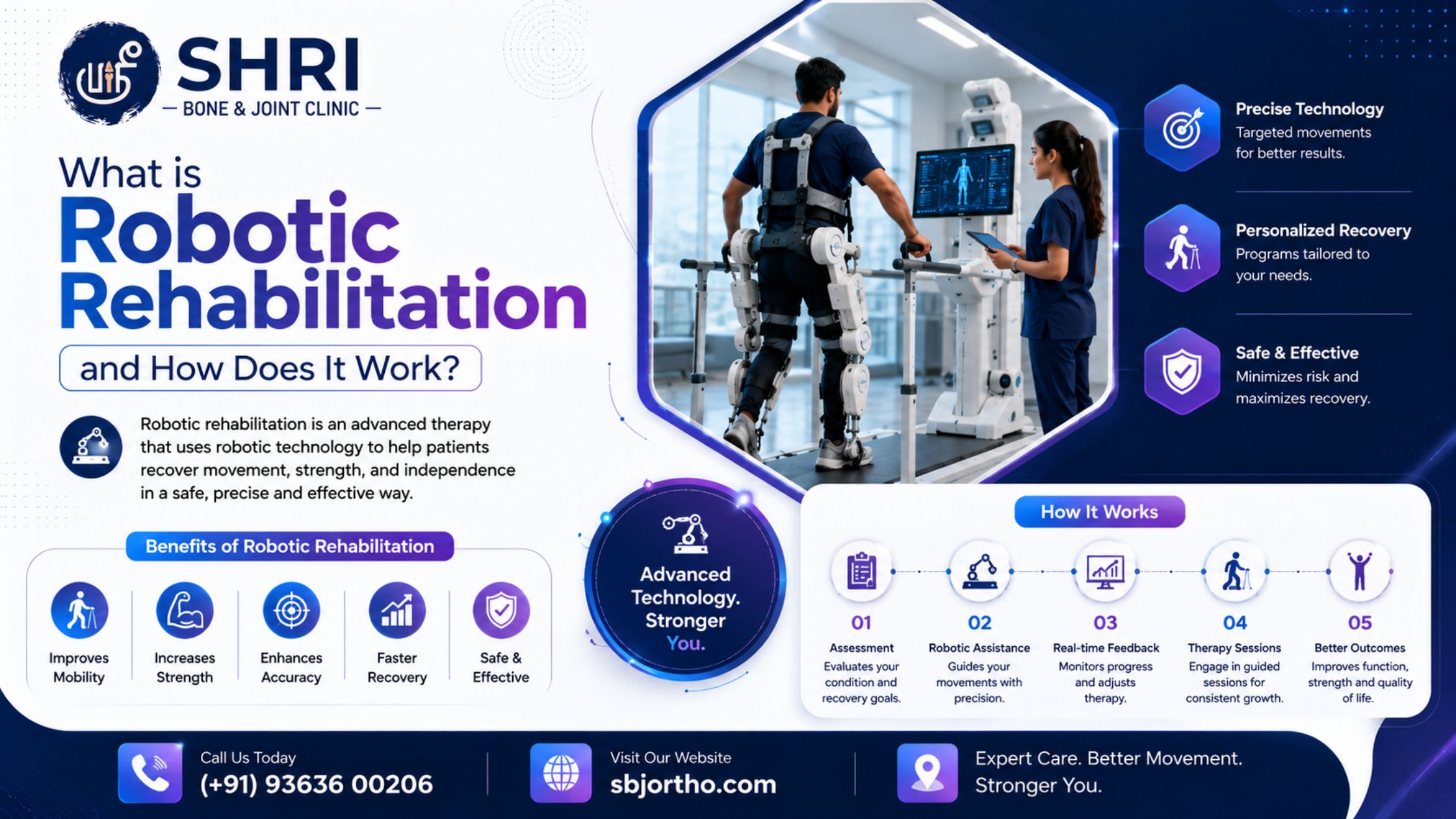
Robotic rehabilitation is a technology-assisted treatment approach that uses specialised robotic systems to help patients perform therapeutic movements in a controlled and structured way.
These systems are designed to:
- Assist movement when necessary
- Monitor performance
- Measure progress
- Improve movement quality
- Support recovery through guided rehabilitation
Unlike conventional exercise equipment, robotic systems can respond to the patient’s movements in real time.
The technology helps create a more personalised rehabilitation experience by adjusting exercises according to the patient’s ability and progress.
Rather than simply performing exercises, patients receive continuous feedback and support throughout the rehabilitation process.
How Does Robotic Rehabilitation Work?
The exact process depends on the type of robotic system being used, but the general principle remains the same.
The rehabilitation process typically begins with a detailed assessment.
Healthcare professionals evaluate:
- Strength levels
- Mobility
- Joint function
- Balance
- Walking patterns
- Pain levels
- Functional limitations
Based on these findings, a rehabilitation plan is developed.
During treatment, the robotic system may:
- Guide specific movements
- Assist weakened muscles
- Provide resistance during exercises
- Monitor movement accuracy
- Record performance data
The technology helps ensure that exercises are performed consistently and safely.
This can be especially beneficial when patients have difficulty controlling movement due to pain, weakness, or injury.
What Makes Robotic Rehabilitation Different?
Traditional rehabilitation relies heavily on therapist observation and patient feedback.
While this approach remains highly effective, robotic systems add an additional layer of precision.
Some unique advantages include:
Consistency
The system can repeat the same movement pattern accurately throughout each session.
Real-Time Feedback
Patients receive immediate feedback regarding their movement quality and performance.
Objective Progress Tracking
Progress can be measured through data rather than relying solely on subjective improvement.
Personalisation
Exercises can be adjusted based on individual needs and recovery goals.
Controlled Movement
The system helps maintain safe movement patterns throughout rehabilitation.
These features can improve both patient engagement and treatment efficiency.
Conditions That May Benefit From Robotic Rehabilitation
Robotic rehabilitation is used in many areas of physical recovery.
Spine-Related Conditions
Individuals with chronic back pain, disc-related problems, movement restrictions, or spinal rehabilitation needs may benefit from technology-assisted treatment.
The ability to provide controlled movement can be particularly useful when managing spine-related symptoms.
Knee Problems
Knee pain often affects walking, balance, and daily function.
Robotic rehabilitation can help improve:
- Movement patterns
- Strength
- Stability
- Functional performance
This can be useful for individuals recovering from injuries, joint conditions, or long-standing knee problems.
Sports Injuries
Athletes and active individuals often require structured rehabilitation programs that focus on restoring movement and preventing re-injury.
Robotic systems can help monitor progress and improve movement control during recovery.
Post-Surgical Rehabilitation
Following surgery, restoring strength and movement safely is important.
Technology-assisted rehabilitation may support this process by providing controlled progression throughout recovery.
Balance and Mobility Problems
Some patients struggle with balance, coordination, or walking mechanics.
Robotic rehabilitation can help improve movement confidence while providing measurable progress.
What Happens During a Typical Session?
A typical robotic rehabilitation session may involve several stages.
Initial Preparation
The therapist reviews symptoms, progress, and treatment goals.
System Setup
The robotic equipment is adjusted according to the patient’s body measurements and rehabilitation needs.
Guided Exercises
Patients perform exercises while the system provides assistance, resistance, or movement guidance.
Performance Monitoring
The system tracks movement quality and records important data throughout the session.
Progression
Exercises are adjusted as recovery improves.
Each session is tailored to the patient’s current abilities and long-term goals.
Is Robotic Rehabilitation Painful?
One of the most common concerns patients have is whether robotic rehabilitation will be painful.
In most cases, the treatment is designed to improve movement while minimizing unnecessary stress on the body.
Exercises are adjusted according to the patient’s comfort level.
While some muscle fatigue may occur during strengthening activities, the goal is not to push through severe pain.
Instead, rehabilitation focuses on gradual and controlled improvement.
Advantages of Robotic Rehabilitation
Patients often choose robotic rehabilitation because of its structured and measurable approach.
Some of the major advantages include:
- Improved movement accuracy
- Better exercise consistency
- Enhanced patient engagement
- Objective progress tracking
- Personalised rehabilitation plans
- Improved confidence during recovery
- Better monitoring of rehabilitation outcomes
- Integration with traditional physiotherapy programs
These benefits make robotic rehabilitation an increasingly valuable tool in modern rehabilitation practice.
Does Robotic Rehabilitation Replace Physiotherapy?
No.
This is one of the biggest misconceptions about robotic rehabilitation.
The technology is designed to support physiotherapy, not replace it.
Therapists remain responsible for:
- Assessment
- Treatment planning
- Exercise progression
- Clinical decision-making
- Monitoring recovery
The robotic system simply provides additional tools to help deliver rehabilitation more effectively.
The combination of clinical expertise and technology often produces the best results.
Who Should Consider Robotic Rehabilitation?
Robotic rehabilitation may be worth considering for individuals who:
- Have persistent pain affecting movement
- Are recovering from injury
- Need structured rehabilitation
- Want measurable progress tracking
- Have difficulty performing exercises independently
- Require movement retraining
However, suitability depends on the individual’s condition and rehabilitation goals.
A proper assessment is always necessary before beginning treatment.
The Future of Rehabilitation
Healthcare technology continues to evolve, and rehabilitation is becoming more personalised, data-driven, and precise.
Robotic systems are helping therapists deliver more consistent treatment while allowing patients to actively participate in their recovery.
As technology advances, these systems are likely to play an even greater role in rehabilitation programs focused on improving movement, strength, and overall function.
The future is not about replacing therapists—it is about giving them better tools to help patients recover more effectively.
Conclusion
Robotic rehabilitation represents an exciting advancement in modern recovery and rehabilitation. By combining technology with clinical expertise, it provides a structured, measurable, and personalised approach to treatment.
Whether the goal is improving mobility, rebuilding strength, restoring function, or recovering from injury, robotic systems can help support rehabilitation when used as part of a comprehensive treatment plan.
For individuals exploring advanced rehabilitation options, consulting an experienced Orthopedic Specialist can help determine whether technology-assisted rehabilitation is appropriate for their condition. Patients seeking structured recovery programs may also benefit from learning more about Robotic Treatment for Spine in Chennai and Robotic Treatment for Knee Pain in Chennai as part of their rehabilitation journey.
FAQs
Is robotic rehabilitation suitable for everyone?
Not necessarily. The suitability of robotic rehabilitation depends on the individual’s condition, symptoms, and recovery goals. A proper assessment is needed to determine whether it is the right option.
How is robotic rehabilitation different from regular physiotherapy?
Robotic rehabilitation uses technology to guide, monitor, and measure movements with greater precision. However, it works alongside physiotherapy rather than replacing it.
Can robotic rehabilitation help with chronic pain?
In many cases, robotic rehabilitation may help improve movement patterns, strength, and function, which can contribute to better management of chronic pain conditions.
How many robotic rehabilitation sessions are usually needed?
The number of sessions varies depending on the condition being treated, severity of symptoms, and rehabilitation goals. Treatment plans are usually customised for each patient.
Is robotic rehabilitation only used after surgery?
No. While it can be useful after surgery, robotic rehabilitation is also used for spine problems, knee pain, sports injuries, mobility issues, and other non-surgical conditions.